Thursday, January 2, 2014

The Greatest Migration of All

Ask an American historian to define the Great Migration and you’ll hear one of several answers.  Most will describe the movement of 6 million African Americans from the rural South who headed north and west, from
A Jack Delano photo of migrants
heading north from Florida, 1940.
World War I through 1970, seeking economic opportunity and relief from Jim Crow laws. This is the story so beautifully told in Isabel Wilkerson’s Pulitzer Prize-winning book, The Warmth of Other Suns.

There’s another group of historians who might describe the Great Migration as the 20,000 English men, women, and children who crossed the Atlantic between 1620 and 1640, seeking opportunity and relief in New England. These are the Mayflower names, the families that delight and provide such rich insights for genealogists.  Since 1988 the New England Historic Genealogical Society has sponsored the Great Migration Study Project, scheduled for completion in 2016.

In his monumental What Hath God Wrought: The Transformation of America, 1815-1848 Daniel Walker Howe describes “one of the greatest migrations in America,” when Andrew Jackson encouraged white squatters from the Carolinas, Georgia, and Tennessee to move onto 14 million acres expropriated from the Creeks. By 1819 this flood of humanity had established Mississippi and Alabama. “The Alabama fever rages here with great violence,” one North Carolina farmer moaned, “and has carried off vast numbers of our citizens.” Never, Howe remarks, had so large a territory been settled so rapidly—though the peopling of the Old Northwest Territory was not far behind.

Still, there has been another kind of Great Migration in America, less dramatic, but in some ways the steadiest and perhaps most influential. It also has great bearing upon one of today’s hottest political issues, immigration policy, and helps explain why Silicon Valley is so vested in the bill currently making its way through Congress.

"The Puritan Migration to America, 1620-1640."
From Bedford/St. Martin's MapCentral.
Brooke Hindle (1918-2001) was the historian emeritus at the Smithsonian’s National Museum of American History when he, along with (current) Brown University’s Steven Lubar, authored Engines of Change: The American Industrial Revolution 1790-1860. It’s a beautiful book that emphasizes the material aspects of innovation (later reinforced in Hindle’s excellent Emulation and Innovation). It also answers in a very simple way a very profound question: How did a nation of farmers stage their own Industrial Revolution and by 1851 stun the world with their technological prowess at London’s Crystal Palace Exhibition?

One answer, of course, is theft and industrial espionage. If good ideas can be stolen and copied, from Samuel Slater’s work in duplicating an Arkwright-type spinning factory at Pawtucket, to Francis Cabot Lowell’s study of English power looms, then revolution is possible. Indeed, even Eli Whitney—who all good Americans know invented the cotton gin—relied upon a millennium of global cotton gin technology (and not very well, Angela Lakwete’s Inventing the Cotton Gin tells us). One wonders if the talk in 19th-century Parliament about Americans wasn’t roughly akin to that of today’s U.S government and its recent indictment of China’s military for stealing industrial technology.

A second answer is that Jefferson’s virtuous farmer also just happened to be conversant with machines of all kinds; a healthy farm required that cams, ratchets, escapements, pistons, and even (or especially!) whiskey stills be in good working order. Lubar and Hindle quote one New Jersey farmer-tavern keeper, who told an astounded visitor not long after the Revolution, “I am a mover, a shoemaker, furrier, wheelwright, farmer, gardener, and when it can’t be helped, a soldier. I make my bread, brew my beer, kill my pigs; I grind my axes and knives; I built those stalls and that shed there; I am barber, leech, and doctor.” 

Finally—and here’s the Great Migration aspect—America (with a few notable decades excepted) has long been a welcome destination for skilled artisans. Dutch and Polish glassworkers, Italian silk reelers, and German sawyers arrived in Jamestown, the authors tell us, at the invitation of the Virginia Company. England, itself a destination for German miners, Flemish weavers, and French glassworkers and horologists, in turn transferred those technologies to America as skilled artisans crossed the Atlantic.

As early as 1754, Bethlehem, Pennsylvania, had a pumped and piped water supply courtesy of Moravian Germans. The famous Pennsylvania rifle and Conestoga wagon evolved from German prototypes. The sawmill, so important to America’s growth, was brought by artisans from Hamburg. England passed along navigational and mathematical instruments, clockmaking, gunnery, and coal-fuel industries. In the 1830s and 1840s when the steam engine pushed the geographic center of industry from New England to Pennsylvania, it was English, Scottish, Welsh, and Cornish miners and ironworkers who brought their skills to bear. “The leading cities—Philadelphia, Boston, and New York—received a continuing stream of artisans,” Hindle and Lubar write, “most of them from London, quickly making available the skills and newer developments of the British metropolis.”
Occupational portrait of a skilled worker,
ca. 1850. Courtesy of the Library of Congress.

There seems more than a casual relationship between the fact that, from 1824 to 1831, more than 1,000 Englishmen classifying themselves as “machinists” immigrated to the United States, and by 1860 American machinists were among the best in the world.

Like a modern CEO warning his engineers that they will surely fail if they adopt a “not invented here” mentality, George Washington told his countryman in his first address to Congress that “the introduction of new and useful inventions from abroad” could be as valuable as those created by the “skill and genius” of Americans. Those kinds of “foreign entanglements” were ones that the Commander in Chief appeared to welcome.

While Hindle and Lubar focus on cutting edge technology, we also know that sometimes the sort of “artisan talent” that migrated to America came in the form of incredible persistence and sheer ambition. In The Maritime History of Massachusetts, Samuel Eliot Morison tells us that conditions on whaling vessels became so abysmal that American citizens refused to serve; this left opportunity for “Kanakas, Tongatabooras, Filipinos, and even Fiji cannibals like Melville’s hero Queequeg” to make their way in America. By taking jobs that Americans would not, these hearty immigrants supported an enormously profitable global trade and enriched their adopted country.

It’s a powerful historical reminder that this Great Migration of skills that advanced America’s innovation economy over the last 300 years sprang from both the most advantaged and the least advantaged immigrant groups.

Wednesday, January 1, 2014

Why Were Tariffs Politically Important in Late 19th-Century America?

After the Civil War, new industries brought Americans not just new products, but also more spending money and leisure time than any generation had ever had before. Far flung railroad, oil, and steel
President Grover Cleveland humiliated by the Wilson-Gorman Tariff Act.
operations, along with those of every other business, needed middle managers who could oversee production and sales and then report back to business owners. These new “white collar” workers had steady incomes and free time. They bought nice clothing and novels, and went to the theater; their wives played lawn tennis and their children had ice cream to eat and toys to play with at newfangled parties given just for them on their birthday.

Big business brought comfort and entertainment to many Americans, but it also brought grinding poverty to many others. Workers sweating near factory furnaces and entrepreneurs forced out of markets by monopolists resented the power of industrialists. By 1880 they focused their anger on the fact that American industry held its extraordinary position because it was protected by a law that kept foreign goods out of America. That law was called a tariff.
Tariffs were essentially taxes on products coming into America. They meant that foreign goods could not compete with American products because, no matter how cheaply they could be produced, the addition of tariff fees to their selling costs would make them more expensive than American goods. Since American producers did not have to worry about foreign competition, the leaders in an industry could work together and set whatever prices they wished.
People squeezed in the new economy resented the fact that tariffs kept prices artificially high. It didn’t seem fair that laws should prop up business while workers barely scraped by on pennies and industrialists like J. D. Rockefeller and Cornelius Vanderbilt lived in mansions in New York City and built 70-room “cottages” in Newport, Rhode Island.

No one really knew what to do about the huge fortunes and great poverty of the post-Civil War years. When the Founding Fathers drafted the Constitution, no one could envision those sorts of extremes of wealth. Many late 19th-century Americans urged government to stop industrialists from joining together to set the high prices that made them so rich. Others pointed out that the Constitution had given government no power to break combinations of businessmen.
The Constitution did, though, give Congress the power to regulate the tariff. So, beginning in the 1880s, when the problems of industrialization began to become apparent, Americans who didn’t like the rise of big business clamored for Congress to lower the tariffs that kept foreign products out of the country. Foreign competition, they thought, would break the monopolies that American businessmen used to control the economy.
For the rest of the century, the tariff was the central issue in American politics. Debates over the tariff were really fights over whether the government should protect business or workers when it developed economic policy. Republican congressmen backed a high tariff because they insisted that protecting business would guarantee a healthy economy in which workers could find jobs. Democratic congressmen wanted to lower the tariff, because they insisted that the economy would collapse if people couldn’t afford to buy very much.
Republicans had invented the nation’s system of extensive tariffs in 1861 to develop new businesses and to raise money to pay for the Civil War. After the war, the tariff became their signature issue. Republicans controlled every branch of the national government from 1861 to 1875, but in that year, Democrats took control of the House of Representatives. Republicans got nervous. For the rest of the century, they focused all their energy on staying in power so they could keep the tariff high. They insisted that, if elected, Democrats would destroy the economy by lowering tariffs.
Republicans managed to protect their system of tariffs until 1913, when Democratic President Woodrow Wilson and a Democratic Congress finally lowered the tariffs and replaced the lost revenue with taxes. The fight over the government’s role in the economy switched for a struggle on tariffs to a fight over taxes, and few Americans even remember now why tariffs were so important to the late 19th century. But to people who lived after the Civil War, tariffs symbolized a much larger struggle between rich and poor, employers and workers, capital and labor. Tariffs were at the very heart of the questions raised by the new era of industry.
A version of this post will appear in COBBLESTONE’S upcoming Captains of Industry issue, which examines the role of industry and industrialists in American history.

Was Santa White?

Pundits have sunk their teeth into a fight recently over whether or not Santa was white. After Fox News commentator Megyn Kelly declared Santa’s whiteness was a given, some called up the history of the original St. Nicholas (the patron saint of scholars, as well as children, by the way) to point out that the historical figure was Greek and therefore probably not light-skinned. Others have responded by noting that “Santa” is a universal and timeless figure who should not be bound by any physical characteristics.

But there is a different story worth noting in this odd debate. In fact, America has its own, very specific version of “Santa” who arrived during a particular moment in American history. That moment was the 1880s, a time when the nation appeared to be reaching some kind of healing after the deep wounds of the Civil War.

By the 1880s, Americans North, South, and West, had reached a political equilibrium, and that calm appeared to be driving a healthy economy. Politicians had ceased to fight over reconstruction. Northerners had come to accept that white Democrats would control the South; northern leaders turned to new western territories to make up the electoral votes they needed to continue to hang onto national power.

After a terrible financial crash in 1873, the economy had begun to pick up again by 1878, and by 1880, Americans were feeling flush and optimistic again. They began to celebrate significant events with parties and gifts. Weddings were no longer small affairs in someone’s front parlor; now they were elegant occasions in a decorated church with a reception afterward. For the first time, parents held parties for their child’s birthday, and those invited brought gifts for the guest of honor. Thanksgiving became a major holiday, marked with feasts of turkeys, ducks, or geese.

Nothing showed this change more clearly than the arrival in 1881 of cartoonist Thomas Nast’s iconic Santa. Printed in Harper’s Weekly before Christmas that year, the image was one of American prosperity. Santa was fat, warmly dressed, and smiling. He carried an armful of children’s toys, including a belt with a buckle embossed with the letters “US.”

As Nast’s Santa showed, the new prosperity was uniquely American.

But the success Nast celebrated was uniquely American in a negative sense, too. It belonged only to the sort of people who read Harper’s Weekly: white, well-off, and well-represented in government. These were the nation’s new white-collar workers, middle men for the new corporations. They, and their wives and children, had more money and more time than Americans had ever had before. They had time to plan parties for their children, and to tell them stories of a well-fed man who would give them toys for Christmas—just because they were loved. These men were secure. Government economic policies guaranteed that the booming economy would continue to put money into their pockets, enabling them to continue to coddle their children (who would go on to be the first generation to go through high school and then college).

But most Americans did not share this prosperity. In the 1880s industrial factories were growing while workers fell behind. Wages dropped and working conditions deteriorated. Farmers, too, were ground into poverty as overproduction depressed the prices of farm commodities. The economic dislocation of the era was terrible for white workers and farmers, but adding racial and ethnic discrimination into the mix made the lives of most African Americans, immigrants, and Indians horrific. At the same time, Congress sternly refused to consider any policies that might help these Americans. Living in dirt poverty, working when they could, their only experience with the prosperity of the 1880s was being blamed for their inability to participate in it. There was no jolly Santa Claus to bring toys to the children of southern sharecroppers, Polish steelworkers, Chinese laundrymen, or reservation-bound Lakota and Cheyenne.

Thomas Nast’s American Santa was indeed white. But that’s not something we should celebrate.

Thursday, December 26, 2013

FIGHT OF THE CENTURY: BLACK VERSUS WHITE IN THE AMERICAN BOXING RING

It was a swelteringly hot afternoon. The mercury had risen above 110 Fahrenheit and there was not a whisper of wind. But the heat inside the boxing ring in Reno, Nevada, was nothing when compared to the fiery atmosphere in the country at large.
Jack Johnson: black America.
The fourth of July, 1910, was to witness one of the most infamous boxing bouts in history - one that pitched black against white in a forlorn and foolish bid to demonstrate white racial supremacy.

The two men in the ring were both undisputed champions. Jack Johnson, the black-skinned son of an ex-slave, had been named World Heavyweight Champion in 1908 after successfully knocking out the Canadian fighter, Tommy Burns. His victory had caused such racial animosity among whites that boxing promoters began to search for a ‘Great White Hope’ to crush the black upstart.

James Jeffires: white America
The ‘Great White Hope’ they settled upon was the former undefeated heavyweight champion, James Jeffries. He was persuaded out of retirement to challenge Johnson. He represented the best hope for a white boxer to knock black Johnson down to size. After all, he had retired undefeated and was famous for his extraordinary strength and stamina. A natural left-hander, he possessed one-punch knockout power in his left hook.

But there was one problem. He was seriously out of shape by the time it came to fight Johnson. He hadn’t fought for six years and was hugely overweight. He also had little interest in the overtly racist fight, being quite content with his new life as a farmer.

Publicity for the fight
He was finally tempted back into the ring by the offer of a staggering $120,000. There was intense nationwide interest in the fight and racial tension increased dramatically in the days beforehand. ‘No ring contest ever drew such an attendance,’ noted the Los Angeles Herald, ‘and never before was so 
many thousands of dollars fought for or paid by the sport-loving public to
 see a fight.’
To prevent any violence in the arena, guns were prohibited, along with the sale of alcohol.

White-skinned Jeffries remained out of the limelight until the day of the fight, whereas Johnson did everything he could to court publicity. Confident he would win, he appeared for interviews and photo-shoots. He was a celebrity athlete before his time and his constant womanising (with white women) ensured that he was a regular feature in the gossip columns.

The fight: a great deal at stake.
The fight took place on 4 July in front of 20,000 people. It quickly became clear that Jeffries was incapable of imposing his will on the young black champion. Indeed Johnson dominated the fight and by the 15th round, Jeffries had suffered enough. To the horror of his white supporters, he threw in the towel. Johnson showed no magnanimity in victory. ‘I won because I outclassed him in every department of the fighting game,’ he said. ‘Before I entered the ring, I was certain I would be the victor.’
The outcome triggered immediate race riots across the United States. Johnson's decisive victory left many hard-line white supporters feeling deeply humiliated.

Not looking good for Jeffries.
According to the Los Angeles Herald, ‘race rioting broke out like prickly heat all over the country between whites, angry and sore because Jeffries had lost
 the fight at Reno, and negroes, jubilant that Johnson had won.’

Blacks were jubilant; they hailed Johnson's victory as a victory for racial advancement.
In some cities, the police joined forces with furious white citizens in order to subdue the black revellers. There were murders, knife-fights and even running gun battles. In New York, Chicago and other cities, violence spread throughout the poorer areas. In all, riots occurred in more than 25 states and 50 cities. There were thirteen certified deaths and hundreds more were injured, some seriously.

It's real hot today.
The film of the fight, ‘Fight of the Century’ caused almost as much controversy as the fight itself. Many states banned it from being screened. Within three days of the clash, there was a huge white campaign to censor Jack Johnson's victory by ensuring the film would never be shown.

The would-be censors found heavyweight support in former President Roosevelt, an avid boxer. He wrote an article supporting the banning of the film.

Not until 2005 did the Library of Congress decree that the film was of such historic importance that it should be listed on the National Film Register. Almost a century after one of the most infamous fights in boxing history, the clash between black and white has finally been granted its official place in history. 

BY BALLOON TO THE NORTH POLE: THE DOOMED EXPEDITION OF 1897

At exactly 2.30pm on 11 July, 1897, a gigantic silk balloon could be seen rising into the Arctic sky above Spitzbergen. Inside the basket were three hardy adventurers, all Swedish, who were taking part in an extraordinary voyage.
The doomed balloon
Salomon Andrée was the instigator of the mission. Charismatic and confident, he managed to persuade Nils Strindberg and Knut Fraenkel to accompany him on his historic balloon flight over the North Pole.
Andrée was confident of success. His balloon, the Eagle, used advanced hydrogen technology and he had developed a complex steering system using drag ropes.

Salomon Andree
A disastrous test flight suggested that Andrée’s confidence was seriously misplaced. The much vaunted rope-steerage system had numerous glitches and hydrogen was found to be seeping out of the balloon’s eight million little stitching holes.

The expedition ought to have been abandoned before it even took off. But Andrée overruled all objections and the launch was scheduled for the second week of July. The problems began within minutes of getting airborne. As the balloon drifted across the sea to the north of Spitzbergen, it was weighed down by the weight of the drag ropes - so much so that the balloon actually dipped into the water.

Almost airborne
Andree jettisoned 530 kilograms of ropes, along with 210 kilograms of ballast. This lightened the balloon so much that it now rose too high: the change in air pressure caused huge quantities of hydrogen to escape through the little stitching holes.
Andrée remained optimistic, releasing a carrier pigeon with the message ‘All well on board.’

This was far from true. The first ten hours of troubled flight were followed by 41 hours in which the balloon - soaked in a rainstorm - flew so low that it kept bumping into the frozen sea.

Knut Fraenkel
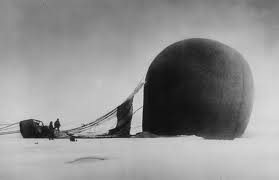
The Eagle eventually crash-landed onto the sea-ice some fifty hours after taking off from Spitzbergen. No one was hurt, but it was clear that the balloon would never fly again. The men were stranded, many miles from anywhere and lost amidst an Arctic wilderness. They were well equipped with safety equipment, including guns, sleds, skis, a tent and a small boat. Yet returning to the relatively safety of Spitzbergen involved a gruelling march across shifting, melting ice.

Nils Strindberg
The men spent a week at the crash site before setting out on their long hike. They had a reasonable quantity of food - meat, sausages and pemmican - but found it impossible to transport so much weight across the rucked-up ice. Much of the food had to be abandoned: henceforth, they were to rely on hunting for their survival.

They left their makeshift camp on 22 July and initially headed for Franz Josef Land. But the ice soon became impassable so they headed instead towards the Seven Islands, a seven-week march, where there was known to be a depot of food.
Over the ice
The terrain was so gruelling that they were reduced to advancing on all fours. But they eventually reached a place where the sea-ice had melted sufficiently for them to use their collapsible boat.

‘Paradise!’ wrote Andrée in his diary. ‘Large even ice floes with pools of sweet drinking water and here and there a tender-fleshed young polar bear!’

Their passage soon became impassable once again, forcing them to change direction. Aware that winter would soon be upon them, they built a hut upon an ice floe. But the ice broke up beneath them and they were lucky to struggle ashore onto desolate Kvitoya island.
Supper: polar bear
‘Morale remains good’, reported Andrée. ‘With such comrades as these, one ought to be able to manage under practically any circumstances whatsoever.’

It was the last coherent message he ever wrote. Within a few days, all three men were dead. Their fate was to become one of the great mysteries of Arctic exploration.
What happened to them? They had shelter, food and ammunition and ought to have been able to keep themselves alive. In the absence of any news, the world’s media began to speculate as to what had happened.

Nils with sledge
It was not until 1930 - fully 33 years after the men were lost - that their remains were finally found. Far from answering questions, the discovery of their bodies only deepened the mystery. The most plausible theory is that the men died of trichinosis, contracted after eating undercooked polar bear meat. They certainly had the symptoms of the disease and larvae of the trichinella parasite were found in a polar bear carcass at the site. But recent scientific evidence has thrown doubt on this conjecture.
Other suggestions include vitamin A poisoning from eating polar bear liver, lead poisoning from the food cans or carbon dioxide poisoning from their primus stove.

Their diary entries reveal that by the time they struggled ashore they were living off scanty quantities of canned goods from the balloon stores, along with portions of half-cooked polar bear meat.

They were suffering from foot pains and debilitating diarrhoea and were constantly cold and exhausted. Indeed they were so weary on their arrival at Kvitøya Island that they left much of their valuable equipment down by the water's edge.
Remains: 1930.
Nils Strindberg, the youngest, was the first to die. His corpse was found wedged into a crack in the cliff. Analysis of his clothing suggests he was killed by a polar bear.

The other two men seem to have weakened dramatically in the days that followed Strindberg’s death. As the Arctic winter struck in earnest, they lost the will to live.
It will never be known how many days they survived in their makeshift Arctic shack. By the time they were eventually found, all that remained was their diaries, a few spools of film (now developed) and a heap of bleached bones. 

Tuesday, December 24, 2013

Ed Gein


Edward Gein, the mild mannered, Midwestern psychopath from Plainfield, Wisconsin who, in the nineteen fifties, would shock the nation with his gruesome crimes. He would become the basis for the best selling book by Robert Bloch, "Psycho", as well as for the Hitchcock film of the same name. Accounts of Edward Gein's heinous crimes would also enter the consciousness of a young Tobe Hooper who, as an adult, would write and direct the classic cult film, "The Texas Chainsaw Massacre".

In November 1957 the world would learn about a seemingly innocuous man from America's heartland who ended up being so deviant from the norm, Ed Gein. He would shock the nation with his last grisly crime, that of hardware store owner Bernice Worden, and with his secret hobby so depraved that it would shock the entire nation when it came to light. News anchors from around the world and journalists would come to the small town of Plainfield Wisconsin to give the public a brief, visual glimpse into the life of Edward Gein.

Edward's mother, Augusta would move him and his older brother, Henry, from La Crosse Wisconsin to Plainfield when they were still children. His mother moved to this location to prevent outsiders from influencing her sons. They were only allowed to leave the premises to go to school and spent most of the time doing chores on the family's farm. Augusta, a fervent Lutheran, believed in and preached to her boys the innate immorality of the world which in her eyes was the evil of drinking, and the belief that all women (herself excluded) were prostitutes and instruments of the devil. She reserved time every afternoon to read to them from the Bible, usually selecting graphic verses from the Old Testament dealing with death, murder, and divine retribution. Gein tried to make his mother happy, but she was rarely pleased with her boys; she often abused them. During their teens and throughout their early adulthood, the boys remained detached from people outside of their farmstead, and so had only each other for company. To make matters worse, his mother punished him whenever he tried to make friends, which was difficult for him to do in school since he had a very shy and effeminate nature which made him a target for bullies.

When His father died the two boys took up random jobs around town to help pay expenses and Ed would start to babysit for families in the community. He enjoyed babysitting, seeming to relate more easily to children than adults. As his older brother matured, Henry began to reject his mother's view of the world and worried about his brother Ed's attachment to her. He spoke ill of her around his brother and it wasn't long after this behavior that he would wind up dead. According to statements by Ed Gein, on May 16, 1944 his brother Henry decided to burn off a marsh on the property. Reportedly, the brothers were separated, and as night fell, Ed Gein lost sight of his brother. When the fire was extinguished, he reported to the police that his brother was missing. When a search party was organized, Gein led them directly to his missing brother, who lay dead on the ground. The police had concerns about the circumstances under which the body was discovered. The ground on which Henry Gein lay was untouched by fire, and he had bruises on his head. Despite this, the police dismissed the possibility of foul play and the county coroner listed asphyxiation as the cause of death. Although some investigators suspected that Ed Gein killed his brother, no charges were filed against him.

Shorlty fallowing the mysterious death of his brother, Gein lived alone with his mother, who died on December 29, 1945. Gein was devastated by her death; in the words of author Harold Schechter, he had "lost his only friend and one true love. And he was absolutely alone in the world." Gein remained on the farm, supporting himself with earnings from odd jobs. He boarded up rooms used by his mother, including the upstairs, downstairs parlor, and living room, leaving them untouched. He lived in a small room next to the kitchen. Gein became interested in reading death-cult magazines and adventure stories to pass the time as he lived alone on the farm house. It is clear the Edward Gein had an abnormal attachment to his deceased mother. It was an attachment that would manifest itself in unimaginable ways. It is almost hard to believe that such a diminutive, seemingly inoffensive man could be such a madman, but who but a madman would do what he did? Edward Gein, it was discovered, had turned his small farmhouse into a gruesome charnel house, replete with furnishings adorned with human flesh and bones.


On November 16, 1957, Plainfield hardware store owner Bernice Worden disappeared and police had reason to suspect Gein. Worden's son had told investigators that Gein had been in the store the evening before the disappearance, saying he would return the following morning for a gallon of anti-freeze. A sales slip for a gallon of anti-freeze was the last receipt written by Worden on the morning she disappeared. Upon searching Gein's property, investigators discovered Worden's decapitated body in a shed, hung upside down by ropes at her wrists, with a crossbar at her ankles. The torso was "dressed out" like that of a deer. She had been shot with a .22-caliber rifle, and the mutilations were made after death.

Searching the house, authorities found:

* Four noses
* Whole human bones and fragments
* Nine masks of human skin
* Bowls made from human skulls
* Ten female heads with the tops sawn off
* Human skin covering several chair seats
* Mary Hogan's head in a paper bag
* Bernice Worden's head in a burlap sack
* Nine vulvas in a shoe box
* A belt made from human female nipples
* Skulls on his bedposts
* Organs in the refrigerator
* A pair of lips on a draw string for a windowshade
* A lampshade made from the skin from a human face

When questioned, Gein told investigators that between 1947 and 1952, he made as many as 40 nocturnal visits to three local graveyards to exhume recently buried bodies while he was in a "daze-like" state. On about 30 of those visits, he said he had come out of the daze while in the cemetery, left the grave in good order, and returned home empty handed. On the other occasions, he dug up the graves of recently buried middle-aged women he thought resembled his mother and took the bodies home, where he tanned their skins to make his paraphernalia. Gein admitted robbing nine graves, leading investigators to their locations. Because authorities were uncertain as to whether the slight Gein was capable of single-handedly digging up a grave in a single evening, they exhumed two of the graves and found them empty, thus corroborating Gein's confession.

Shortly after his mother's death, Gein had decided he wanted a sex change and began to create a "woman suit" so he could pretend to be a female. Gein's practice of donning the tanned skins of women was described as an "insane transvestite ritual". Gein denied having sex with the bodies he exhumed, explaining, "They smelled too bad." During interrogation, Gein also admitted to the shooting death of Mary Hogan, a tavern operator missing since 1954.

A 16-year-old youth whose parents were friends of Gein and who attended ball games and movies with Gein reported that he was aware of the shrunken heads, which Gein had described as relics from the Philippines sent by a cousin who had served in World War II. Upon investigation by the police, these were determined to be human facial skins, carefully peeled from cadavers and used as masks by Gein.

At his trial, some hair-raising testimony on what was found at Gein's home, as well as on some of the ghoulish practices in which Gein engaged, took nearly a year from start to finish, and resulted in Gein being sent to the hospital for the insane in Waupun Wisconsin.

The case of the century was drawing to a close and for many years, it would still be a topic discussed in newspapers, books, in movies, on television and in comics. Even today we see new films and even *musicals about the notorious Ed Gein who had exhumed corpses from local graveyards and fashioned trophies and keepsakes from their bones and skin. Who confessed to killing two women: tavern owner Mary Hogan in 1954 and a Plainfield hardware store owner, Bernice Worden, in 1957. Not just the murders would be horrific to many, but the way in which they were treated after death make's Ed Gein one of Americas most bizarre murderers, long before other deviants such as Jeffrey Dahmer and Ted Bundy.

----------------------------------------------------------------
Ed Gein was placed between his older brother and mother and due to his tombstone being vandalized and even stolen on 3 ocassions, it is no longer placed there. This is also spot for many of Ed's visits to exhume bodies that he would then use to make his many furnishings in his home. One of the bodies he stole was only one row in front of him. Bernice, his last victim, is also buried at this cemetery only about 20 feet away.


----------------------------------------------------------------
These are the photo's taken of Ed Gein's property. The home was burned to the ground by the locals in 1958 after he was convicted of the crimes and sent to the mental institution. When he was told about it, he shrugged and said, "Just as well." Now the property is vacant.