Sunday, November 3, 2013

Count Peter Schilovsky: Forgotten Genius of the Gyrocar

This ingenious two-wheeled gyroscopically balanced motorcar was invented almost a century ago by Count Peter Schilovsky (in bowler hat), shown taking it for a trial run. After it was built and ran successfully, it was buried. Then, many years later, it was disinterred. Even without the distinction of an entombment and a subsequent resurrection, the car would have attracted attention anywhere. And so would its inventor, Count Peter Schilovsky, a tall, aristocratic Russian. Early in 1912, Schilovsky appeared at the offices of the Wolseley Tool and Motor Car Company on Victoria Street in London with an unusual proposal. He would pay the Wolseley Company to build a gyroscopically balanced two-wheeled car of his design. Wolseley was then the largest automobile maker in Britain. Its plant at Addersley Park in Birmingham covered several acres and produced some 50 cars a week. Part of the giant Vickers empire, the Wolseley company had more than 1,400 machine tools in its factory. It was ideally equipped to handle the job the Russian inventor proposed.

Early Attempts


Ever since mankind got itself into mechanically propelled motion in the three-and four-wheeled vehicles that were early motorcars, inventors have dreamed of conquering the problems of balance to produce a two-wheeled motorcar. In 1908, a 20-year-old Detroit artist and self-taught engineer, James Scripps Booth, constructed such a car. Powered by a V-8 engine of his own design and charmingly named the "Bi-Autogo," the car was little more than a motorcycle--a two-wheeled car with a pair of small "training wheels" at the rear. The venture was eventually abandoned. Scripps Booth turned his energies to the production of more conventional four-wheeled automobiles.

One rotating device, however, had the potential to make a two-wheeled vehicle balance itself even when stationary: the gyroscope. Friedrich von Bohnenberger constructed the first of these in Germany in 1810. For years it remained little more than an interesting demonstration in physics classrooms. Steelmaker Henry Bessemer was the pioneer who first applied the gyroscope to a form of transportation. Bessemer had made a fortune from his ingenious process for producing steel in which air was introduced into molten pig iron, burning out carbon and other impurities. His process not only made him rich but also later earned him a knighthood. Prone to seasickness, Bessemer installed a gyroscope mounted on bearings beneath the public cabin of his Channel steamer, the S.S. Bessemer, to keep it upright in rough seas.

The experiment ended in a costly disaster. On its maiden voyage in 1875, Bessemer's ship sailed from Dover and crossed the Channel. In a calm sea in broad daylight, the out-of-control ship demolished a dock at the French port of Calais. After repairs, another attempt was made. Despite being in the hands of an experienced captain, Bessemer's ship again did not respond to the helm and smashed into the Calais dock. Bessemer wisely decided to abandon his plan for a fleet of gyroscopically balanced ships.

The first proposal to apply gyroscopic stabilization to a land vehicle was made in 1903 by Louis Brennan in his application for a British patent. Brennan had already made a fortune from his invention of the Brennan torpedo directed by wires from the shore and widely used for harbor defense. By 1907, he displayed a large working model of a monorail at a meeting of the Royal Society. In November of the following year, Brennan exhibited at his Brennan Torpedo Works a 22-ton, 40-foot-long gyroscopic car that successfully traveled on a specially built monorail line. This car could carry 40 standing passengers.

By coincidence, a German, Richard Scherl, was simultaneously demonstrating a smaller gyroscopic rail car capable of carrying six persons. Both monorails were supported by a single traditional rail and ballasted roadbed, as contrasted with suspended monorails that depend solely on gravity to keep them in balance.

Schilovsky's Gyrocar


Count Schilovsky explained to Wolseley's engineers that his one passion in life was an all-consuming interest in the gyroscope. Although he was a lawyer, he was no stranger to mechanics or mathematics, being the product of the system of higher education of Czarist Russia. Estimable in quality, it was a far cry from universal public education, being highly selective and limited to the wealthy and the ruling class. Schilovsky already held several British patents and a U.S. patent for monorail vehicles balanced by a gyroscopic device. It was inevitable that he should turn his attention to producing a rubber-tired two-wheel vehicle that could travel over roads.

Far from being regarded as a curious if impractical toy, such a car was already exciting interest in various war ministries. Road conditions in wartime could make the passage of four-wheeled, two-tracked vehicles difficult, if not impossible. His 1912 U.S. patent application had listed Schilovsky's address simply as "Kostroma, Russia." He was, in fact, the governor of the entire province of Kostroma, an area of some 32,500 square miles northeast of Moscow on the Volga River. Previously, he had been vice-governor of Simbirsk province, east of Moscow.

The principle behind Schilovsky's Gyrocar was the same as that of the toy gyroscope so familiar to children. It took advantage of the tendency of a rapidly spinning massive rotor to maintain its orientation in space when the position of the outside framework changed. Common examples of gyroscopic motion and stability are found in spinning tops, the wheels of bicycles and motorcycles and even the spinning of the Earth in space. In Schilovsky's two-wheeled car, the slightest tilting motion to either side would tip one of two pendulums and call into play a heavy, rotating gyroscopic flywheel to immediately check the tipping and return the car to an upright position.

Wonderfully Simple

Wolseley engineers admitted that Schilovsky's idea was wonderfully simple. Work on the "GY Car," as it was called in Wolseley Company reports, began almost immediately under the supervision of A.W. Dring, chief experimental engineer. His October 9, 1912, report show that springs to be installed on the car were being tested. On October 21, the modified four-cylinder Wolseley C5 engine, with a bore of 90mm and stroke of 121mm, was tested. This was basically the same gasoline engine installed in Wolseley cars of the period. It also turned a generator to power the electric motor that rotated the gyrostat.

The gyrostat--a 780-pound flywheel, the heart of the gyroscope--was tested for acceleration and deceleration in early November. In December the generator and electric motor were tested in the presence of Schilovsky, by then a frequent visitor to the plant. By July of 1913, the chassis of the GY car was completed to specifications and the electrical equipment had been tested installed. That the Gyrocar was no mere overgrown motorcycle is shown by the fact that the chassis alone tipped the scales at more than 5,300 pounds, and the body without trim or fittings weighed an additional 500 pounds.

Not only was Schilovsky's vehicle heavy, it was huge, with a wheelbase of 158-3/4 inches. This made it more than three feet longer than the 124-inch wheelbase of the 2007 Lincoln Town Car. The Schilovsky car's wire wheels were made by Rudge-Whitworth, and its tires (of a size identified as 915 x 100) were supplied by Dunlop. The finished car was ready in November of 1913. After a test run, the front fork mount was changed to a more nearly horizontal position. Additional testing early in 1914 resulted in minor modifications to the controls and the speeding up of the gyroscope wheel. Failure of the gyroscope in January put the car in the shop again for additional work. An automatic device was added to lower the side supports, or "sprags," whenever the gyroscope got into trouble.

Testing Completed

By April the Gyrocar was deemed ready for a public demonstration in London with reporters and cameramen present. One of the invited passengers was Louis Brennan, inventor of the Brennan torpedo and monorail enthusiast. Wolseley engineer Dring recorded the event in his notes:

"After this the car was stopped and the sprags let down, whilst I showed the press men and His Excellency's friends the Gyrostat and explained the working of same, demonstrating how by pressing the ball controls the car was balanced and ready for running again. Then His Excellency, the driver and myself took the car into Regent's Park where rides were given to His Excellency's most intimate friends. These runs were made at very low speeds in order to demonstrate that the gyrostat had perfect control of the car. We then started back to Portman Square, His Excellency being loudly cheered and highly congratulated."

Following the demonstration, fellow inventor Louis Brennan remarked to the press "one has to ride in such a vehicle in order to fully appreciate the luxury of travel in the absence of lateral displacements of ordinary motor cars." He also noted that a saving in the cost of tires would be achieved, not only because of their reduced number but because it was easy for the driver of a Gyrocar to choose the best path to steer--an important factor in undeveloped countries having poor roads. In 1929, Brennan, by then in his 70s, touted the advantages of a two-wheeled gyro car for use in warfare, a purpose for which the Shilovsky car had been promoted. Brennan's model car was demonstrated at Farnborough airport for British carmakers Austin, Morris and Rover, who decided that they had their hands full manufacturing conventional automobiles.

The Auto-Motor Journal, which called itself somewhat presumptuously "The Times of Automobilism," reported that another Schilovsky car would be constructed with sliding gears instead of the pendulums used to control the gyroscope. The new design was expected to be a much lighter car. Schilovsky was pleased with the Wolseley Company's work on the car. He may have intended to pick up his car or to have it shipped to Russia, but the First World War intervened. The car spent the war years in the Wolseley plant. Schilovsky's name and references to either his Gyrocar or monorail disappeared completely from newspapers and from engineering literature.

Postwar Activities

Despite the wrenching upheaval of the Bolshevik revolution, Schilovsky survived and was back in London in 1922. He was invited to lecture to the November 24th meeting of the Physical Society at the Imperial College of Science. Schilovsky was listed as "Chairman of the Gyroscopic Society of Petrograd." His presentation was entitled "A Demonstration of Some Applications of the Gyroscope." The "big guns" of British physical science attended.

He revealed that 50 engineers and scientists were working on a monorail system to connect Petrograd and Tzarskoe Selo (later called Pushkin), a suburb some 15 miles distant. The Bolshevik government, faced with a huge and undeveloped country and having only limited financial means, decided to explore the advantages of an overhead monorail line. Schilovsky assembled a group of Russian experts: mathematicians, mechanical engineers, economists and track designers. German monorail experts were brought in to design the passenger cars and electrical system.

Following Schilovsky's lecture, Sir George Greenhill, 75-year-old former professor of mathematics at the Artillery College at Woolwich and author of an exhaustive 277-page volume entitled Report on Gyroscopic Theory, thanked Schilovsky for his presentation. Physicist Sir Charles Vernon Boys, later vice-president of the Royal Automobile Club, expressed his pleasure at seeing the Russian scientist alive and well, and hoped that Schilovsky would take back a message of good will and sympathy to his confreres in Petrograd--its name had not yet been changed to Leningrad. Professor Buys had been an enthusiastic passenger in Schilovsky's Gyrocar in its 1914 London demonstration.

Sir James Henderson, former professor of applied mechanics at the Royal Naval College and later advisor on gyroscopic equipment to the Admiralty, asked for details of the Russian monorail project. Schilovsky replied that the impression the Soviet government had actually completed the railway was unfortunately not true. About ten kilometers (6.2 miles) of track had been laid, but lack of funds and resources had kept it from being completed.

Schilovsky's presence at the London meeting is interesting, for it shows that the revolutionary government considered him a scientific asset and did not bar him from traveling outside the country. A year later, however, Schilovsky, his wife and their three daughters became permanent residents of England, making their home in a London suburb. In March of that year he attended a scientific meeting at the technical institute at Loughborough that discussed gyroscopes.

During the summer of 1923 he worked on the manuscript of a book, assisted by a young physicist, J.F.S. Ross, author of An Introduction to the Principles of Mechanics, whom he had met at the Loughborough meeting. It may have been a case of intellectual cross-pollination; later, Ross's 1931 Ph.D. thesis was entitled The Gyroscopic Stabilization of Land Vehicles.

Published by the respected London firm of E. and F.N. Spon, Schilovsky's book, The Gyroscope: Its Practical Construction and Application, appeared in 1924. It was considered sufficiently authoritative to merit republication by Spon in 1938 with no changes to the text. In his book, Schilovsky described his Gyrocar and offered as frank an appraisal as any inventor ever gave of the shortcomings of a brainchild: "But as the eccentricity of the gyroscope was only sufficient for a smooth curve in the direction of spin of the gyroscope, no rounding of sharp curves was possible to the left." Schilovsky added that he had already drawn up the necessary patent specifications to rectify this difficulty. Money being in short supply, however, an improved Gyrocar was never built.

Aircraft Instruments

Despite the "white elephant" outcome of his Gyrocar project, Schilovsky maintained an interest in gyroscopes. His book led to a meeting with Frederick Handley Page, famous British builder of giant aircraft, later knighted by King George in 1942. For Handley Page, Schilovsky designed the first of his Orthoscopes, the original turn and bank indicator for aircraft.

Turn and bank indicators are essentially two separate instruments. The turn indicator shows rotation about the vertical axis. It incorporates a small gyroscope that develops a torque when the aircraft turns. This torque controls a pointer that shows the pilot the turning rate in degrees per unit of time. The bank indicator shows rotation about the longitudinal axis and is the much simpler instrument of the two. It consists of a U-shaped glass tube filled with a damping liquid in which a small steel ball rolls. When the plane is horizontal, the ball is at the bottom. As the plane banks, gravity keeps the ball at the lowest point as the tube rotates from side to side.

G. H. Cooke, whose improvements included a simplification of the wiring and the addition of a small light bulb behind two movable screens, one red, and the other green, later introduced modifications into the Schilovsky Orthoscope. In the static position, these screens blocked passage of light. Banking the aircraft to the left exposed the red screen, while banking to the right exposed the green screen.

Schilovsky later worked with Vickers-Armstrongs, Ltd., where he developed navigational gyroscopes for torpedoes at the Royal Navy's base at Devonport. He also assisted in the design and construction of the Sperry gyroscopic stabilizers installed in 1932 in the Italian Line's Conte di Savoia. The sleek and lovely vessel, the first gyro-stabilized vessel to cross the Atlantic, displaced 45,502 gross tons, was 815 feet long and had a beam of 96 feet. As one of the first large vessels to be equipped with gyrostabilizers, the roll of this ship in heavy seas was claimed to be limited to 3 degrees. Passengers reported that they still got seasick. Her maiden voyage to New York began on November 30, 1932. Regrettably, she had a too-short life. After brief wartime service as a troop transport, she was sunk by Allied bombing planes in the Adriatic near Venice. After the burned-out hulk was raised in 1945, plans fell through for refurbishing the ship to carry Italian emigrants to South America. She was broken up for scrap in 1950.

Following the ship project, Schilovsky returned to designing improved turn-and-bank indicators. His new instrument was small, lightweight and quick starting--the gyroscope was powered by the aircraft's slipstream--and had a constant speed. In 1937, he was working on a project to develop a directional gyrocompass for armored vehicles. The Vickers Group magazine Vickers News published an amusing cartoon in the May 1937 issue. It showed Schilovsky in a black hat and fur-collared coat conducting a test of one of his gyroscopic instruments. He left Vickers in 1940 and moved to Surbiton, a London suburb, where he continued his research in his own workshop.

In their declining years, Dr. and Mrs. Schilovsky lived in Holmer Park in Hereford, with Lady Wood, a friend. He would jokingly tell friends, "In Russia I used to devote half my time to governing the state and half my time to science; now I devote all my time to science." The Schilovskys had lost almost everything in the Bolshevik Revolution and its aftermath, managing to salvage only a Stradivarius violin and a set of gold tableware. Yet, friends recalled that they never complained about their lot.

Over the years, Dr. Schilovsky's Gyrocar had been sitting in a corner of the Wolseley factory, the subject of occasional curiosity about its origin and the fate of its creator. The two-wheeled car managed to survive the spectacular 1926 bankruptcy that put the Wolseley Company into the hands of William Morris's car company, perhaps best known for its MG sports car.

Consigned to the Grave

As for the Gyrocar, in 1930 Wolseley decided to dispose of the unwieldy Schilovsky 1912 vehicle. Instead of turning it over to a scrap metal dealer, a huge hole was dug and the car was unceremoniously dumped in and buried. This should have been the end of the story. The factory freight yard was gradually extended, with railroad tracks and puffing locomotives covering the grave of the two-wheeled oddity.

In 1938, in one of those curious flip-flops of corporate policy that dot the history of technology, the decision was made to dig up the Gyrocar. Rail traffic was halted and tracks were moved. The monster carcass was located, uncovered and hauled up by a crane. Chassis and running gear--in a remarkable state of preservation despite their eight-year burial--were restored, and the car was accorded a place of honor in the company's museum.

According to a Wolseley factory legend, Schilovsky, now an old man, visited the factory museum one day to gaze once more at his invention. All the familiar faces he had known at the plant were gone. Even its output was different, for it was engaged in war production, and the plant's buildings had been camouflaged to resemble a housing development. The old man stood looking at the car for a long time, his tall figure stooped by age. Then he left, this time never to return.

The Gyrocar miraculously survived the destruction of the war. For a time it was hidden when a German invasion was feared after the fall of France. Having been saved from repeated wartime scrap drives that swallowed British fences, railings, lampposts and other objects of iron or steel, the now-venerable relic emerged unscathed from the heavy German air raids that badly damaged the factory.

Ironically, in 1948--in another unpredictable and totally indefensible turnabout in corporate thinking--someone in the Wolseley organization gave the stupid order to destroy the Gyrocar. The unusual vehicle, which had literally come back from the grave, was broken up and sold as scrap metal. The reason offered to justify its destruction was ludicrous: "It was hard to store. It always had to lean against something."

Fortunately, Schilovsky lived long enough to witness the ultimate technological triumph of the gyroscope. The German vengeance weapons--V-1 and V-2 rockets that rained down on England in 1943 and 1944--were gyroscopically guided. Gyroscopes are also at the heart of the inertial guidance systems of today's spacecraft. Dr. Peter Schilovsky died in 1955, still single-mindedly believing in gyroscopes and monorails, still hoping to convince the British Admiralty to adopt his gyroscopic ship stabilizer. It would be nice to think he passed away without ever learning of the ignominious fate of his Gyrocar.

Tony Sirico


Sirico was born Genaro Anthony Sirico Jr. in 1942 in Brooklyn, New York. He has played gangsters in numerous films, some poorly made, some pretty decent, including, in the latter category, Fingers (probably his earliest mob film worth watching; Harvey Keitel plays the lead), GoodfellasInnocent BloodBullets Over BroadwayMighty AphroditeGottiCop Land, and Mickey Blue Eyes.

Before turning to acting, Sirico was reportedly an associate of the Colombo crime family serving under Carmine "Junior" Persico -- and had been arrested an amazing 28 times, it has been said. There is even a Sopranos reference to Tony’s real past, when he, as Paulie, said in one of the last episodes in the series: "I lived through the seventies by the skin of my nuts when the Colombos were goin' at it." And indeed they were: The Colombos have had three family wars, the first two in the ‘60s and ‘70s courtesy of the Gallo brothers taking on the boss – first Joseph Profaci, when the family had his name, and then Joseph Colombo, whom the family was renamed after because the Commission wasn’t pleased with the mess Profaci left behind when he died: namely, a street war and an attempt by Profaci’s successor, brother-in-law Joseph Magliocco, who had been underboss, and Joseph Bananas Bonanno (Was everyone in the mob named Joseph in the 1960s and '70s?) to wipe out the Comission and take over all the New York families a la The Godfather.

In 1967, Sirico was sent to prison for robbing a Brooklyn after-hours club, but was released after serving 13 months. In 1971, he plead guilty to felony weapons possession and was sentenced to an "indeterminate" prison term of up to four years, of which Sirico ended up serving 20 months. In was during that stint in the can that Sirico got interested in acting – and gave up a life of crime for a life of playing criminals -- a wise move, safer and probably better paying.

His past was dredged up when the show "48 Hours Mystery: The Last Take" did a special on party girl, celebrity-chaser and wannabe-starlet Christa Helm, who was murdered late one night in a posh area of LA. It happened in front of her agent's house.

Sirico was involved somehow – but only as a witness, and was wanted for questioning, police said.

At the time of her murder, Helm was a gorgeous "B" movie starlet who hung around with the likes of Warren Beatty, Jack Nicholson and Frankie Crocker. When she died, she left behind a semi-sordid past, plenty of suspects, and several "persons of interest" who, if they are still alive, may know more than they are saying.

One of them – Sirico, who knew Helm and was apparently dispatched by someone the day after her murder to "look after" her roommate. According to the show, he may also have taken away some of Christa's belongings, including incriminating sex tapes, diaries (which are still missing), furs and other personal belongings.

When recently questioned in tandem with the 48 Hours segment, Sirico reportedly told detectives that he "didn't know she was killed" and that he "hardly knew her." This was about 40 years ago.

Sirico was never a suspect, and his involvement appears to be limited to the missing tapes and diaries, which may have been weapons in Helm’s blackmail arsenal. She had the goods to nail the Shah of Iran and several of the hottest celebs of the day. The tapes could have been taken to protect them – or to protect her reputation.

Sirico, a proud member of the USO (he spent a few years in the US Army himself), is an Italian-American of Sicilian descent. Interestingly, in a minor—very minor, blink and you’ll miss him—role in Goodfellas (1990), he played a mobster named Tony who reported to a boss named Paulie. In The Sopranos (1999), he plays a mobster named Paulie who reports to a boss named Tony.

Now, it's Anthony Borgese, another Sopranos almunus, character name Larry Boy Barisi, who really has his pair in the ringer. He pleaded guilty Wednesday to extorting a debtor who was beaten by mob goons.

"I used extortionate means to collect a debt from a person who lived near Monticello," Borgese, 72, said in Brooklyn Federal Court.

The unidentified victim owed money to an upstate car dealership whose owner had sought Borgese's help in collecting the debt. The victim ended up with a broken jaw and broken rib. What were the car dealer and Mr. Borgese thinking? Or were they thinking? Who'd find a 72-year-old man who played a mobster on TV as intimidating as a real-life mobster?

Well, it appears in Borgese's case, the line between fiction and reality was blurred. According to The Mafia Today website, Borgese was involved with the Gambinos, who supplied the enforcers who broke the victims ribs and jaw.

In Goodfellas, Borgese played the luckless owner of the Bamboo Lounge, a successful restaurant/nightspot that the mob got their hands on and sucked every dime out of before setting it ablaze.

Borgese faces up to 41 months in prison when he's sentenced sometime in late summer so as to not interfere with a charity golf tournament he hosts every summer to raise money for United Cerebral Palsy.

Saturday, November 2, 2013

Atheists don’t commit as much crime as the Religious do.

Congratulations atheists… you are more well-behaved than the rest of society. No, this isn’t a “pat you on the back” piece. But, I think it’s important for us to remember that we ARE moral people that know how to be good citizens without a divine babysitter telling us what’s right and wrong. And, there is evidence to show that this is correct.

In 2005, the Kripke Center released a detailed study called, “Cross-National Correlations of Quantifiable Societal Health with Popular Religiosity and Secularism in the Prosperous Democracies.” Long title, I know. But, what it said was very important and gets overlooked by many atheists. Keep in mind, the Kripke Center ISN’T secular and has no reason to promote a secular view. According to their own website, “The Kripke Center is dedicated to facilitating scholarly activity in the areas of religion and society. Special attention is given to promoting understanding between and among faith communities, including especially Judaism, Christianity, and Islam. The Kripke Center’s primary audience is the academic community, but its scholarship and services are available to all who seek them. The Center is named in honor of Rabbi Myer and Dorothy Kripke.” The study had some amazing discoveries. They concluded:

Indeed, the data examined in this study demonstrates that only the more secular, pro-evolution democracies have, for the first time in history, come closest to achieving practical “cultures of life” that feature low rates of lethal crime, juvenile-adult mortality, sex related dysfunction, and even abortion. The least theistic secular developed democracies such as Japan, France, and Scandinavia have been most successful in these regards. The non-religious, pro-evolution democracies contradict the dictum that a society cannot enjoy good conditions unless most citizens ardently believe in a moral creator. The widely held fear that a Godless citizenry must experience societal disaster is therefore refuted. Contradicting these conclusions requires demonstrating a positive link between theism and societal conditions in the first world with a similarly large body of data – a doubtful possibility in view of the observable trends.

It also stated (check out the graphs at the bottom of the report to see for yourself) that the United States, while still one of the most religious countries on earth, also has the highest rates of teen pregnancy, STDs, and abortions. So much for god looking out for his flock, right? They note:

There is evidence that within the U.S. strong disparities in religious belief versus acceptance of evolution are correlated with similarly varying rates of societal dysfunction, the strongly theistic, anti-evolution south and mid-west having markedly worse homicide, mortality, STD, youth pregnancy, marital and related problems than the northeast where societal conditions, secularization, and acceptance of evolution approach European norms


But, I digress… This post was supposed to be about crime. But, it all ties together, which is why I felt it was important to start with the above information. Ask anyone with a masters in criminology and they’ll tell you that crime is caused by so many social issues: poverty, parenting, religion, economics, demographics, geography, etc. It’s a deep issue with a lot of sides. But, I want to look at just one… religious affiliation of those in prison. Denise Golumbaski, Research Analyst for the Federal Bureau of Prisons released the following numbers in 1997 under the Freedom of Information Act. take a look:

Response Number %
---------------------------- --------
Catholic 29267 39.164%
Protestant 26162 35.008%
Muslim 5435 7.273%
American Indian 2408 3.222%
Nation 1734 2.320%
Rasta 1485 1.987%
Jewish 1325 1.773%
Church of Christ 1303 1.744%
Pentecostal 1093 1.463%
Moorish 1066 1.426%
Buddhist 882 1.180%
Jehovah Witness 665 0.890%
Adventist 621 0.831%
Orthodox 375 0.502%
Mormon 298 0.399%
Scientology 190 0.254%
Atheist 156 0.209%
Hindu 119 0.159%
Santeria 117 0.157%
Sikh 14 0.019%
Bahai 9 0.012%
Krishna 7 0.009%
---------------------------- --------
Total Known Responses 74731 100.001% (rounding to 3 digits does this)

Unknown/No Answer 18381
----------------------------
Total Convicted 93112 80.259% (74731) prisoners' religion is known.

Held in Custody 3856 (not surveyed due to temporary custody)
----------------------------
Total In Prisons 96968
If you look at just the Judeo-Christian totals, they account for 83.761% of the total survey.
Catholic 29267 39.164%
Protestant 26162 35.008%
Rasta 1485 1.987%
Jewish 1325 1.773%
Church of Christ 1303 1.744%
Pentecostal 1093 1.463%
Jehovah Witness 665 0.890%
Adventist 621 0.831%
Orthodox 375 0.502%
Mormon 298 0.399%


So, what can we conclude from this? Either Atheists are really good at getting away with crime, or we commit less of it. I think the latter is more plausible. Yes, the total population of ”admitted atheists” in the country at that time was only about 8-15%. You would then expect the total prison population to be about the same… but it wasn’t. Atheists accounted for 0.209% of the total incarcerated – 1/5th of 1%. That’s at least 40 times lower than would be expected from random distribution based on the population. Hmmm…

Now, let me address the “naysayers” who will attack this (and there are many). There are obviously some difficulties in establishing the “validity” of the numbers. Yes, they DO come from the Federal Bureau of Prisons, but people have made claims like “some atheists in prison say they are religious to get better parole”. While this may be true, it couldn’t be the majority, and most states don’t require religious affiliation to be listed in files available to parole boards. The results shown above was a random sampling of about 5% of the total US prison population (which anyone that has taken a basic statistics class knows is statistically significant and a big enough sample size to extrapolate results across the board). If religious affiliation was on EVERY prisoner file, this chart would have had more than 74,000+ prisoners… it didn’t.

Also, some people claim that the “8-15%” number of atheists in America at the time is highly suspect and must be exaggerated since it’s assumed that it includes “non-theists” that aren’t really “atheists”. My answer…. BIG FUCKING DEAL! Even if the study only counted 10% of the total of atheists in prison and the numbers for the whole U.S. population were as small as 4%, that’s still less in prison than in the overall citizenry. I don’t mean to use the numbers to say that being religious MAKES you commit crime… but i think it’s fair to conclude that being religious DOESN’T PREVENT YOU FROM BECOMING A CRIMINAL! If god (or gods – depending on the religion) is “looking out for” believers or giving them some form of moral compass not available to the heathens amongst us, then how do so many of them wind up in prison.


Myth: Religious people are better people and make for a better society! Result: Well… BUSTED!

EXTRA NOTE:There is most likely a correlation here to intelligence. I had thought about it but didn’t think it was worth mentioning. There is a correlation between education level and belief in god. Smarter people tend to be atheists and smarter (better educated) people also tend to commit less crime (or hire better lawyers – LOL). So, I can see how it is possible that the less educated you are, the more likely you are to commit crime AND be a believer in a fantastical myth! I don’t presume to state that the evidence above is proof that being a believer MAKES you commit crime, but I think it’s fair to say that being an atheist means that you might be better educated than your religious peers and therefore less likely to commit crime. The belief or non-belief IS NOT the deciding factor to crime… just a correlation. I am only speaking to “moral authority” here, just showing that believers are no more “moral” or “good” due to their belief in a supernatural babysitter.

ONE MORE NOTE: Several people have asked what the overall religious population of the United States looked like in 1997 when these numbers on criminals were released. The following is the best I can find if from http://www.religioustolerance.org/us_rel1.htm:

In 1997, the US Society and Values magazine published an overview of religion in the U.S., using data from the Pluralism Project at Harvard University. 3,4 They reported:
bullet 63% of Americans (163 million) state that they are actively affiliated with a faith group:


In 1997, the US Society and Values magazine published an overview of religion in the U.S., using data from the Pluralism Project at Harvard University. 3,4 They reported:
bullet:

.63% of Americans (163 million) state that they are actively affiliated with a faith group:

.Roman Catholicism is the largest single religious group (60 million; 23%).

.Anglicans, Eastern Orthodox and Protestant churches total 94 million members (36%) within 220 denominations.

.There are 3.8 million religiously active Jews (1.5%) ; an additional 2 million regard themselves as cultural or ethnic Jews.

.Estimates of Muslims vary greatly. Some surveys show that there are about 3.5 to 3.8 million Muslims (1.4 to 1.5%) in the U.S. Most Muslim sources estimate about six or seven million.

.There are over 300,000 congregations.

.There are over 530,000 priests, ministers, pastors, etc.

.Islam is numerically the fastest growing organized religion in the U.S., in terms of numbers of adherents.

.The most rapidly growing religious/spiritual/ethics grouping in the US is not an organized religion; it consists of non-believers (Atheists,Agnostics, etc.).

Sophie Scholl

"Many people think of our times as being the last before the end of the world. The evidence of horror all around us makes this seem possible.

But isn't that an idea of only minor importance? Doesn't every human being, no matter which era he lives in, always have to reckon with being accountable to God at any moment? Can I know whether I'll be alive tomorrow morning?

A bomb could destroy all of us tonight. And then my guilt would not be one bit less than if I perished together with the earth and the stars.”

Sophie Scholl


"Love does not make you weak, because it is the source of all strength, but it makes you see the nothingness of the illusory strength on which you depended before you knew it."

Léon Bloy

As you know, I have been commemorating the anniversary of Die Weiße Rose, the Munich Students Movement, and the series of leaflets which they produced and distributed in Nazi Germany as a statement of conscience during the height of the reign of terror.

I do not think it is possible for any one of us to genuinely appreciate the courage it takes to do something like this. And I hope that we never do come to understand such an extraordinary vocation to the same degree.  But each one of us is called to act, in our own way, and in our own time.

“The real damage is done by those millions who want to 'get by.'   The ordinary men who just want to be left in peace. Those who don’t want their lives disturbed by anything bigger than themselves. Those with no sides and no causes. Those who won’t take measure of their own strength, for fear of antagonizing their own weakness. Those who don’t like to make waves—or enemies.

Those for whom freedom, honour, truth, and principles are only literature. Those who live small, love small, die small. It’s the reductionist approach to life: if you keep it small, you’ll keep it under control. If you don’t make any noise, the bogeyman won’t find you.

But it’s all an illusion, because they die too, those people who roll up their spirits into tiny little balls so as to be safe. Safe?! From what? Life is always on the edge of death; narrow streets lead to the same place as wide avenues, and a little candle burns itself out just like a flaming torch does. I choose my own way to burn.”

Sophie Scholl

What is surprising is not that we are called to do so much, but rather, so little.  Love and be grateful to God, treat people as you would like to be treated with respect, kindness, and forgiveness.  Do not lie or steal or cheat,  do not be proud and look down on your fellow creatures, and act with honor and respect for the gifts of His creation. And when we fail through weakness, we are readily forgiven. 'Can you not watch with me, for even one hour?'

But all too often we bargain away our souls, rebelling from even these slight and reasonable requests-- and for so little.


The White Rose
Second Leaflet
Munich, 1942

We will not be silent.

It is impossible to engage in intellectual discourse with National Socialist philosophy, for if there were such an entity, one would have to try by means of analysis and discussion either to prove its validity or to combat it. In actuality, however, we face a totally different situation.

At its very inception this movement depended on the deception and betrayal of one's fellow man; even at that time it was inwardly corrupt and could support itself only by constant lies. After all, Hitler states in an early edition of "his" book (a book written in the worst German I have ever read, in spite of the fact that it has been elevated to the position of the Bible in this nation of poets and thinkers): "It is unbelievable, to what extent one must betray a people in order to rule it."

If at the start this cancerous growth in the nation was not particularly noticeable, it was only because there were still enough forces at work that operated for the good, so that it was kept under control. As it grew larger, however, and finally in an ultimate spurt of growth attained ruling power, the tumor broke open, as it were, and infected the whole body.

The greater part of its former opponents went into hiding. The German intellectuals fled to their cellars, there, like plants struggling in the dark, away from light and sun, gradually to choke to death.

Now the end is at hand. Now it is our task to find one another again, to spread information from person to person, to keep a steady purpose, and to allow ourselves no rest until the last man is persuaded of the urgent need of his struggle against this system. When thus a wave of unrest goes through the land, when "it is in the air," when many join the cause, then in a great final effort this system can be shaken off.

After all, an end in terror is preferable to terror without end.

We are not in a position to draw up a final judgment about the meaning of our history. But if this catastrophe can be used to further the public welfare, it will be only by virtue of the fact that we are cleansed by suffering; that we yearn for the light in the midst of deepest night, summon our strength, and finally help in shaking off the yoke which weighs on our world.

We do not want to discuss here the question of the Jews, nor do we want in this leaflet to compose a defense or apology. No, only by way of example do we want to cite the fact that since the conquest of Poland three hundred thousand Jews have been murdered in this country in the most bestial way.

Here we see the most frightful crime against human dignity, a crime that is unparalleled in the whole of history. For Jews, too, are human beings - no matter what position we take with respect to the Jewish question - and a crime of this dimension has been perpetrated against human beings.

Someone may say that the Jews deserve their fate. This assertion would be a monstrous impertinence; but let us assume that someone said this - what position has he then taken toward the fact that the entire Polish aristocratic youth is being annihilated? (May God grant that this program has not yet fully achieved its aim as yet!)

All male offspring of the houses of the nobility between the ages of fifteen and twenty were transported to concentration camps in Germany and sentenced to forced labor, and all the girls of this age group were sent to Norway, into the bordellos of the SS!

Why tell you these things, since you are fully aware of them - or if not of these, then of other equally grave crimes committed by this frightful sub- humanity? Because here we touch on a problem which involves us deeply and forces us all to take thought.

Why do German people behave so apathetically in the face of all these abominable crimes, crimes so unworthy of the human race? Hardly anyone thinks about that.

It is accepted as fact and put out of mind. The German people slumber on in their dull, stupid sleep and encourage these fascist criminals; they give them the opportunity to carry on their depredations; and of course they do so.

Is this a sign that the Germans are brutalized in their simplest human feelings, that no chord within them cries out at the sight of such deeds, that they have sunk into a fatal consciencelessness from which they will never, never awake?

It seems to be so, and will certainly be so, if the German does not at last start up out of his stupor, if he does not protest wherever and whenever he can against this clique of criminals, if he shows no sympathy for these hundreds of thousands of victims. He must evidence not only sympathy; no, much more: a sense of complicity in guilt.

For through his apathetic behavior he gives these evil men the opportunity to act as they do; he tolerates this "government" which has taken upon itself such an infinitely great burden of guilt; indeed, he himself is to blame for the fact that it came about at all...

Please make as many copies of this leaflet as you can and distribute them.


Thankfully few are called to the martyr's crown.  But we are all called to take up our cross and follow, each day, in each of our own small ways. That is all most of us can do-- be still, and faithful, and wait on the Lord in our calling.  

And above all do not add to or assist, in any way, the evil in the world, especially by condemning or harming those who stand up against its onslaught.  That is Pilate's sin, to ask 'What is truth' and turn away and lie, if only to ourselves, while looking truth in the face, for the sake of expediency. It is a sin against the Spirit, and one that will not be easily forgiven.

We may believe what we will.   But we will be held accountable for our beliefs.
"I was satisfied that I wasn't personally to blame and that I hadn't known about those things. I wasn't aware of the extent of the crimes. But one day I went past the memorial plaque which had been put up for Sophie Scholl in Franz Josef Strasse, and I saw that she was born the same year as me, and she was executed the same year I started working for Hitler. And at that moment I actually sensed that it was no excuse to be young, and that it would have been possible to find things out."

Traudl Junge,  Im toten Winkel - Hitler's Sekretärin
The saddest words in any language are those of irreparable regret, that come to haunt us in our last hours, 'If only...'


On 22 February 1943, Scholl, her brother Hans and their friend Christoph Probst were found guilty of treason and condemned to death. They were all beheaded by executioner Johann Reichhart in Munich's Stadelheim Prison only a few hours later, at 17:00 hrs. The execution was supervised by Walter Roemer, the enforcement chief of the Munich district court. 

Prison officials, in later describing the scene, emphasized the courage with which she walked to her execution. Her last words were:
"How can we expect righteousness to prevail when there is hardly anyone willing to offer themselves up individually for a righteous cause?

Such a fine, sunny day, and I have to go."

The White Rose
Fourth Leaflet
Munich, 1942

We will not be silent.

"...It is the time of the harvest, and the reaper cuts into the ripe grain with wide strokes. Mourning takes up her abode in the country cottages, and there is no one to dry the tears of the mothers. Yet Hitler feeds those people whose most precious belongings he has stolen and whom he has driven to a meaningless death with lies.

Every word that comes from Hitler's mouth is a lie. When he says peace, he means war, and when he blasphemously uses the name of the Almighty, he means the power of evil, the fallen angel, Satan. His mouth is the foul maw of Hell, and his power is at bottom accursed. True, we must conduct a struggle against the Nazi terrorist state with rational means; but whoever today still doubts the reality, the existence of demonic powers, has failed by a wide margin to understand the metaphysical background of this war.

Behind the concrete, the visible events, behind all objective, logical considerations, we find the irrational element: The struggle against the demon, against the servants of the Antichrist.

Everywhere and always demonic powers lurk in the dark, waiting for the moment when man is weak; when of his own volition he leaves his place in Creation, as founded for him by God in freedom; when he yields to the force of evil, he separates himself from the powers of a higher order; and after voluntarily taking the first step, he is driven on to the next and the next at a furiously accelerating rate.

Everywhere, and at times of greatest trials, men have appeared, prophets and saints who cherished their freedom, who preached the One God and who with His help brought the people to a reversal of their downward course. Man is free, to be sure, but without the true God he is defenseless against the principle of evil. He is a like rudderless ship, at the mercy of the storm, an infant without his mother, a cloud dissolving into thin air..."

Please distribute this as widely as possible.


"Isn't it a riddle and awe-inspiring that things can be so beautiful, despite the horror? I've seen something wondrous peering through my joy in the beautiful, a sense of its creator...Only people can be truly ugly, because they have free will to separate themselves from this song of praise. 

It often seems they will drown out this hymn with cannon thunder, curses, and blasphemy. But I have realized they will not succeed. And so I want to throw myself on the side of the victor.” 

Sophie Scholl

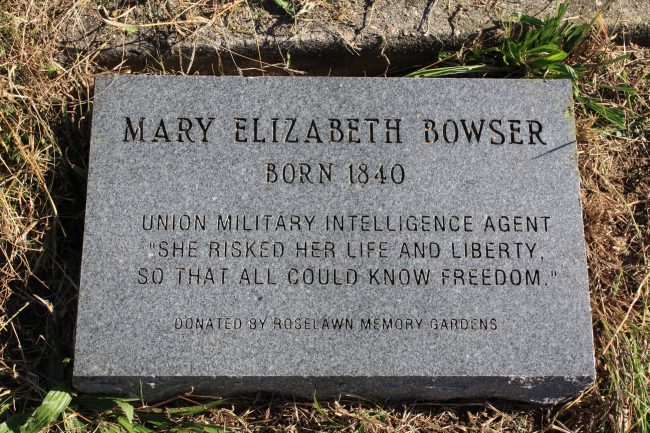
Mary Elizabeth Bowser

Mary Elizabeth Bowser: The Invisible Union Spy
In 1839, (an approximate date), Mary Elizabeth Van Lew was born a slave in Richmond, Virginia.  Her owner was the John Van Lew family.  He was a wealthy hardware merchant.
After his death in 1843 or 1851, (sources differ), Van Lew’s daughter Elizabeth and her mother freed his slaves.  When the women learned of slaves of other owners were offered for sale, they purchased and freed them.
Mary remained with the Van Lew family after she had her freedom and worked as a paid servant.  Elizabeth sent Mary to the Quaker School for Negroes in Philadelphia in the late 1850’s.
Following her graduation, Mary returned to Richmond and married William or Wilson Bowser, a free black man on April 16, 1861, just a few days before the beginning of the Civil War.  Their wedding was unusual because the church where the ceremony was held was mostly white.  They settled just outside Richmond, and Mary continued to work for the Van Lew family.
After the war began, Elizabeth Van Lew asked Mary to help her with an elaborate spying system she carried out in the Confederate Capital.  Elizabeth was a strict abolitionist, and a Union Army supporter.  Because her father was a wealthy and prominent member of Richmond, she was tolerated.  Her views and actions, namely attending to the wounds and feeding Union soldiers at Libby Prison, gained her enmity within the community.  She used it to her advantage.  She managed to appear as a muttering, slovenly, and crazy woman, earning her the nickname “Crazy Bet”.  She acquired information from the captives, and when one would escape, she would hide them in a secret room in the family mansion.  She wrote ciphered messages and hid them in the soles of servant’s shoes or eggshells, and, with the aid of other agents, smuggled them out to the Union Army.

Mary was exceptionally intelligent, and displayed some acting skills.  Hoping to gain access to secret information, she became “Ellen Bond”, a dim-witted, crazy, but very able servant.  Elizabeth had a friend take Mary along to help with functions held by Varina Davis, wife of Confederate President Jefferson Davis.  She proved herself very efficient, and was taken on full-time in the Confederate White House, where she stayed until just before the end of the war.  Of course, they believed she was still a slave.
Racial disrespect assumed that all slaves were illiterate, and lacked intelligence.  And slaves were trained to be “invisible”.  Mary listened carefully to troop and military strategies exchanged between Davis and his Officers.  Serving and cleaning up after meetings gave her access to documents left behind.  In Davis’ study, she memorized dozens of vital documents with the aid of a “photographic memory”.  She never missed a single word.
Mary collected some of the most vital information about the war and passed it on to Elizabeth on some evenings, meeting her at the Van Lew farm just outside Richmond, or gave it to Thomas McNiven, a reputable Richmond baker.  With his business, he was able to pass on information both at the bakery and on his deliveries.  When he arrived at the Davis residence, Mary would greet him briefly at his wagon, keeping their conversation as short as possible.  Just before his death in 1904, he told his daughter Jeanette about the activities.  She passed the information on to her nephew Robert Waitt, Jr., who recorded them in 1952.  Thomas said about Mary:
“…as she was working right in the Davis home and had a photographic mind. Everything she saw on the Rebel president’s desk, she could repeat word for word. Unlike most colored, she could read and write. She made a point of always coming out to my wagon when I made deliveries at the Davis’ home to drop information.”
Towards the end of the war, suspicion fell on Mary.  It is not known how or why.  She fled in 1865, but before she did, she make one last attempt to aid the Union.  She unsuccessfully attempted to burn down the Confederate Capitol.
After the war, the government destroyed all records of the southern spy effort, including those of Mary, Elizabeth, and Thomas, that’s why there are no details to tell.  It is believed that Mary kept a diary of her actions, and that it was accidentally discarded in 1952.  Others say it was intentionally destroyed by her family, fearing retribution by the Confederacy.  And still others claim it is in the possession of a Black family who will not disclose its whereabouts.
There is no record of Mary after her escape from Richmond, or when or where she died.  It is commonly believed she headed north, possibly to Philadelphia.
In 1995, the U.S. government honored Mary Elizabeth Bowser for her efforts by inducting her in the U.S. Army Military Intelligence Corps Hall of Fame in Fort Huachuca, Arizona. During the ceremony, her contribution was described thus:
“Ms. Bowser certainly succeeded in a highly dangerous mission to the great benefit of the Union effort. She was one of the highest placed and most productive espionage agents of the Civil War. … [Her information] greatly enhanced the Union’s conduct of the war. … Jefferson Davis never discovered the leak in his household staff, although he knew the Union somehow kept discovering Confederate plans.”

Why We Must Reject the Dogma of Religious Frauds and Find Our Own Truth

Many of those claiming to be speaking for God have little patience for people who want to figure out for themselves what life is about.


The following is an excerpt from Create Your Own Religion: A How-To Book Without Instructions. Reprinted with permission.

The whole notion of creating one’s own religion goes against the claim made by many religions that they alone possess the Only Truth revealed to them by the deity of their choosing. In their eyes, religion is to be followed by human beings, but is never created by them. Countless people have been burned at the stake for simply urging others to challenge religious dogma and question beliefs. While this injunction is no longer followed literally, Jewish scriptures sanction the murder of anyone inviting us to change religious outlook. The Inquisition, which lasted over 600 years, fills the history of Christianity with plenty of mass killings of people whose only crime was holding unconventional opinions in matters of religion. Still today, in some Muslim countries, any Muslim who decides to abandon Islam faces the death penalty for apostasy.

Why such venom and brutality? Because many of those claiming to be speaking for God have little patience for people who want to figure out for themselves what life is about. What is so terrible about it? Because you should not search for what is wise and good. You should listen to what we tell you is wise and good.

“Create your own religion”

In light of these attitudes, it should become clear why a call to “create your own religion” is by its very nature quite radical. But it doesn’t have to be that way. OK, since you are a most pleasant reader, I’ll share a secret with you. Lean toward me so that I may whisper it in your ear. . . . Everyone already creates their own reli­gion. Some people just don’t lie about it.

Did I say something offensive or shocking? It’s a dirty job, but somebody’s got to do it. At the risk of raising the blood pressure of some modern wannabe inquisitors, let’s look at the ugly truth for what it is. Despite their professed devotion to a text or a teacher or a path, even members of established religions don’t observe literally the dictates of their religion of choice. Many believers claim to be strict followers of their traditions, and some actually believe they are. But the reality is that they all are engaged to some degree in a selective reading of their sacred texts, adopting what suits them and rejecting the rest. It’s a simple process, really. Pick up the sacred books of your religion, look for passages supporting your values, and adapt them a little to your liking. Then highlight their importance in the overall balance of the religion, and conveniently forget all those other unsavory passages that either downright contradict your values or support behaviors and attitudes that don’t fit with your inclinations. Rather than having the guts to admit what they are doing and openly defend their right to pick and choose the passages they want to live their lives by, most people prefer hiding under the fable that their particular take on religion is the only correct one. All other people who put the accent on different messages and values contained in the same scriptures, they claim, are heretics who are twisting the essence of the religion. If this strikes you as intellectually dishonest, it’s because it is.

Philosophy of Religion


Hey Amer, are you really accusing billions of orthodox believers worldwide of being consummate liars? Not necessarily. Some don’t lie consciously. They just happen to be masters at self-delusion, so skilled at lying to themselves that they can do it without ever becom­ing aware of it. Why would they do this? you may ask. Because it would be too scary to take responsibility for choosing which values, among so many, to live by. It’s much more reassuring to go on pre­tending that one’s values are the only true eternal ones that enjoy God’s stamp of approval.

Other believers, on the other hand, don’t lie at all—not even subconsciously. What shields them from facing the contradictions that exist in every religious tradition, including their own, is plain old ignorance. As is the case with many faithful followers, their ac-tual knowledge just doesn’t match their religious passion. Great num­bers of Christians have never read the Bible cover to cover. Many Muslims only know the Koran through the passages their preach­ers decide to share with them. The same goes for the adherents of most religions. In the absence of direct knowledge, most people end up espousing some simplistic fairy tale version of what they believe their religion is about, never bothering to find out that reality is quite a bit more complicated. They are too lazy and unwilling to deal with complexity to want to dig a little deeper. It is easy to avoid facing contradictions if you don’t know about them. And the deal­ers of second-hand religious fairy tales are very careful to feed their audience only coherent, simple stories that will not require them to ask questions and think for themselves. Still mad about the day when they were told that there is no Santa, masses of people swallow up these stories and gladly ask for more.

Even if ignorance were not so widespread, things would not be much simpler. If you care to lean toward me again, I’ll share with you one more secret: most sacred books revered by various religions are filled with internal contradictions. Since the contradictory char­acter of most scriptures leads believers to pick and choose which passages to follow and which to ignore, it should come as no surprise that the very same sacred books have been used to support drasti-cally opposite ideas. During the American Civil War, Abraham Lin­coln noted that, “Both [Southern and Northern soldiers] read the same Bible, and pray to the same God; and each invokes his aid against the other.”6 It was in this same time period, after all, that Christians used the Bible to argue for the abolition of slavery while just as many Christians found in the Bible the ideological ammuni­tion to support slavery as a divinely ordained institution.

Other time periods tell the same tale. Early Christians were as divided then as modern Christians are today. For example, Saint Paul advocated celibacy and held a very negative view of any type of physical pleasure, whereas second century CE Christian teacher Carpocrates stirred his followers toward juicy sexual orgies. Martin Luther King Jr. was a Christian and so were the members of the Ku Klux Klan. Protestants and Catholics have slaughtered each other for a couple of hundred years all in the name of Jesus. Even today, you can find Christians who are gay and Christians who consider homosexuality to be the most horrid of sins; Christian feminists and Christians who abhor feminism; anticapitalist Christians who view the accumulation of wealth as a sin, and Christians who believe wealth to be a sign of divine blessing; Christians who are very liberal, and Christians who are very conservative. Naturally, they all believe God supports their point of view.

This same story could be repeated about pretty much any other religion. Each denomination is usually firmly convinced that it is the only one that is faithful to the original message of its tradition and accuse all others of having strayed away. The simple fact that every religion always gives rise to multiple variations (Christianity, for ex­ample, has over 30,000 different denominations) is enough to tell us that Truth with a capital t is not exactly self-evident.

The myth of “three Abrahamic faiths”


Trying to figure out who is right is a hopeless undertaking. We are too far removed from the origins of most religions to establish with any degree of certainty what the founders really meant. Most established religions, in fact, are based on shaky sources. Divine rev­elations seem to indulge in the very annoying habit of popping up in semiliterate corners of the world at a point in human history long before accurate, modern means of recording information were invented. What results, then, is an endless chain of revelations be­ing told and retold over decades until somebody finally writes them down. Clearly, this is a process that leaves much room for error.

Did you ever play the game “Telephone” as a kid? Yeah, the game in which you whisper something in someone’s ear who then whispers it in somebody else’s ear, and so on down the line until the last person says out loud what he heard and everyone laughs because it usually has nothing to do with the original message. Imagine do­ing this for a few decades with a few thousand individuals before writing the results down. Then, let a few more decades/centuries go by before a council of “authorities” gets to vote on which versions are accurate and which ones need to be destroyed. As weird as it may sound, this is exactly how the modern versions of most sacred texts were produced. No wonder these texts are littered with contra­dictions. And it is on the authority of these very dubious, very old documents that followers then fight among themselves regarding the essence of the original message.

Far from being an obstacle, this confusion is a gift that most members of organized religions actually cherish. The fact that their prophets are long dead and little information is known about them makes it easier for followers to project their own ideas, values, and expectations onto their favorite authority figure—something that many believe gives more legitimacy to an ideology. This allows peo­ple to create their own religion within a respected, established tradi­tion while keeping the appearance of following the “official” version.

In the midst of these endless arguments, the founders’ original intention is clouded beyond recognition. Organized religions end up killing the insights of the prophets/gods they supposedly revere. Like demented kids hugging a puppy too tight and crushing him to death out of “love,” followers destroy their founders’ teachings with blind devotion. The freshness, beauty, and vital energy of the original message dies a miserable death when the message is turned into dogma. And what followers are left to worship is the dried-up, mummified corpse of what was maybe once a wonderful idea.

Religious Dogma


What this book invites you to do is to take responsibility for your ideas and, without slavish devotion to dogma, create your own religion. Rather than groping the past to find justification for your values in centuries-old texts, and using revered corpses as a source of authority, it is time to grow the heart and guts to follow your own insights and defend them on their own worth. Don’t believe something because Buddha said it, or Jesus said it, or Muhammad said it. Don’t believe it because I say it. (OK, don’t listen to this last sentence. I just threw it in there to look democratic. Of course if I say it, you should blindly believe it.) Better yet, don’t believe any­thing at all that is not born out of your own experience. Belief is the habit of those too lazy or too scared to trust in themselves. Let’s try a more courageous path: find out for yourself. If we want to stop wiping each other out over religious dogma, this is the healthiest step we can take.

If rejecting dogma and nourishing the courage and creativity required to make our own choices is a good idea in all times and places, it is a talent that is becoming even more essential in today’s world. This, after all, is the age of globalization, choice, and syncre­tism. More people on earth have access to more information now than at any other point in human history. We know more about each other than ever before; ideas circle the globe at a speed our ancestors never even imagined. The most learned intellectual from just a couple of centuries ago had access to far less information than anyone alive today who happens to have Internet access. Being ex­posed to different stimuli and ideas coming to us from every corner of the world means we have more material to play with. It is only natural then that greater numbers of people are mixing the ingredi­ents, making new connections, and revolutionizing traditions.

This explosion in creativity can be seen everywhere. For exam­ple, just about any song born today comes from the union of musi­cal traditions that just a few decades ago had never been introduced to each other. “Fusion” seems to be the operative word at the root of everything, from the types of food we eat to the movies we watch—even the diverse ethnic makeup of many people alive here and now.

With every facet of human culture being touched by this rapid exchange of information, it only makes sense that religion would be affected as well. In the days before our globalized, interconnected world, people practiced whatever religion happened to be the domi­nant one in the country of their birth. Thankfully, the stupidity of the belief that by random luck one is born in the one true religious tradition, while the rest of the world needs to be shown the light, is beginning to become progressively more evident. In the face of increased knowledge and choices, traditional forms of authority are collapsing. Rigid identities—be they national, ideological, or reli­gious—are becoming more obsolete. Prepackaged answers satisfy fewer and fewer people. Solutions and ideas that appeal to a particu­lar place and time reveal themselves to be painfully narrow-minded in a global world. Many of the answers people still turn to were born in a world where one couldn’t see beyond the confines of one’s village—where what existed in the next valley was foreign, exciting, and mysterious. But this will no longer do. Nostalgically holding on to the past is not going to help us face a reality that’s changing at breakneck pace.

Damn, it’s an exciting time to be alive. We are just a few steps away from self-destruction, but we are also a few steps away from creating a better world that could exceed the imagination of the most optimistic prophets from our past. We are dancing on a tight­rope stretched on the abyss, the destiny of the world in our hands. The weapons we take into battle are heart, vision, and creativity. What we need are new solutions that reflect the greater degree of knowledge and the radically different experiences that characterize the modern world.

The availability of a much wider range of choices is transform­ing the face of religion today. Many individuals belonging to sev­eral mainstream religions have responded by dramatically reshaping some of their core beliefs. Increasing numbers of people are opening new paths outside of the confines of mainstream religions altogether. Most traditional religions, in fact, change only under duress; other­wise, they resist change and any challenge to their authority with tooth and nail.

The most conservative, fundamentalist branches see the global world as a threat. To them, more choices mean more opportunity to fall in error and stray from the One True Way. In their worldview, choice is the Devil’s tool to lead us away from the truth. Confronted with a world offering greater chances for choosing one’s own way, their answer is to dig deeper trenches and become even more radi­cally rigid. The more freedoms human history offers us, the more fundamentalists will fight them. Despite their mutual hatred for one another, Jerry Falwell and the Taliban are twins separated at birth—modernity makes both of them recoil in horror.

I see the global world as the greatest opportunity humanity has ever had. In my view, it is healthy for traditions to be challenged. If traditional values lose popularity, it’s either because they are poorly communicated or because they are not relevant anymore. No healthy solution was ever born from whining about the good old days. As Nietzsche puts it, “[The sage] does not acknowledge custom or tradi­tion, but only new questions from life and new answers.”7 While it is not necessarily true that newer is always better, it is certainly true that any theory, religion, or philosophy that was born in the midst of intellectual poverty can only be improved upon today. Whatever was good in it will endure, and whatever fails will do so because it belongs to a darker, more ignorant world.

What we will do here then is take aim at all the central questions debated by different religions in order to see what gifts of wisdom the past has to offer us, and how we can use that to come up with our own answers.