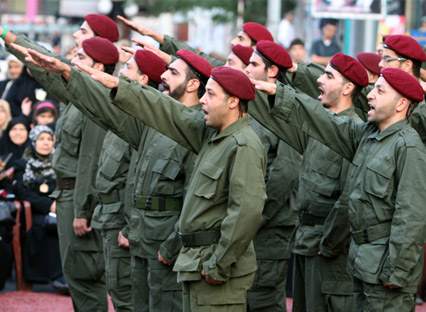
Founded in Egypt in 1928, the Muslim Brotherhood has been an immensely powerful force in Middle East politics, now boasting chapters in 80 countries. Its mission statement: "Allah is our objective; the Quran is our constitution, the Prophet is our leader; Jihad is our way; and death for the sake of Allah is the highest of our aspirations." The Brotherhood's founder, Hassan al-Banna, stated that the group's goal was to assert Islam's manifest destiny and create an empire governed by Islamic religious law and unified in an autocratic caliphate. He claimed "It is in the nature of Islam to dominate, not to be dominated, to impose its law on all nations and to extend its power to the entire planet. The brotherhood objective was, to depend and follow the Islamic rules and regulations and maintain the Islamic and Egyptian identity. The movement began as an association for Islamic reform, aiming to serve workers who had emigrated from the countryside to cities in the Suez region, then under British rule. It soon spread to Cairo (in 1932-1934) and, in its second decade, already had an estimated 500 branches and half a million members. The movement was able to rise above similar organizations common in Egypt at the time and become highly popular thanks to Hassan al-Banna’s charisma and his ability to combine a religious message addressing the masses, preaching for a return to pure, original Islam.
With the end of World War II and the defeat of Hitler, Egypt's brotherhood hoped that Europe's Jews would be content to re-establish their lives in Europe. The Brotherhood was disappointed. And they were annoyed by Egypt's Jews helping to smuggle arms to Jews in Palestine. They asked their government to restrict the activities of Jews in Egypt. They complained about Jewish influence with Egyptian newspapers and magazines. They called for a boycott of Jewish products and anything promoting Zionism, and they claimed that no difference existed between Judaism and Zionism. In December 1948, the Muslim Brotherhood assassinated Egyptian Prime Minister Mahmoud al-Nuqrashi Pasha. It also sought to kill Egyptian leader Abdul Nasser in October 1954.
"Up to 1967 the Muslim Brotherhood was one among many political movements organizing and agitating for change in Muslim, particularly Arab, conditions under the banner of anti Zionism and, but less fervently, anti imperialism anti Americanism. It was often at odds with the then prevalent nationalist/socialist public mood and popular devotional cause and at war with its major proponents Nasser of Egypt and the Baath party in Syria and Iraq. But it was a relatively minor force suspected for it Anglo and American ties and its warm relation with conservative, pro USA, Arab regimes. Then it had a quite limited public appeal dwarfed and overshadowed by the then prevalent nationalist/socialist appeal of Nasserism and Baathism. The outcome of the 1967 wat with Israel, led to abject defeat of the two Arab states that waged, Egypt and Syria and the collapse of the Nasserist/Baathist, nationalist/socialist, appeal it embodied and the spectacular rise, their actual sup plantation,by the Islamist movement fronted by the Muslim Brotherhood. Thence Palestine, the conflict with Israel, became the predominant issue. The Muslim Brotherhood, who came out of the 1967 Arab collapse unscarred, was not late on banking on Arab total disillusionment with Nasser and the Baath and on raising the banner of Islam as the only mean to contain Israel. Thence it became the major, in many way, the sole political movement primarily dedicated to resisting Israel and to opposing its lifeline provider, the USA and With anti Israel/anti Zionism and opposition to the USA as major tenants of its political platform, and as the major unifying factor of it diverse organizations, it achieved unparalled public support throughout the Arab world. The Muslim Brotherhood's present anti Israel vigorours advocacy, more than its anti Americanism ( the Iraqi branch of the Muslim Brotherhood did not oppose the USA conquest of Iraq, to the horror and condemnation of other branches) seem to have caused its present estrangement with the USA.
Friday, September 13, 2013
Thursday, September 12, 2013
Muslim Nazi Connections
Record of the Conversation between the Fuhrer and the Grand Mufti of Jerusalem on November 28, 1941, in the Presence of Reich Foreign Minister and Minister Grobba in Berlin. The Grand Mufti began by thanking the Fuhrer for the great honor he had bestowed by receiving him. He wished to seize the opportunity to convey to the Fuhrer of the Greater German Reich, admired by the entire Arab world, his thanks of the sympathy which he had always shown for the Arab and especially the Palestinian cause, and to which he had given clear expression in his public speeches. The Arab countries were firmly convinced that Germany would win the war and that the Arab cause would then prosper. The Arabs were Germany's natural friends because they had the same enemies as had Germany, namely the English, the Jews, and the Communists. Therefore they were prepared to cooperate with Germany with all their hearts and stood ready to participate in the war, not only negatively by the commission of acts of sabotage and the instigation of revolutions, but also positively by the formation of an Arab Legion. The Arabs could be more useful to Germany as allies than might be apparent at first glance, both for geographical reasons and because of the suffering inflicted upon them by the English and the Jews. Furthermore, they had had close relations with all Moslem nations, of which they could make use in behalf of the common cause. The Arab Legion would be quite easy to raise. An appeal by the Mufti to the Arab countries and the prisoners of Arab, Algerian, Tunisian, and Moroccan nationality in Germany would produce a great number of volunteers eager to fight. Of Germany's victory the Arab world was firmly convinced, not only because the Reich possessed a large army, brave soldiers, and military leaders of genius, but also because the Almighty could never award the victory to an unjust cause. Al-Husseini used his office as a powerful bully pulpit from which to preach anti-Jewish, anti-Zionist, and (turning on his patrons) anti-British vitriol. He was directly involved in the organization of the 1929 riots which destroyed the 3,000-year-old Jewish community of Hebron. And he was quick to see that he had a natural ally in Hitler. As early as spring 1933, he assured the German consul in Jerusalem that "the Muslims inside and outside Palestine welcome the new regime of Germany and hope for the extension of the fascist, anti-democratic governmental system to other countries." On November 28, 1941 the former Mufti was officially received by Hitler, who agreed to establish a bureau for al-Husseini which was used to spread propaganda on behalf of Nazi Germany, organize spy rings in Europe and the Middle East, and, most importantly, establish Muslim Nazi SS divisions and Wehrmacht units in Bosnia, the Balkans, North Africa and Nazi-occupied parts of the Soviet Union. After the meeting, the Mufti was also named SS gruppenfuehrer by Heinrich Himmler and referred to as the “Fuhrer of the Arab World” by Hitler himself. He then spent the rest of World War II as Hitler’s special guest in Berlin, advocating the extermination of Jews in radio broadcasts back to the Middle East and recruiting Balkan Muslims for infamous SS “mountain divisions” that tried to wipe out Jewish communities throughout the region. At the Nuremberg Trials, Eichmann’s deputy Dieter Wisliceny (subsequently executed as a war criminal) testified. The Mufti was one of the initiators of the systematic extermination of European Jewry and had been a collaborator and adviser of Eichmann and Himmler in the execution of this plan. He was one of Eichmann’s best friends and had constantly incited him to accelerate the extermination measures. Accompanied by Eichmann, he had visited incognito the gas chamber of Auschwitz.“After the war, Husseini fled to Switzerland and from there escaped via France to Cairo, were he was warmly received. The Mufti used funds received earlier from the Hilter regime to finance the Nazi-inspired Arab Liberation Arm.”
Israel Has "right to defend itself"
This is not a new war, just a new phase of a very old war. Although Islam started off as peacefully, it became very violent when Jews, Christians & Mohammad's own tribe refused to believe that Mohammad was a prophet. For what holy prophet comes with a bloody sword? Muhammad set the example for antisemitism. The oldest extant biography of Muhammad, by Ibn Ishaq is replete with the Prophet's evident hatred of Jews. Most people don't realize that Mecca and Yathrib (Medina) were Jewish and Christian enclaves. Mohammad had individual Jews assassinated if he felt they had somehow insulted or disobeyed him. When Muhammad gave the command "Kill any Jew that falls into your power," an increasing number of attacks were made upon members of the three large Jewish tribes that dominated the area. The Sirah, written in the 7th Century, records that "Our attack upon God's enemy cast terror among the Jews, and there was no Jew in Medina who did not fear for his life." In 627 AD, Mohammad personally oversaw the extermination of the Jewish tribe Banu Qurayza, He built a trench and then cut off the heads of 600-800 Jewish Tribesmen, and then he and his men raped the women and children and sold them off as slaves. Mohammad then used the land and wealth from the Jewish tribe to fund more to attacks on Jewish and Christian tribes in Mecca and Medina. Just like the technique used by the Nazi's in WW2 to fund their war with the wealth from the Jews that they killed. Nothing has really changed since then. We have been dealing with Muslim factionalism for 1400 years now. Islam is not the Religion of Peace. It is a cult of Death and Terror. Islam's two gods, Allah and Mohammad are the embodiment of the deepest and darkest evil in this world. The Jews have never been immediately welcome anywhere, throughout their entire history. Has it been due to religious persecution during the crusades and even modern Islamic writings? That most likely had a large contribution. But regardless, the Jews did not move into an area that was inhabited only by Arabs. There were Jews living in that area, completely at peace with their Arab neighbors. In fact, anyone using the term "Palestinian" was more likely referring to a Jew rather than an Arab before 1940. The Jews moved largely into completely desolate areas that Arabs sometimes moved through as nomads. The several existing population centers of Tel Aviv, Jerusalem, and other were small and could not easily support growth without Jewish innovation of course. The Jews irrigated the land, and turned desert sands into parks and paved cities. Dry, merciless land was adapted by hard working European immigrants in the late 1900s and early 20th century into a habitable area amid the desert. The Arabs could have lived in peace, and taken the 50% of the land that Britain awarded them in the area when the Mandate of Palestine was dissolved, but instead were jealous of the newly habitable areas the Jews developed and claimed that land was theirs, causing the Palestinian refugee debate. The Arabs there were no different in culture from their neighbors, and would have had no difficulty assimilating, unlike the Jews in ewery area they tried to move to. They would not have wanted the old arid desert that "was their land for generations" if it weren't for the revamping by the Jews. This dissent and in my opinion, general antisemitism in the world, has allowed the Palestinian cause stick for so long when there are great atrocities going on in the world, Africa and Asia namely. They elected a terrorist organization as their leadership they hide in schools and religious buildings because they know that international law protects civilian targets how can you support such a people.Jews may protect their faith till death but they will not blow up their own children to do so, those people are simply sick in the head, either because of how they were raised or something more innate. Israel is America's frontier in the middle east. The only truly sane ally (defining sane as having extremely liberal rights, and pursuing on every front a better earth through green-tech, bio-tech, and humane-related causes) in the region is constantly being tested militarily and thus serves as the perfect test ground for USA made weapons. Similarly, if one of those nations were to go berserk with a powerful attack on civilian areas in other nations (Iran : Nuke) then Israel would be America's closest safe place to launch a defensive attack, making its security in some ways more important than security of areas in non-volatile regions, such as North America.
Wednesday, September 11, 2013
Remember 9/11
American Muslim Political Action Committee (AMPAC), Muslim March planned for Sept. 11. “They could’ve picked any other day of the year. There’s 364 other days of the year they could’ve picked, but the fact they chose 9/11 just simply apppears to be a slap in the face to America and an insult to every American who died in attacks on those days in 2001 and 2012. Miserable Muslims weren't satisfied with just the attack on 9.11, now they want to rub salt into the wounds of Americans. Knowing what happened to our country on 9.11 and then they pick this day to march is only about one thing and one thing only. They are letting us know they are here. Muslims are burning Christian Churches and killing Christians in Muslim countries and American Muslims are silent! A U.S. Army, radical Muslim physician, guns down innocent American soldiers! American Muslim perform honor killings according to Sharia law in the U.S.A.! Muslims are targeting and killing Americans over seas. American Muslims want Sharia Law imposed in this country! Muslims make no secret of their hatred for Jews and Christian. Why would non-Muslim Americans not be afraid? On a day when just about everyone knew were and what they were doing on 9.11 2001 it hit the American people very hard, for it made us look vulnerable to the Muslim radicals, even some Muslims in American were dancing in the streets with joy as three thousand American lade dead, first we felt fear then we felt anger. I remember George Bush standing with fire fighters with a bullhorn on top of a fire truck demolish by the World Trade Center, letting the World know we will come after those who did this. Today i know again i will feel proud again come 9.11. 2013 when two million bikers will stand tall and show the world what real America is all about in D.C. Not what Obama is trying to do to America by weakening the will and strength and bring this nation to it's knees. As bad as some people thought George Bush was, at least he stood with the American people when we needed a president to lead. We simply could not tolerate 9/11 being hijacked like that. It seems like a lot of people like to hijack things in this country, like Obama tries to hijack the word patriot for his progressives.” The fact of the matter is 9/11 is the day, across America, people remember planes smashing into the World Trade Center, a planes smashing into the Pentagon, and men and women willing to give their lives in another plane, whose last words were ‘Let’s Roll’ before crashing into a field in Pennsylvania.” Remember 9/11 and thousands who's live were lost by Islamic decree. Every man women and child that died there, so yes i am against the Muslim march on Washington on 9/11/13 as every American should be.
A Bible Fight Over 'Allah' Malaysia
The Semitic family of languages consists of Aramaic, the language Jesus spoke, Arabic (the most widely-spoken Semitic language with over 400 million speakers), Am'haric (language of Ethiopia with 20 million speakers), Tigrinya (spoked by the Tigre people of Eritrea and eastern Sudan) and Hebrew (9 million speakers). The Quran states that Israel is home of Judaism and their God is the same as Islams. The same! The Christian God is the same as Judaism and the same as that of Islam. There is no argument. This is a problem in Islam today. They have become so competitive, even against other Muslim sects. They divide people. Make claims on things that do no belong to them only. If they do believe in one God, there should be no such problems. Yet there is this constant us vs them going on. Enemies made where none exist. Fighting over pettiness. Why don't clerics clear this up instead of making it worse. Islam will never know peace. Jibral, Gabriel? Adam, Abraham, Isaac, Ishmael? Allah was used in Mecca long before Mohammed was even born and loner than before the Quran written. It means whatever we mean by God. The Supreme. Even pagans used the name Allah to mean the Supreme one which in the old days, they thought was the Moon. As we learn more about the Universe and after Mohammed, it was discovered the Moon was not the Supreme. The Universe is so much bigger than humans first thought. And its bigger than we think now today. Allah was just an Arabic word for Supreme God, who we still do not know much about. Allaht. Non-Muslims are barred from using up to 35 other Arabic terms, besides "Allah", in every state except for Penang, Sabah, Sarawak, and the Federal Territory. Malacca has reportedly banned the most number of Arabic words and phrases compared to the other states. In Selangor, the Non-Islamic Religion Enactment 1988 (Control of Propagations Among Muslims) listed 25 words that cannot be uttered by non-Muslims either orally or in writing, including "Allah", "firman Allah" (God’s decree), "solat" (daily prayers), "Rasul", "mubaligh" (missionary), "mufti" (cleric), "iman" (faith), "Kaabah", "Qiblat" (the direction in which Muslims pray), and "Haji". Non-Muslims are also banned in Selangor from using 10 other phrases such as "subhan-Allah" (Glory be to God), "insha-Allah" (God-willing), "astaghfirullah" (forgive me God), "masha-Allah" (God has willed it) and "Allahu Akbar" (God is great). This word is not something special to Muslims only. It is just a name. It isn't the thing. The supreme thing is not something to own or fight about! As human awareness expanded over time religion was invented to help orientate ourselves to a Universe 14 billion years old and truly vast in scale. Hopefully as religion evolves it will return to its most useful function, that being the promotion of love in the form of the "Golden Rule." Though Christianity has largely reached that point in the West, it looks like Islam will take a bit more time. Does the rest of the world have the time and patience to wait for them to catch up? To me Islam seem's to be stuck in a reverse gear.THE BLACK SLAVE OWNERS
The majority of black slave owners were members of the mulatto class, and in some cases were the sons and daughters of white slave masters. Many of the mulatto slave owners separated themselves from the masses of black people and attempted to establish a caste system based on color, wealth, and free status. According to Martin Delany, the colored community of Charleston City clung to the assumptions of the superiority of white blood and brown skin complexion.
These mulattoes of the old free Black elite did not attend church with the dark-skinned blacks of Charleston City. They not only formed congregations which excluded freedmen of dark complexion, but they only married among other mulattoes to “keep the color in the family.”
Large numbers of free Blacks owned black slaves in numbers disproportionate to their representation in society. According to the federal census of 1830, free blacks owned more than 10,000 slaves in Louisiana, Maryland, South Carolina, and Virginia. The majority of black slave-owners lived in Louisiana and planted sugar cane.
Slave holding among the mulatto class in South Carolina was widespread according to the first census of 1790, which revealed that 36 out of 102, or 35.2 percent of the free Black heads of family held slaves in Charleston City. By 1800 one out of every three free black recorded owning slave property. Between 1820 and 1840 the percentage of slaveholding heads of family ranged from 72.1 to 77.7 percent, however, by 1850 the percentage felt to 42.3 percent.
According to the U.S. Census report in 1860 only a small minority of whites owned slaves. Out of a population of 27 million whites only eight million lived in the South, and out of this population fewer than 385,000 owned slaves. In short, the total white population own about 1.4, while the southern white population own about 4.8 enslaved Africans.
On the other hand the black population in 1860 was 4.5 million, with about 500,000 living in the South. Of the blacks residing in the South, 261,988 were not slaves. Of this number, 10,689 lived in New Orleans. In New Orleans over 3,000 free blacks owned slaves, about 28 percent of the free Black population in the city.
Year
|
Owners
|
Slaves
|
1790
|
49
|
277
|
1800
|
36
|
315
|
1810
|
17
|
143
|
1820
|
206
|
1,030
|
1830
|
407
|
2,195
|
1840
|
402
|
2,001
|
1850
|
266
|
1,087
|
1860
|
137
|
544
|
The following chart shows the free Black slave owners and their slaves in Charleston, 1790-1860.In 1860 there were at least six African Americans in Louisiana who owned 65 or more slaves. The largest number, 152 slaves, were owned by the widow C. Richards and her son P.C. Richards, who owned a large sugar cane plantation. Another Black slave magnate in Louisiana with over 100 slaves was Antoine Dubuclet, a sugar planter whose estate was valued at $264, 000. In North Carolina 69 free Blacks were slave owners.
The majority of urban black slave owners were women. In 1820, free black women represented 68 percent of heads of households in the North and 70 percent of slaveholding heads of colored households in the South. The large percentage of black women slave owners is explained by manumission by their white fathers, or inheritance from their white fathers or husbands. Black women were the majority of slaves emancipated by white slave owning men with whom they had sexual relations. Thirty-three percent of all the recorded colonial manumissions were mulatto children and 75 percent of all adult manumissions were females.
THE FIRST BLACK SLAVE OWNER--AND THE ORIGINS OF SLAVERY
Euro-Americans arrived in Jamestown Virginia in 1607, and the first large group of Africans arrived in 1619. However, House of Burgess records show that Africans were already in the colony before 1619. John Rolfe provides us with an eyewitness account of this first group. “About the last of August [1619] came a Dutch man of Warre that sold us twenty negars.” Among them was one called Antonio from Angola. Later, we find that Antonio becomes Anthony Johnson. Other listed was Angelo, a negro woman,” and John Pedro, a neger aged 30.” The census of 1624-25 showed that there were twenty-three Africans living in Jamestown, Virginia listed as servants and not slaves.
Africans coming to Jamestown between 1630 and 1640 could expect to be freed after serving their indented period of time about seven to ten years for Africans and Indians. At this time there was no system of perpetual servitude or slave for life, but the system was rapidly evolving. Between 1640 and 1660 slavery was becoming a customary reality. In 1640 three servants of Hugh Gwyn, “a Dutchman called Victor, a Scotchman named James Gregory, and John Punch, a negro,” having run away from their master were overtaken in Maryland and brought back to stand trial for the misbehavior. The verdict of the court would change the system of indentured servitude and set the system in transition to plantation slavery. The court ruled that the three servants shall received punishment by whipping and have “thirty stripes apiece.” The court ordered that the Dutchman and the Scotchman should “first serve out their times with their master according to their Indentures and one whole year apiece after the time of their service is expired” and that they shall served the colony for three years. “The third being a negro. . .shall serve his said master or his assigns for the time of his natural life.” This marks the first time that race and color becomes a factor in the status of both black and white indentured servants. In other words, the system is rapidly evolving to meet the new demand for cheap labor, and race is slowing being used as the justification for the enslavement of peoples of African origins. Between 1640 and 1660 Africans were going to court and suing for their freedom.
In 1644 Thomas Bushrod, assignee of Colonel William Smith, sold a mulatto boy named Manuel “as a slave for-Ever, but in September, 1644 the said servant was by the Assembly adjudged no Slave and but to as other Christian servants do and was freed in September, 1665." A similar ruling is found in the case Robinson.
In 1649, there were about three hundred Africans in the colony and an increasing mulatto population. African and European indentured servants off springs were increasing and considered alarming in regard to the status of the mulatto. That is a system was evolving based on being either black or white.
Africans who entered Jamestown between 1620 to 1650 could expect to be freed after serving their indented time and given 50 to 250 acres of land, hogs, cows and seeds and the right to import both white and black indentured servants. For a brief period in American history between 1630 to 1670, a number of Africans had become freedmen and owned indented white servants. The act of 1670 forbidden free Negroes to own Christian servants but conceded the right to own servants of their own race. By 1670, it was becoming customary to hold African servants as “slaves for life,” and by 1681 what was customary became law.
The first laws regarding the status of Africans recognized the free blacks. The first status was passed in 1662 provided that the status of offspring should follow that status of the mother. What this law did was to allow white fathers to enslave their own children, and free women of color to perpetuate the free black population. In other words, it also guaranteed freed black females the right to extend their free status to their children. Black women who have served their indentured period would not provide foundation for the free black community. Many of those African who were grandfathered in the new system not only became the free black community, but this is the origins of Black slave owners.
The act of 1668 dealing with the condition of the colored population related solely to the tax obligations of a free black woman, and two years later an act guaranteed to “negroes manumitted or otherwise free” the right to own servants of their own race and expressly denied to them the right to purchase or to own white or “Christian servants.” This law recognized and sanctioned slavery, but also guaranteed the continuity of the free black class, who were now largely mulatto.
ANTHONY JOHNSON
Black slave owners have not been studied as a part of American history, rather as a datum to American history, and yet slavery as a perpetual institution is legalized based on a case brought before the House of Burgess by an African, who had been indentured in Jamestown, Virginia 1621 and was known as Antonio the Negro according to the earliest records. He later Anglicized his name to Anthony. Anthony Johnson was believed to be the first Black to set foot on Virginia soil. He was the first black indentured servant, the first free black, and the first to establish the first black community, first black landowner, first black slave owner, and the first person based on his court case to establish slavery legally in North America. One could argue that he was the founder of slavery in Virginia.
Anthony Johnson arrived in Jamestown, Virginia in 1621. In 1623, Antoney[sic] and Isabella married. The next year they were the proud parents of William. William is believed to be the first African American born in British America. During his first years in North America, he escaped death in an Indian attack on Jamestown. During the following year Africans and people of color were a small minority in the Virginia colony. The census of 1625 reported only twenty-three Africans living in the colony out of a total of 1,275 white people and indigenous Africans. By 1649 the total black population was only 300 out of a total of 18,500 whites.
In 1635 Johnson’s master, Nathaniel Littleton finally released him. As the custom was he received a 250 acre plantation in 1651 under the “head right system” by which the colonial government encouraged population growth by awarding fifty acres of land for every new servant a settler brought to Virginia. He became the master of both black and white servants.
Anthony Johnson's plantation was located on the neck of land between two creeks that flowed into the Pungoteague River in Northampton County. A few years later, his relatives, John and Richard Johnson, also acquired land in this area. John brought eleven servants to the colony and received 550 acres, and Richard brought two and received 100 acres.
In 1654 Anthony Johnson went to court and sued his white neighbor for keeping his black servant John Casor. Casor claimed that Johnson “had kept him his serv [an] t seven years longer than hee should or ought. Johnson who the courts described as an “old Negro,” claimed that he was entitled to “ye Negro [Casor] for his life.” Johnson realized that if he continued and persisted in his suit, Casor could win damages against him. So, Johnson brought suit against his white neighbor Robert Parker, whom Johnson charged had detained Casor “under pretense [that] the s[ai]d John Casor is a freeman.” The courts now ruled in his favor and John Casor was returned to him and Parker had to pay the court costs.
This case establishes perpetual servitude in North America, and it is ironic that the case was brought to the court by an African who had arrived from Angola in 1621. Slavery was established in 1654 when Anthony Johnson, Northampton County, convinced the court that he was entitled to the lifetime service of John Casor; this was the first judicial approval of life servitude, except as punishment for a crime.
Anthony Johnson lived on his plantation surrounded by his white neighbors. He had entered a system not based on slavery, but indentured servitude. There were many Anthony Johnson's in America, who never spent a day in slavery but were owners of slaves.
MARIE THERESE METOYER
In 1767, a Frenchman named Claude Thomas Pierre Metoyer met Marie Therese Coin-Coin from the Kongo and promptly fell in love. They became immediate occupants in Natchitoches, Louisiana where Marie and Claude lived together as man and wife. They had their first children together in January 1768, a set of twins. Things were rough going for the couple; the church would not have anything to do with the relationship and at this time Marie and her infant son Augustine were still enslaved. Early in 1776 Metoyer purchased his child and shortly after that in a private document he freed Marie and the child. Years later Marie and Metoyer broke up but, not before fathering six children. Marie stayed in Natchitoches and worked the Melrose plantation Claude Metoyer left for her; he then moved to New Orleans, left for France and married a proper French woman.
In 1778 free nonwhites were a very small minority in Natchitoches, Louisiana. By 1785, that had not changed. Marie, Augustine, and two additional sons born to her after manumission were half of the free nonwhite population. By 1786, she had eight children Augustine, Pierre, Joseph, Dominique, Francois, Toussaint, Louis, Marie Suzanne, four of whom were still enslaved.
From the money and land that Metoyer gave her, she started a plantation. The first crop was tobacco, and in 1792 she was shipping 9,900 rolls to Cuba for cigars (Mills, 30). She also produced indigo, manufactured medicine and the major source of her income came from hunting bears and fowl. All this was done with the help of her older sons, because she had no slaves at this time. She tried for nine years to free her other children from slavery and in 1815 when Metoyer died all her children were freed. In 1816 written Church documents show that she had twelve slaves, but local tradition credits her with many more. Marie Theresa now had three plots of land estimated at 11,000 acres. She was now in her late sixties and completely turned over the plantation to her children. She died sometime in the spring of 1816.
Augustine was now married and on his own since 1795. He was the first of Marie and Claude's children to acquire a plantation, and become a slave owner. Within two years he purchased his first slave, a male between the age of eighteen and twenty to help him clear the fields. Most of the slaves he bought were for labor, but he did purchase some for family devotion. In 1798, he bought his second slave, an eight-year-old named Marguerite who was his wife's sister. In 1800, $300 was paid for his third slave; this was a child of his still enslaved brother. The next year a slave named Marie was purchased and became Pierre’s wife. His second labor slave was purchased in 1806, a female to be the wife of the male he already owned. In June of 1809, Augustine purchased eight “African Negroes” for $3,500 cash: a male, five boys and two girls aged eleven to thirteen, and then three of the males were sold to his brother for $1,350. In 1810, he purchased two more slaves from a planter in the next county. Similar purchases and manumissions are recorded for of the Metoyer children. In 1810, Marie Suzanne purchased a slave costing $600; the peculiar thing was that she was still a slave herself. By the 1810 census Augustine had seventeen slaves; Louise, fifteen; Pierre, twelve; Dominique, eight; Francois, three; Joseph, two; and Toussaint, one. A total of fifty-eight slaves were acquired in just twelve years. The fifty-eight slaves had increased to 287 by the end of 1830. The Metoyer surname owned an average of 2.3 slaves per person, and the whites in the county only owned an average of .9 slaves per person. No other family group came close to matching the holdings of the Metoyer name.
The affluent period was between 1830 and 1840 for the Metoyer family. Pierre, one of the less prosperous brothers died in 1834 leaving a plantation of 677 acres, after giving his seven children land for their marriages. Augustine divided the land between six children and kept two plantations for himself, which contained 2,134 acres (Mills, 109). Early in 1850 the Metoyer family had improved their land by 5,667 acres and had a total of 436 slaves. In the treatment of Metoyer family slaves there are some contradictory statements.
When it came to the treatment of slaves black owners were “in a bind”. If they were nice to their slaves, they were considered by the whites to be overly tolerant. On the other hand, if they treated their slaves harshly the blacks would say they were abusive of “their people”. Legend has it that one of the original Metoyer brothers was a hard taskmaster, but not to his own slaves. He would try-out the slaves and makes them do the worst work on his plantation, things that he didn’t want his own slaves doing. After the work was done he would return the slave and claim poor working habits. That same tradition holds for one of the sisters also; there are also many written advertisements about runaway slaves that the Metoyer family put in the local newspaper. They occasionally hired a slave catcher to retrieve a slave. There is no real proof that the Metoyer family was any different from other slave owner’s black or white. Not all of the black slave owners worked and owned plantations. There were many black masters who were artisans and used slaves as workers. One of the most prominent of these owners was William Ellison.
WILLIAM ELLISON (APRIL)
On June 20, 1820 April Ellison appeared in the Sumter District courthouse in Summerville, South Carolina, to change his slave name. Since, he was a free man he wanted his name changed to his former master’s William.
After his emancipation William moved to Stateburg, South Carolina (see figure 2) and became an apprentice for Mr. William McCreight. After four years of hard labor and William Ellison was ready to start his own business as a gin maker. The first few years he primarily repaired gins, but each year his customers and reputation grew. Between June 8, 1816 and January 1817, William (then April) purchased and freed his wife Matilda and his daughter Eliza Ann and brought them to Stateburg. His son Henry was born in or near Stateburg in January 1817, followed two years later by William Jr. and in another two years by Reuben.
By 1820 Ellison had managed to buy his first two slaves, two males, ages twenty-six and forty-five respectively. With the purchase of the two slaves he demonstrated to the local whites that he was not afraid to own, use and exploit slave labor. In just four short years he was a master gin maker, had changed his name and was now a slave owner.
William purchased a valuable location for his shop right at the cross road of town. The going rate at the time was $3.00 to $7.00 an acre, but he knew what prime land was worth and paid $375.00 for the land to his shop. The gin business flourished, and his reputation among the whites grew. Now that he was a prominent figure in the community he purchased more land, but this land was for a plantation.
To William Ellison slaves were a source of labor. This ideology helps to explain why there was a ratio male to female of 4 to 1 in the 1860s. The male slaves were a direct source of income, the females were future benefits. Assuming that the women produced children at a ratio of one boy to one girl the best explanation for a shortage of girls is that they were sold as slaves. The average price for a slave girl was $400 and selling twenty girls would add additional $8,000 cash, which could contribute to land and slave purchases. This silent tradition around Stateburg was not questioned, but his reputation as a harsh master was talked about. His slaves were said to be the district's worst fed and clothed. Ellison and his family lived frugally; he was even more tightfisted about providing food, clothes, and housing for his slaves. His harsh treatment may have come from the fact that his slaves were very bitter, because the men and women had seen their daughters sold away into slavery. Also, the harsh treatment could have been from Ellison’s need to prove to the whites that he was not soft on slaves, because of his color. Sometimes his slaves ran away, and on at least one occasion he hired a slave catcher. He never skipped on medical care for his slaves, but he did not care to help their spiritual needs. Through all the years William Ellison may have been harsh on his slaves, but the money they produced helped keep his family well-to-do up until the Civil war.
In 1829 he purchased two more male slaves between the ages twelve and twenty-four. Early in the 1830s Ellison started using his sons as gin makers, but there was still more work than the men could handle. At the end of the decade, Ellison now owned thirty-six slaves thirty were male, and six female who mostly worked the fields and produced children. The census at this time had Ellison with fourteen slaves. As his ownership of slaves grew so did his land, buying over 350 acres in that ten-year span. By his fiftieth birthday, in 1840, William had reached a plateau that few whites let alone blacks had ever reached. In the early 1840s his sons and daughters married mulattos from Charleston and came to live on the Ellison Plantation. His sons became slave owners with the help of their father. The slaves were from the Ellison family and were just passed down to the next generation. These slaves were not income producing slaves, but rather house servants. By 1860, Ellison increased his slave population from thirty-six in 1850 to sixty-three, an increase of seventy-five percent.
That year, in the census he reported that his total worth was just over $61,000, which was very low for the property and personal slaves that he owned. The man who started out life as a slave achieved financial success. His wealth was 90 percent greater than his white neighbors in Sumter district. In the entire state, only five percent owned as much real estate as Ellison. His wealth was fifteen times greater than that of the state’s average for whites, and Ellison owned more than 99 percent of the South’s slaveholders. He never achieved a monopoly in Stateburg, but was the highest producing slave owner in the county. Without slaves Ellison could never gotten past the income of a tradesman; with the slaves he accomplished the security of no other.
Although, a successful slave owner and cotton farmer, Ellison major source of income came from “slave breeding.” Throughout the South slave breeding was looked down on with disgust. He began slave breeding in 1840. Females were not productive workers in his factor or cotton fields, so he only kept a few women for breeders, and sold most of his females. He had the reputation of being a harsh master. His slaves were the worst fed and clothed. He maintained on his property a windowless building where he chained his problem slaves.
His slaves were listed among the runaways because of his harsh treatment. Having started life out as a slave did not make him sensitive to their needs because he saw his slaves as no more than property.
On one occasion Ellison hired the services of a slave catcher. According to an account by Robert N. Andrews, a white man who had purchased a small hotel in Stateburg in the 1820s hunted down one of his valuable slave in Belleville, Virginia. He stated: “I was paid $77.50 returning the slave, and $74.00 for expenses.”
William Ellison died on December 5, 1861. According to his last will and testament his estate should be divided jointly by his free daughter and two surviving sons; he also bequeathed $500 to a daughter he had sold into slavery.
During the Civil War the Ellison family actively participated and supported the Confederacy throughout the war. They converted nearly their entire plantation to the production of corn, fodder, bacon, corn shucks and cotton for the Confederate armies. They paid $5,000 in taxes during the war, and they also invested more than $9,000 in Confederate bonds, treasury notes and certificates in addition to the Confederate currency. At the end of the war all this was worthless and cost the family a great deal of wealth.
On March 27, 1863 John Wilson Buckner, William Ellison’s oldest grandson, enlisted in the 1stSouth Carolina Artillery. Buckner served in the company of Captains P. P. Galliard and A. H. Boykin, local whites who knew that Buckner was Black was but overlooked this factor because of the Ellison family’s prestige and money his race status was changed to “honorary” white. Buckner was wounded in action on July 12, 1863. At his funeral in Stateburg in August, 1895, he was praised by his former Confederate officers as being a “faithful soldier.”
WHITE SKIN BLACK MASK
The majority of the colored masters were mulattoes and their slaves were overwhelmingly of black skin. There was strong division between the two classes based on color, class, status and a culture of whiteness. There was a color and cultural clash between the two groups. The mulatto community in Charleston separated themselves from the dark skinned people, and they banned dark skinned people from their social clubs and seldom married unmixed blacks.
They created exclusionary societies such as the Brown Fellowship society. Membership was based on brown skin meaning the sons and daughters of slave masters. They formed schools and benevolent groups to provide mutual aid and operated a burial ground and society. Among its members were John W. Gordon, William T. Oliver, Edward P. and Lafayette F. Wall, Richard Dereef and Robert Houston.
Richard Edward Dereef was one of the richest black men in Charleston. He had a Wharf at the end of Chapel Street, was in the wood business, and owned slaves and rental properties, most of which were located on the east side of Charleston. Richard Dereef would never have been accepted into Charleston’s elite mulatto society, but he claimed to be an Indian- and had money. For the most part the mulatto slave owner aligned themselves with the white ruling class and helped to preserve the system of slavery.
Among black slave holders the free mulattoes owners were over represented, being the offspring of white planters and merchants. Many of their white fathers provided for them. Thomas Hanscome, a white planter of St. James and Goose Creek, provided for the mulatto children of Nancy Randale, a free black woman, with six slaves as well as stocks and bonds valued at $150,000. In 1823, the mulatto children of Henry Glencamp, the superintendent of the Sante Canal, and Jenny Wilson, a free black woman, inherited eighteen slaves as well as the plantation called Pine Hill in Stephens of Charleston District.
Many white fathers accepted their black children as legitimate heirs. For example, the children of Michael Fowler, a white planter of Christ church Parish, and his black slave/wife named Sibb lived as man and wife and raised a family on his plantation. According to Calvin D. Wilson “there was a rich planter in Charleston named Fowler who took a woman of African descent and established her in his home…There was a daughter born, who was called Isabella; the planter insisted that she be called as miss Fowler. He expected his slaves to treat his mulatto children if though they were white. His children were so acculturated into the white elite slave holding class that they only associated with whites. In 1810, the estate of Michael Fowler was divided among his mulatto children: John Fowler, Jacob Fowler, Stanhope Fowler, Nelly Fowler Collins, Becky Fowler and Isabell Fowler Dereef. The Fowler failed to emancipate any of their slaves and regarded them as investment property. They held their slaves until the end of the Civil War.
Many enslaved mulattoes like William Ellison started out as a slave. Another case is Anthony Weston, a de facto free black of Charleston City, was trained as a millwright. As the slave of Plowder Weston, he was able to hire himself out to several white planters as well as work for his master. In 1826, his master declared him freed. His skill as a millwright allowed him to accumulate a great deal of wealth and he began to invest in slaves. Technically being a slave himself, he purchased a large number of slaves in his wife name between 1834 and 1835, to purchase a total of 20 slaves, investing $8,950. He trained some of his slaves as mill wrights and they worked in his business. He became one of the wealthiest black persons in the city. By 1860, his estate was valued at $48,075 by city officials
In 1822, Moses Brown, a colored barber, purchased an African American boy named Moses from Mary Warhaim for $300. He trained the boy in the art of barbering. By 1823, the boy was working in his shop on 5 Tradd Street as a barber. In 1829, Camilla Johnson, a colored pastry cook, purchased a mulatto woman named Charleston Todd from Joseph and Ann Wilkie for $375. According to a Charleston socialite, Camilla Johnson used her mulatto servant to work at several of the parties she was hired to cater.
RICHARD HOLLOWAY SR.
Richard Holloway Sr., a free person of color bought a slave named Charles Benford in order that the slave might enjoy his freedom. Yet at the same time he owned other slaves who were not treated so kindly. In 1834, he purchased a slave woman named Sarah and her two children, Annett and Edward, from Susan B. Robertson for $575. Within three years after the purchase, he apparently became dissatisfied with the slave family and sold them for $945. Even though Richard Holloway, Sr., allowed a trusted servant to enjoy-his freedom, he was still a slave owner for profit. He sold and purchased slaves as an investment.
In 1851, Elizabeth Collinis Holloway, a woman of color, placed her servant Celia in the city jail after her slave had run away. In 1852, Holloway’s servant Peggy was confined in the workhouse for disciplinary reasons.
In the Palmetto (rice areas) there were only seven large rice planters of African descent, and they were primarily related to white kin. One example of this is the Pendarvis family, which was one of the largest slave owning “colored” families to plant rice in the state during the 1730s. The mulatto children of Joseph Pendarvis, a white planter of Colleton County, and his African mistress Parthena, were given 1,009 acres of land near the Green Savanna as well as a plantation in Charleston Neck. Joseph Pendarvis gave to his children James, Brand, William, John, Thomas, Mary, and Elizabeth, land, money and slaves. They became one of the wealthiest and most prominent slaveholding families in South Carolina. James the first born received most of the property of his deceased father, and owned more than 100 slaves. By 1786, he owned 113 slaves and 3,250 acres of land. The 1790 census informs us that he owned 123 slaves. Many of the mulatto offspring of white planters became large plantation owners in their own right.
For example, Margaret Mitchell Harris and her half brother Robert Michael Collins inherit money, plantation and slaves from their white father. In 1844, she bought Santee Plantation for 4,050, but made $7,635 from the harvest in 1849. She ran a profitable enterprise.
SUMMARY
The notion of a homogenous African American group united by a common African ethnicity and culture is a myth. Many scholars failed to recognize the diversity in language, culture, class and color among African Americans, and how those differences provided one group of African Americans with extraordinary opportunities for higher educational and trade skills when compared to the black population. Historically, there has always been great tension between the “mulatto” and black classes because of the association of “yellow” skin with high status and class within the black social apex. Slave masters exploited these tensions for their obvious benefits, keeping their mulatto children elevated over the African field worker, and African Americans have continue to perpetuated this system of privilege and discrimination based on light skin long after whites stop make any distinction between light and dark skinned blacks. The root to this disparity is the American plantation during the 17th and 18th century.
The majority of black slave owners were members of the mulatto class, and in most cases were the sons and daughters of white slave masters. Many of the mulatto slave owners separated themselves from the masses of black people and attempted to establish a caste system based on color, wealth, and free status. According to Martin Delany, the colored community of Charleston City clung to the assumptions of the superiority of white blood and brown skin complexion.
After slavery it was the children of the mulato class that was more willing to cross the color line and to bridge the gap between light-skinned and dark-skinned blacks. Also, a large number of the “new” black leaders in the South came from this class/caste group. The sons and daughters of black slave masters were educated and resourceful. In the late 1860s, Frances Rollins, the daughter of William Rollins, a black slave owner of Charleston City, worked as a school teacher in Beaufort County. She was educated at the Institution for Colored Youth in Philadelphia and was one of four sisters who worked to uplift the newly freed in South Carolina. Later, she married William James Whipper, a state representative of South Carolina. Thaddeus Sasportas, the son of Joseph A. Sasportas, a mulatto slave owner, went to Orangeburg County to aid the ex-slaves and to work as a teacher, where he taught ex-slaves to read and write.
Tuesday, September 10, 2013
The Winged Hussars
Alexander the Great, whose empire spanned from the Ionian Sea to Asia Minor, was much lauded in life as after his death for being the greatest military mastermind the world had ever known. His desire was to reach the "ends of the world and the Great Outer Sea". Hannibal was a Carthaginian military commander whose most famous battle was the Second Punic War (218 to 202 BC). He led his armies in a spectacular march across the Alps, conquered Italy and consolidated his control over the Roman heartland for the next fifteen years. And Julius Caesar, whose conquest of Gaul reached all the way to the North Sea. In 55 B.C. he conducted the first invasion of Britain, a victory which ranked him as the greatest military leader in the ancient world.
But fate took its turn with each one: when Alexander the Great attempted to invade India in 326 BC, a mutiny of his own troops forced him to turn back. He died three years later never having realized his ultimate goal - the conquest of Arabia. His great empire rapidly disintegrated, and following a series of civl wars, it was transformed into a number of states ruled by his generals. Hannibal met his nemesis years later when a Roman counter-invasion forced him back to Carthage (where he was defeated by Cipio) at the Battle of Zama. On the 14th of March, 44 BC, Julius Caesar was assassinated by 60 senatorial consipirators, an event which marked the beginning of the demise of the Roman Republic.
These and many other brilliant military masterminds continue to fascinate the world, and have since been a source of awe and inspiration not only to historians but military leaders of each era. Alexander the Great, Hannibal, and Caesar have been lauded, among others, as "gifted strategists" by men such as Napoleon Bonaporte and Duke of Wellington. In fact, military academies today still teach many of their brilliant tactics
But in the realm of war stories, there is but one great story which has always been omitted. It does not dwell on the victories of any one leader, but rather on the succession of victories by a lineage of great and noble warriors. The greatest army ever assembled in the history of mankind was an elite branch of the Polish cavalry. They quickly developed into one of the most formidable armies throughout Europe. During the Middle Ages they struck fear into the hearts of their enemies. Their conquests surpassed that of any predecessor and their military prowess was supreme and undefeated for over 200 years.
To describe the Polish Hussars as an elite branch of the cavalry would be an understatment. Most of them were recruited from wealthier Polish and Lithuanian noblity, and were referred to as the "szlachta". Each "towarzysz", or "comrade" was responsible in assembling his own "poczet" or retenue, and several of these were combined to form a hussar banner or company. In the meantime, during the 16th century, the hussars in Hungary had replaced their heavy wooden shields with full body metal armour. After the election of Stephen Batory as King of Poland (1575) and later acceptance of him as Grand Duke of Lithuania (1576), Batory re-organized the hussars of his Royal Guard to be equipped along the same lines as those of the Hungarian regiments, and equipped his men with long lances as their primary weapon. By the 1590s this transformation to heavy armor was all but complete and the Polish regiment became known as the "husaria".
While the exact position of the Polish cavalry cannot be ascertained, it is known that part of the Polish right flank had advanced in the dense mist and was able to encircle Maximillians left flank without being detected. Once the mist began to clear, Maximillian realized his predicament and could not retreat to Byczyna, so he ordered an attack. However his troops, misunderstanding his command, retreated instead. Under the command of Stanislaw Zolkiewski, the Polish left wing was able to disperse the enemy.
The Polish Hussars played a major part in this battle (even though the infantry was in the forefront).The battle was a bloody one and resulted in a rapid retreat by Maximillian's army, which took refuge in Byczyna. The Germans suffered very heavy casualties and lost their artillery and guns to the Poles who were poised to use them against the town. But before the Poles could attack, Maxmilian surrendered and was taken prisoner.
One of the greatest victories of the Polish Hussars took place on June 23, 1601 in the Battle of Kokenhausen. Despite overwhelming numbers, Polish forces were able to defeat the Swedish army. In early March about 2,000 Swedish troops led by Carl Carlsson Gyllenhielm, had blockaded the town of Koknese (located on the Daugava River, between Riga and Daugavpils, currently in Latvia) and on the 1st of April had taken the town. However, they were unable to take the inner castle as it was defended by a Polish garrison. By May 11, Polish reinforcements arrived, and under the command of Krzysztof Mikolay "the Thunderbolt" Radziwill, laid siege to the town. By mid-June Polish ranks grew from less than 1,000 to over 4,000 troops. At the same time, Polish forces reinforced nearby strongholds and took to harassing the Swedish units. A Swedish relief force of about 5,000 soldiers arrived on the morning of June 23rd and attempted to break the Polish encirclement.
The field of battle was raised along the shore of the Daugava for a distance of approximately one and a half kilometers, to a width of about half a kilometer -with the side adjacent to the river being quite steep and gradually sloping towards the field. Gyllenhielm's army consisted of 900 infantry, 4,000 cavalry and 17 cannons. Radiziwell gave orders to 500 of his men to maintain the siege, and he led the remaining troops afield consisting of 3,000 men, of which 400 were infantry, as well as 1,000 Polish hussars, and 9 cannons. The Poles successfully broke through the Swedish right flank and defeated their attempt to maneuver a counterattack.
The Battle of Kircholm, one of the major battles in the Polish-Swedish War, was fought on September 27, 1605, (or the 17th according to the Old calendar then in use in Protestant countries). The hussars launched a devastating charge against the enemy which ended the battle in the decisive victory of the Polish-Lithuanian forces. It is remembered and celebrated to this day as one of the greatest triumphs of the Polish Hussars.. The battle was decided in all of 20 minutes!
On the eve of battle Swedish forces and that of the Commonwealth assembled near the town of Kircholm (which is about 18km SE of current day Riga, Latvia). The Swedish forces under the command of Charles IX numbered 10,800 men and 11 cannons, and were reinforced by several thousand German and Dutch mercenaries, as well as a few hundred Scots, greatly outnumbering the Commonwealth forces.
The Battle of Klushino was fought during the Polish-Muscovite War between the forces of the Polish-Lithuanian Commonwealth and Russia. It took place on July 4, 1610 near the village of Klushino (near Smolensk).
Polish forces under the command of Hetman Stanislaw Zolkiewski numbered approximately 4,000 men, 80 percent of which consisted of the famous Winged Hussars. Russian forces, under the command of Dmitry Shuisky, Andrew Golitsyn and Danilo Mezetski, greatly outnumbered the Poles with 35,000 to 40,000 men. In addition they were reinforced by 10,000 Finnish and Swedish mercenary units under the command of Jacob De la Gardie as well as French, German and British regiments. Altogether the Russians had 48,000 men pitted againsted only 12,300 Poles. Moreover, the Russians were supported by 11 cannons, while the Poles had only two. Despite these greatly disproportionate numbers, the Polish-Lithuanian Hussars had a decisive victory over the Russians due largely to the military prowess and tactical skill of the the Polish Winged Hussars.
The Russian army, under the command of Prince Dmitry Shuisky, was heading towards the besieged fortress of Smolensk when they were intercepted by Polish forces. Soon after dawn the Poles attempted an attack but lost the element of surprise as the Russians had been able to fortify their positions in advance. In the opening stages of battle, the Polish Hussars engaged in repeated and ferocious attacks against Russian positions but without success. According to a witness, Samuel Maskiewicz, the hussars had charged about 8 or 10 times. The battle was extremely hard fought throughout the early part of the campaign, largely due to the barriers on the battlefield: it was divided by a high fence which permitted the Polish hussars to charge only through a narrow gap.
Nevertheless, so fierce were the hussars that many of the Russian foreign mercenaries began deserting and joined the Polish forces. That event, and the fact that a large number of native Russians also began deserting their posts, greatly diminished the morale of the remaining Russian forces. Eventually, the Russian cavalry launched a counterattack but were heavily mauled by the Polish hussars. After a brief melee, the Russians broke ranks and fled in panic, suffering extensive losses.
In the meantime, the remaining Russian forces maintained their position on the right wing but they too were overpowered by the Poles. The foreign troops on the left wing continued to put up a strong resistance for several hours but they retreated when the Polish infantry and cannons arrived. It was in their retreat that the Russian forces suffered the heaviest of casualties. There were however a large number of foreign troops who were able to make a relatively safe retreat under the protection of their long infantry pikes and find refuge in their camps. But in the meantime Polish-Lithuanian forces had surrounded two enemy camps as well as the mercenary camps in the forest. Though the Russians still had one fortified camp with able-fighting men, having larger numbers were no consolation to them in the face of the invincible Polish Hussars.
"Then when there were no more of the German infantrymen harassing us by the hedge, a few troops of our cavalry, joining together, charged the foreign cavalry with pikes - those who still had them - sabers and broadswords, They, deprived of protection of the Russian soldiers and cavalry, unable to resist, began escaping back into their camp. But there too our men rode after, and hitting and hacking drove them through their own camp." (from Zolkiewskis' memoirs)
Zolkiewski wielded his negotiating skills as deftly as his military tactics. He succeeded in procuring a surrender from the foreign mercenaries, who had already abandoned the Russians, as well as obtain their agreement to withdraw and not enlist again with the Russian Tsardom against the Polish-Lithuanian Commonwealth. Several hundred of them chose to switch sides and voluntarily enlisted with the Commonwealth forces. The Polish-Lithuanian forces were able to achieve victory with ease, due largely to the poor structure of command and coordination of the Russian forces.
The main Russian army retreated whereupon Polish forces, already exhausted from battle, took to looting the Russian camps for their spoils of war - gold, silver, furs, military equipment, all Muscovite artillery, and the several war trophies such as flags and banners.
Following one victory, Zolkiewski turned towards Tsarovo, whose commander, Walujew, unilaterally surrendered after learning about the defeat of his comrades at Klushino. Shortly after battle, the Russian Tsar Vasily IV was ousted by the boyars and Zolkiewski and his troops marched into Moscow with little opposition. The high-ranking Russian boyars proclaimed Polish prince Wladyslaw Zygmuntowicz the new Tsar of Russia. Though he claimed the title from 1610 to 1634 he never assumed the Russian throne.
The Russian fortress of Smolensk was taken on June 3, 1611 following a 20-month long siege. The Polish forces suffered only 400 casualties, while the Russian casualties were 5,000 men killed or wounded.
The Battle of Trzciano, one of the many during the Polish-Swedish War, was fought on June 17, 1629. In addition to the Polish forces of Sigismund III, led by field crown hetman Stanislaw Koniecpolski, were imperial troops sent from emperor Ferdinand II to aid the Polish king (Sigismund III). The latter troops were under the command of Hans Georg von Arnim-Boitzenburg and Ernst Georg Sparr. From June to August they fought against the Swedish forces commanded by King Gustav II Adolf, who supported the Protestant Lutherans of Germany and northern Europe. In the end the battle ended in a stalemate and acceptance of a truce by Sigismund III.
Sigismund III - of Swedish descent, and Catholic, was king of both Sweden and the Polish-Lithuanian Commonwealth. He sought to maintain the crown of Sweden despite being rejected by the Swedish people.He also wanted the crown of Russia. As fate would have it, Sigismund's uncle Karl instead became king of Sweden, having assumed the throne with the assistance of Russia. However, Sigismund III's plans were considerably more ambitious. He attempted to gain control of the lucrative trade routes in the Baltic Sea and repeatedly requested that Swedish king Gustav Adolph abdicate his throne as a requisite for a truce and peace negotations. Gustav refused and battles and skirmishes ensued for a number of years.
Sigismund III Vasa received military support from emperor Ferdinand II, consisting of 5,000 infantry, and reiters. Reinforcements arrived in Prussia by late spring 1629 and led by General von Arnim and by Ernst Georg Sparr, set up camp near Graudenz (GrudziÄ…dz). Gustav Adolf had arrived in May. On June 17th, 1629 several skirmishes broke out at Honigfelde, situated south of Sztum. Gustav Adolph's army, positioned there, totalled 4,000 cavalry and 5,000 infantry all poised to fight against the Imperial and Polish forces.
In one of the most famous battles of the Polish-Lithuanian Commonwealth occurred on November 11, 1673 when forces under Hetman Jan Sobieski defeated the Ottoman Empire led by Hussain Pasha. It reversed the misfortunes of the previous year and permitted Sobieski to win the royal election and become King of Poland.
The Turks had under their command about 35,000 troops and 120 guns, but were no match for Polish-Lithuanian forces at 30,000 strong. In battle, the rockets of Kazimerz Siemienowicz were used against the enemy to great success. It lead to a resounding victory which allowed the Poles to abrigate the unfavorable Peace of Buczacz. It set the stage for the role Sobieski would play in the Battle of Vienna.
The Battle of Lwow took place near the city of Lwow, (currently in Western Ukraine) on August 24, 1675 between the Polish-Lithuanian Commonwealth and the Ottoman Empire.
In the summer of 1675, 20,000 Turkish troops under the command of Ibrahim Shyshman crossed the Polish border and began a rapid march towards Lwów along the banks of the Dnister. The army was composed mainly of Turkish infantry and cavalry with numerous Tatar detachments. In order to face this assault, Polish King Jan III Sobieski commanded that his troops take positions in and around Lwów, while more reinforcements arrived. Upon hearing of the increased concentration of troops the Turkish commander sent a detachment of about 10,000 men of the Tatar forces to try to stop it. The Polish king assembled about 6,000 men, of whom 1,700 where Hussars. The remaining army consisted of infantry, dragoons and light cavalry.
By early morning on August 24th, Polish reconnaissance units observed Turkish columns quickly approaching the city of Lwow from the direction of the village of Gliniany (currently Hlyniany). The main road leading to the city passed through this area, a plain surrounded by swamps on both sides. Just before reaching Lwow the road passed through hilly terrain. Sobieski predicted that the Tatars would have to reach the road by either of the two narrow valleys located nearby.
The Hussars, numbering 1700-strong were joined by three banners (that is, 300 men) of the Lithuanian light cavalry under the command of Hetman Michal Kazimierz Radziwill. Sobieski ordered the cavalry group to advance through the unguarded western gorge. The ravine was relatively narrow making it impossible for the Turks to outflank the Polish and Lithuanian cavalry while on the move. Upon reaching the plain, Sobieski commanded his troops to form a battle line and ordered a cavalry charge which he led personally.
In less than 30 minutes the battle was over. The Turkish lines were broken and its infantry surrounded, with their cavalry in full retreat.
The pursuit lasted until the dusk.
The Battle of Vienna was the most important of all the battles in Europe in the 17th century and marked a crucial turning point in the balance of power between European Christendom and the Ottoman Empire. For 300 years the struggle between the Ottoman and Habsburgs dynasties ensued as the Turks swept across the continent and conquered territories throughout southwestern Asia, North Africa and central and southeastern Europe. Vienna had long been coveted by the Ottoman Empire as the means to control the trade routes through Europe - from the Black Sea to Western Europe, and from the eastern Mediterranean to Germany, and with it the world.
During the early part of September, over 5,000 Ottoman sappers descended upon the outer walls of the city, and one by one blew up large portions of the walls: the Burg bastion, the Lobel bastion, and the Burg ravelin, creating enormous gaps in the wall 12 m in width. (Ottoman forces totalled 30,000 to 40,000 men while the Habsburg-Polish armies totalled 84,400.) The Austrians desperately tried to circumvent the bombardment by digging their own tunnels to no avail. In a matter of days the Ottomans managed to breach the city walls and occupy the Burg ravelin and the Nieder Wall. Now the Austrians had to prepare for a fight in Vienna itself.
But fate took its turn with each one: when Alexander the Great attempted to invade India in 326 BC, a mutiny of his own troops forced him to turn back. He died three years later never having realized his ultimate goal - the conquest of Arabia. His great empire rapidly disintegrated, and following a series of civl wars, it was transformed into a number of states ruled by his generals. Hannibal met his nemesis years later when a Roman counter-invasion forced him back to Carthage (where he was defeated by Cipio) at the Battle of Zama. On the 14th of March, 44 BC, Julius Caesar was assassinated by 60 senatorial consipirators, an event which marked the beginning of the demise of the Roman Republic.
These and many other brilliant military masterminds continue to fascinate the world, and have since been a source of awe and inspiration not only to historians but military leaders of each era. Alexander the Great, Hannibal, and Caesar have been lauded, among others, as "gifted strategists" by men such as Napoleon Bonaporte and Duke of Wellington. In fact, military academies today still teach many of their brilliant tactics
But in the realm of war stories, there is but one great story which has always been omitted. It does not dwell on the victories of any one leader, but rather on the succession of victories by a lineage of great and noble warriors. The greatest army ever assembled in the history of mankind was an elite branch of the Polish cavalry. They quickly developed into one of the most formidable armies throughout Europe. During the Middle Ages they struck fear into the hearts of their enemies. Their conquests surpassed that of any predecessor and their military prowess was supreme and undefeated for over 200 years.
THEY WERE THE POLISH WINGED HUSSARS
The first recorded evidence of hussars can be found in Polish treasury books dated 1500. Initially these troops were considered only light cavalry and were composed mainly of foreign mercenaries, called "Racowie", (in Polish) meaning "from the Serbian state of Ras". By 1503 the Polish Sejm (Polish Parliament) decreed the formation of hussar units in the Kingdom of Poland. What began with a fledging regiment of three banners of Hungarian mercenaries quickly expanded as Polish citizens enlisted in droves. This Polish-Serbian-Hungarian regiment was at first a light cavalry and fought in wars during the early 16th century, most notably at Orsza (1514) and Obertyn (1541). However their participation was initially relegated to one of lesser importance. But by the mid-1500s during the "transitional period" they were transformed into heavier-armed hussars and it was not until the 1570s that the Polish Hussars finally came into their full glory. This was the Golden era, when the Polish-Lithuanian Commonwealth had become one of the largest, most powerful and most populated nation in all of Europe.
To describe the Polish Hussars as an elite branch of the cavalry would be an understatment. Most of them were recruited from wealthier Polish and Lithuanian noblity, and were referred to as the "szlachta". Each "towarzysz", or "comrade" was responsible in assembling his own "poczet" or retenue, and several of these were combined to form a hussar banner or company. In the meantime, during the 16th century, the hussars in Hungary had replaced their heavy wooden shields with full body metal armour. After the election of Stephen Batory as King of Poland (1575) and later acceptance of him as Grand Duke of Lithuania (1576), Batory re-organized the hussars of his Royal Guard to be equipped along the same lines as those of the Hungarian regiments, and equipped his men with long lances as their primary weapon. By the 1590s this transformation to heavy armor was all but complete and the Polish regiment became known as the "husaria".
FAMOUS BATTLES
Battle of Lubiszew
| King Stefan Batory |
The Battle of Lubiszew was one of the most important battles fought during the reign of the Polish-Lithuanian Commonwealth. It was waged against Danzig, whose citizens refused to accept the election of Stephen Batory as King of the Commonwealth and thus ensued the two-year Danzig Rebellion. The battle took place on April 17, 1577 to the west of the town of Tczew (Dirschau), southeast of Gdansk on the left bank of the Vistula river. It was near Lubiszewo Lake and what is now the modern village of Lubiszewo Tczewskie. The Danzig (Gdańsk) army, led by German commander Hans Winckelburg von Kölln consisted of 10,000 to 12,000 soldiers, but only 800 were cavalry. In addition he brought 7 cannons, and 30 light cannons mounted on wagons. When the Polish Commander heard of the German advance on Lubiszewo, he led his soldiers in battle. Under his command were only 1,000 infantry and 1,300 cavalry. Despite their overwhelming numbers, the Danzig army was utterly defeated by the army of Jan Zborowskik. The Danzig army lost over half of their men: 4,420 killed, and 5,000 captured. The Polish army suffered 88 casualties, and 100 wounded. In the face of attack by Polish troops, the German soldiers retreated and fled in panic to take refuge behind their city walls. The siege had begun. While the battle did not end in a decisive victory, and war raged on, the city of Gdansk did eventually come to terms with the King by the end of the year.
Battle of Byczyna
![]() |
| Sigismund III Vassa |
In 1576, following the death of King Stefan Batory, the Swedish King Sigismund III Vassa was elected to the Polish-Lithuanian throne, much to the discontent of Archduke Maximillian II of Austria who opposed the election claiming that he was the righful monarch. Thus ensued the War of the Polish Succession, by which Maximillian had hoped to defeat Poland. His attempt to conquer the city of Krakow failed. (During the Middle Ages, Krakow was regaled as the academic, cultural and artistic center of Poland. King Sigismund had arrived in Krakow on December 9 and was crowned on December 27th).
In the Battle of Byczyna (January 24, 1588) the Archduke led his army to positions east of Byczyna on the royal road leading into Poland. With him were 5,400 infantry and 600 cavalry and he felt confident that his position on the Hapsburg side of the border would be secure enough that the Polish army would not be likely to cross it. Polish soldiers under the command of Jan Zamoyski numbered only 2,300 infantry but had 3,700 cavalry.
![]() |
| Hetman Jan Zamoyski |
The Polish Hussars played a major part in this battle (even though the infantry was in the forefront).The battle was a bloody one and resulted in a rapid retreat by Maximillian's army, which took refuge in Byczyna. The Germans suffered very heavy casualties and lost their artillery and guns to the Poles who were poised to use them against the town. But before the Poles could attack, Maxmilian surrendered and was taken prisoner.
Battle of Kokenhausen
One of the greatest victories of the Polish Hussars took place on June 23, 1601 in the Battle of Kokenhausen. Despite overwhelming numbers, Polish forces were able to defeat the Swedish army. In early March about 2,000 Swedish troops led by Carl Carlsson Gyllenhielm, had blockaded the town of Koknese (located on the Daugava River, between Riga and Daugavpils, currently in Latvia) and on the 1st of April had taken the town. However, they were unable to take the inner castle as it was defended by a Polish garrison. By May 11, Polish reinforcements arrived, and under the command of Krzysztof Mikolay "the Thunderbolt" Radziwill, laid siege to the town. By mid-June Polish ranks grew from less than 1,000 to over 4,000 troops. At the same time, Polish forces reinforced nearby strongholds and took to harassing the Swedish units. A Swedish relief force of about 5,000 soldiers arrived on the morning of June 23rd and attempted to break the Polish encirclement.
The field of battle was raised along the shore of the Daugava for a distance of approximately one and a half kilometers, to a width of about half a kilometer -with the side adjacent to the river being quite steep and gradually sloping towards the field. Gyllenhielm's army consisted of 900 infantry, 4,000 cavalry and 17 cannons. Radiziwell gave orders to 500 of his men to maintain the siege, and he led the remaining troops afield consisting of 3,000 men, of which 400 were infantry, as well as 1,000 Polish hussars, and 9 cannons. The Poles successfully broke through the Swedish right flank and defeated their attempt to maneuver a counterattack.
Their victory can be attributed to the decisive engagement of their hussars, and artillery fire. In the aftermath of the battle, the Poles had lost 200 men, while the Swedes lost 2,000 men including almost all of their infantry. The 2,000 Swedes who had besieged Koknese Castle, wanting no part in the battle, had surrendered to the Poles, their weapons confiscated by the Polish forces.
Battle of Kircholm
The Battle of Kircholm, one of the major battles in the Polish-Swedish War, was fought on September 27, 1605, (or the 17th according to the Old calendar then in use in Protestant countries). The hussars launched a devastating charge against the enemy which ended the battle in the decisive victory of the Polish-Lithuanian forces. It is remembered and celebrated to this day as one of the greatest triumphs of the Polish Hussars.. The battle was decided in all of 20 minutes!
On the eve of battle Swedish forces and that of the Commonwealth assembled near the town of Kircholm (which is about 18km SE of current day Riga, Latvia). The Swedish forces under the command of Charles IX numbered 10,800 men and 11 cannons, and were reinforced by several thousand German and Dutch mercenaries, as well as a few hundred Scots, greatly outnumbering the Commonwealth forces.
| Jan Karol Chodkiewicz |
The Polish-Lithuanian army, led by the Great Hetman Jan Karol Chodkiewicz, consisted approximately of 1,300 infantry, that is, 1,040 pikemen and 260 musketeers, in addition to 2,600 cavalry, and only 5 cannons. Incidentally, the Polish Crown refused to finance its army, the funds having been obtained from the personal fortune of Chodkiewicz.
Even with numerical superiority the Swedes were at a severe disadvantage. Their troops were less well-trained (though armed with pistols and carbines), had a poorer breed of horses, and were tired after having marched throughout the night in torrential rains. Other the other hand, the Polish-Lithuanian forces were well-rested, confident that their cavalry was superbly trained and were heavily armed with lances. Most came from the Grand Duchy of Lithuania and about 200 from the Polish Crown, the remainder of which were either mercenaries or close personal allies of Chodkiewicz. Among these forces were also a small number of Tatars and Polish-Lithuanian cossack horses used mostly for reconnaissance.
The Swedish soldiers were deployed in a checkboard formation in which infantry assembled into 7 or 8 widely spaced blocks, with intersecting fields of fire while the flanks were covered by Swedish and German cavalry, and cannons positioned ahead of the cavalry. In contrast, the Polish-Lithuanian forces were deployed in the traditional format: the left wing, commanded by Dabrowa, was significantly stronger, while the right wing under the leadership of Pawel Jan Sapieha consisted of a smaller number of Hussars while at the centre were 300 Hussars led by Chodkiewicz, as well as a powerful formation of reiters dispatched by the Duke of Courland.
Even with numerical superiority the Swedes were at a severe disadvantage. Their troops were less well-trained (though armed with pistols and carbines), had a poorer breed of horses, and were tired after having marched throughout the night in torrential rains. Other the other hand, the Polish-Lithuanian forces were well-rested, confident that their cavalry was superbly trained and were heavily armed with lances. Most came from the Grand Duchy of Lithuania and about 200 from the Polish Crown, the remainder of which were either mercenaries or close personal allies of Chodkiewicz. Among these forces were also a small number of Tatars and Polish-Lithuanian cossack horses used mostly for reconnaissance.
The Swedish soldiers were deployed in a checkboard formation in which infantry assembled into 7 or 8 widely spaced blocks, with intersecting fields of fire while the flanks were covered by Swedish and German cavalry, and cannons positioned ahead of the cavalry. In contrast, the Polish-Lithuanian forces were deployed in the traditional format: the left wing, commanded by Dabrowa, was significantly stronger, while the right wing under the leadership of Pawel Jan Sapieha consisted of a smaller number of Hussars while at the centre were 300 Hussars led by Chodkiewicz, as well as a powerful formation of reiters dispatched by the Duke of Courland.
Despite the 1:3 disadvantage of Chodkiewicz forces, he used a feint to lure the Swedish forces from their high position. Thinking that the Commonwealth forces were retreating, the Swedish army was ordered to attack and began to give chase, spreading out their formations as they advanced. This is precisely what Chodkiewicz had planned and at the precise moment, the Commonwealth infantry launched a full-blown attack on the approaching enemy. At this point the Hussars assumed battle formations and charged on the Swedish left flank. At the same time about 300 Polish-Lithuanian Hussars charged the Swedish infantry in the centre to prevent them from interfering with their cavalry action on both of their flanks. Chodkiewicz then ordered his left wing and all reserves to attack the opposing right flank of the enemy.
The Swedish reiters were driven back on both wings and the infantry in the centre was attacked from three sides simultaneously. The Swedish forces turned and ran off in a panic, their whole army having collapsed. It was at this point that the Swedes had suffered their heaviest casualties. Defeat was devastating and complete. Swedish forces had lost more than half, and perhaps as much as two-thirds of their men. Their largest number of losses occurred while retreating in the dense forests and marshes: 8,000 dead or wounded, and 500 captured. The Poles and Lithuanians were fierce warriors and spared few opponents. Commonwealth losses were only about 100 dead and 200 wounded, though the Hussars had lost many of their trained battle horses. That they suffered fewer casualties was largely due to the incredible speed of their victories, not to mention that their horses had also been a shield and protection to the riders.
![]() |
| Polish Hussars depicted in the Battle of Kircholm |
| 1630 painting of Battle of Kircholm, Pieter Snayers |
The Swedish king henceforth abandoned the siege of Riga, relinquished his control of northern Latvia and Estonia, made a complete withdrawal and sailed back to Sweden across the Baltic Sea. Irregardless, the Commonwealth was not capable of exploiting their victory to the fullest owing to the limited financial resources at hand. There was not enough money for military supplies, and for incidentals such as food and fodder for their horses, nor to replace the many horses killed in battle. As a result their military campaign faltered. In 1611 a truce was signed, but by 1617 war broke out again and four years later Gustavus Adolphus, the new Swedish king, succeeded in retaking the city of Riga after a brief siege.
The Battle of Klushino
The Battle of Klushino was fought during the Polish-Muscovite War between the forces of the Polish-Lithuanian Commonwealth and Russia. It took place on July 4, 1610 near the village of Klushino (near Smolensk).
| Stanislaw Zolkiewski |
The Russian army, under the command of Prince Dmitry Shuisky, was heading towards the besieged fortress of Smolensk when they were intercepted by Polish forces. Soon after dawn the Poles attempted an attack but lost the element of surprise as the Russians had been able to fortify their positions in advance. In the opening stages of battle, the Polish Hussars engaged in repeated and ferocious attacks against Russian positions but without success. According to a witness, Samuel Maskiewicz, the hussars had charged about 8 or 10 times. The battle was extremely hard fought throughout the early part of the campaign, largely due to the barriers on the battlefield: it was divided by a high fence which permitted the Polish hussars to charge only through a narrow gap.
In the meantime, the remaining Russian forces maintained their position on the right wing but they too were overpowered by the Poles. The foreign troops on the left wing continued to put up a strong resistance for several hours but they retreated when the Polish infantry and cannons arrived. It was in their retreat that the Russian forces suffered the heaviest of casualties. There were however a large number of foreign troops who were able to make a relatively safe retreat under the protection of their long infantry pikes and find refuge in their camps. But in the meantime Polish-Lithuanian forces had surrounded two enemy camps as well as the mercenary camps in the forest. Though the Russians still had one fortified camp with able-fighting men, having larger numbers were no consolation to them in the face of the invincible Polish Hussars.
"Then when there were no more of the German infantrymen harassing us by the hedge, a few troops of our cavalry, joining together, charged the foreign cavalry with pikes - those who still had them - sabers and broadswords, They, deprived of protection of the Russian soldiers and cavalry, unable to resist, began escaping back into their camp. But there too our men rode after, and hitting and hacking drove them through their own camp." (from Zolkiewskis' memoirs)
Zolkiewski wielded his negotiating skills as deftly as his military tactics. He succeeded in procuring a surrender from the foreign mercenaries, who had already abandoned the Russians, as well as obtain their agreement to withdraw and not enlist again with the Russian Tsardom against the Polish-Lithuanian Commonwealth. Several hundred of them chose to switch sides and voluntarily enlisted with the Commonwealth forces. The Polish-Lithuanian forces were able to achieve victory with ease, due largely to the poor structure of command and coordination of the Russian forces.
The main Russian army retreated whereupon Polish forces, already exhausted from battle, took to looting the Russian camps for their spoils of war - gold, silver, furs, military equipment, all Muscovite artillery, and the several war trophies such as flags and banners.
Following one victory, Zolkiewski turned towards Tsarovo, whose commander, Walujew, unilaterally surrendered after learning about the defeat of his comrades at Klushino. Shortly after battle, the Russian Tsar Vasily IV was ousted by the boyars and Zolkiewski and his troops marched into Moscow with little opposition. The high-ranking Russian boyars proclaimed Polish prince Wladyslaw Zygmuntowicz the new Tsar of Russia. Though he claimed the title from 1610 to 1634 he never assumed the Russian throne.
The Russian fortress of Smolensk was taken on June 3, 1611 following a 20-month long siege. The Polish forces suffered only 400 casualties, while the Russian casualties were 5,000 men killed or wounded.
Battle of Trzciano
The Battle of Trzciano, one of the many during the Polish-Swedish War, was fought on June 17, 1629. In addition to the Polish forces of Sigismund III, led by field crown hetman Stanislaw Koniecpolski, were imperial troops sent from emperor Ferdinand II to aid the Polish king (Sigismund III). The latter troops were under the command of Hans Georg von Arnim-Boitzenburg and Ernst Georg Sparr. From June to August they fought against the Swedish forces commanded by King Gustav II Adolf, who supported the Protestant Lutherans of Germany and northern Europe. In the end the battle ended in a stalemate and acceptance of a truce by Sigismund III.
Sigismund III - of Swedish descent, and Catholic, was king of both Sweden and the Polish-Lithuanian Commonwealth. He sought to maintain the crown of Sweden despite being rejected by the Swedish people.He also wanted the crown of Russia. As fate would have it, Sigismund's uncle Karl instead became king of Sweden, having assumed the throne with the assistance of Russia. However, Sigismund III's plans were considerably more ambitious. He attempted to gain control of the lucrative trade routes in the Baltic Sea and repeatedly requested that Swedish king Gustav Adolph abdicate his throne as a requisite for a truce and peace negotations. Gustav refused and battles and skirmishes ensued for a number of years.
Sigismund III Vasa received military support from emperor Ferdinand II, consisting of 5,000 infantry, and reiters. Reinforcements arrived in Prussia by late spring 1629 and led by General von Arnim and by Ernst Georg Sparr, set up camp near Graudenz (GrudziÄ…dz). Gustav Adolf had arrived in May. On June 17th, 1629 several skirmishes broke out at Honigfelde, situated south of Sztum. Gustav Adolph's army, positioned there, totalled 4,000 cavalry and 5,000 infantry all poised to fight against the Imperial and Polish forces.
| Hetman Koniecpolski |
Polish forces led by Hetman Koniecpolski and by von Arnim and Sparr fought against the Swedish rearguard at the village of Honigfelde on the Stuhmer Heide (which is now Trzciano).
When Gustav II Adolf learned that the Polish-Imperial forces were in the proximity, he ordered the troops of the Count from the Rhine to continue marching. However, the Rhein count did not follow his orders and instead maintained his position at Honigfelde. In the meantime Koniecpolski had hordered his cossacks to advance through the forest NW of Sadowe, and his Hussars engaged in another flanking manoeuvre behinds the hills SE of Honigfelde. The last to reach the battlefied were Von Arnims reiters, which immediately formed into battle order to attack the Swedes from the front.
As the Polish forces approached, the Swedish leather cannons began firing, and the Rheincount ordered his arquebuisers to attack them. (Both cossacks and arquebuisers were mobile cavalry possessing good firepower but the Germans arquebuisers soon gained the upper hand and began pushing the outnumbered cossacks back towards the forest. At this moment, the Polish Hussars arrived from their flanking manoeuvres. A few of whom had fought the Swedish artillery (and the 60 to 80 musketeers supporting them) but the majority of Polish Hussars advanced and charged upon the engaged arquebuisers.
As the Hussars charged their flank and rear, the arquebuisers position quickly collapsed and they fled in disorder towards the north to join the rest of their army. Gustav II Adolf then arrived and helping to regroup the Rheincount, ordered a charge with the Battalion (Zakarias Paulis, and Reinhold Anreps Finnish squadrons). Much of the Battalion were so demoralised by the flight of the rearguard that they too joined the flight. Gustav II Adolf and the remaining cavalry were left alone to face the pursuing cossacks. The cossacks almost captured Gustav, but managed to escape when one of his men, Erik Soop, after having shot the attacker, threw off his harness over his head, and joined the other members of the cavalry in safety. As they approached the village of Straszewo, the situation became critical. Field marshall Wrangel was able to achieve only momentary advantage - allowing Gustav II Adolf enough time to reorganize some of the fleeing squadrons for re-entry into battle. Once again von Arnim's cuirassiers and Konieckpolski's hussars engaged in a full charge and once again the Swedes were thrown back. The Swedes proceeded to withdraw to Pulkowitz where the Gardescuirassiers and Streiff's squadron had taken up defensive positions, while their infantry and artillery continued towards Neudorf, taking up defensive positions at a river crossing. During their retreat, they were hotly pursued, but as they neared Pulkowitz, the Streiffs squadron began a counterattack, thereby relieving the beleaguered troops.
The Swedes and Poles had reached a deadlock, until von Arnim once again caught up with his cuirassiers and turned the battle against the Swedes. Again the Swedes withdrew, this time to Neudorf where their infantry and artillery had taken up positions. From there the Swedes were able to easily hold off the tired Polish-Imperial cavalry until nightfall. The next day was without event, and the Swedes were able to withdraw and make their way to Marienburg.
During the battle, 300 Poles were killed. Casualties suffered by the Swedish cavalry were higher, about 600 killed and 200 captured by the Poles, including many high ranking officers. Despite these losses the Swedish infantry remained somewhat intact.
Koniecpolski's troops launched further attacks on July 15th and on August 9th, both of which were repelled. The battle had come to an end, and a truce called.
When Gustav II Adolf learned that the Polish-Imperial forces were in the proximity, he ordered the troops of the Count from the Rhine to continue marching. However, the Rhein count did not follow his orders and instead maintained his position at Honigfelde. In the meantime Koniecpolski had hordered his cossacks to advance through the forest NW of Sadowe, and his Hussars engaged in another flanking manoeuvre behinds the hills SE of Honigfelde. The last to reach the battlefied were Von Arnims reiters, which immediately formed into battle order to attack the Swedes from the front.
As the Polish forces approached, the Swedish leather cannons began firing, and the Rheincount ordered his arquebuisers to attack them. (Both cossacks and arquebuisers were mobile cavalry possessing good firepower but the Germans arquebuisers soon gained the upper hand and began pushing the outnumbered cossacks back towards the forest. At this moment, the Polish Hussars arrived from their flanking manoeuvres. A few of whom had fought the Swedish artillery (and the 60 to 80 musketeers supporting them) but the majority of Polish Hussars advanced and charged upon the engaged arquebuisers.
As the Hussars charged their flank and rear, the arquebuisers position quickly collapsed and they fled in disorder towards the north to join the rest of their army. Gustav II Adolf then arrived and helping to regroup the Rheincount, ordered a charge with the Battalion (Zakarias Paulis, and Reinhold Anreps Finnish squadrons). Much of the Battalion were so demoralised by the flight of the rearguard that they too joined the flight. Gustav II Adolf and the remaining cavalry were left alone to face the pursuing cossacks. The cossacks almost captured Gustav, but managed to escape when one of his men, Erik Soop, after having shot the attacker, threw off his harness over his head, and joined the other members of the cavalry in safety. As they approached the village of Straszewo, the situation became critical. Field marshall Wrangel was able to achieve only momentary advantage - allowing Gustav II Adolf enough time to reorganize some of the fleeing squadrons for re-entry into battle. Once again von Arnim's cuirassiers and Konieckpolski's hussars engaged in a full charge and once again the Swedes were thrown back. The Swedes proceeded to withdraw to Pulkowitz where the Gardescuirassiers and Streiff's squadron had taken up defensive positions, while their infantry and artillery continued towards Neudorf, taking up defensive positions at a river crossing. During their retreat, they were hotly pursued, but as they neared Pulkowitz, the Streiffs squadron began a counterattack, thereby relieving the beleaguered troops.
The Swedes and Poles had reached a deadlock, until von Arnim once again caught up with his cuirassiers and turned the battle against the Swedes. Again the Swedes withdrew, this time to Neudorf where their infantry and artillery had taken up positions. From there the Swedes were able to easily hold off the tired Polish-Imperial cavalry until nightfall. The next day was without event, and the Swedes were able to withdraw and make their way to Marienburg.
During the battle, 300 Poles were killed. Casualties suffered by the Swedish cavalry were higher, about 600 killed and 200 captured by the Poles, including many high ranking officers. Despite these losses the Swedish infantry remained somewhat intact.
Koniecpolski's troops launched further attacks on July 15th and on August 9th, both of which were repelled. The battle had come to an end, and a truce called.
Battle of Khotyn
In one of the most famous battles of the Polish-Lithuanian Commonwealth occurred on November 11, 1673 when forces under Hetman Jan Sobieski defeated the Ottoman Empire led by Hussain Pasha. It reversed the misfortunes of the previous year and permitted Sobieski to win the royal election and become King of Poland.
The Turks had under their command about 35,000 troops and 120 guns, but were no match for Polish-Lithuanian forces at 30,000 strong. In battle, the rockets of Kazimerz Siemienowicz were used against the enemy to great success. It lead to a resounding victory which allowed the Poles to abrigate the unfavorable Peace of Buczacz. It set the stage for the role Sobieski would play in the Battle of Vienna.
![]() |
| Kazimierz Siemienowicz |
Kazimierz Siemienowicz was a Polish-Lithuanian general and military engineer and had excelled at artillery, gunsmith, and a pioneer in his time in rocketry. He published Artis Magnae Artilleriae in 1650 expounding on his development of rocketry and pyrotechnics, which by the way, remained a standard work in these field for over two hundred years.
![]() |
| Khotyn Fortress in what is now western Ukraine |
Battle of Lwow
The Battle of Lwow took place near the city of Lwow, (currently in Western Ukraine) on August 24, 1675 between the Polish-Lithuanian Commonwealth and the Ottoman Empire.
In the summer of 1675, 20,000 Turkish troops under the command of Ibrahim Shyshman crossed the Polish border and began a rapid march towards Lwów along the banks of the Dnister. The army was composed mainly of Turkish infantry and cavalry with numerous Tatar detachments. In order to face this assault, Polish King Jan III Sobieski commanded that his troops take positions in and around Lwów, while more reinforcements arrived. Upon hearing of the increased concentration of troops the Turkish commander sent a detachment of about 10,000 men of the Tatar forces to try to stop it. The Polish king assembled about 6,000 men, of whom 1,700 where Hussars. The remaining army consisted of infantry, dragoons and light cavalry.
By early morning on August 24th, Polish reconnaissance units observed Turkish columns quickly approaching the city of Lwow from the direction of the village of Gliniany (currently Hlyniany). The main road leading to the city passed through this area, a plain surrounded by swamps on both sides. Just before reaching Lwow the road passed through hilly terrain. Sobieski predicted that the Tatars would have to reach the road by either of the two narrow valleys located nearby.
So he decided to split his forces. One unit of 180 infantrymen, 200 light cavalry and several cannons were placed in the easternmost area of the ravines leading to the road to Lwów. Most of the heavy cavalry took the road itself, directly behind the valleys and the plain. The left flank of his forces was guarded by 200 Hussars positioned in the village of Zboiska. The remainder of the light cavalry and infantry guarded all the other approaches leading to Lwow, in case the Tatars outflanked the defenders and attacked the city from other directions. The remaining taborites and civilians were ordered to assemble on the hills surrounding the plains and were given spare lances by the Hussars in order to create the impression that the number of Polish troops was much higher.
The Tatars arrived on the plain at noon - precisely as Sobieski had predicted. The Turkish commander was convinced that a large group of Hussars were hiding in the woods on the hills, and he ordered his cavalry to reach the road through one of the ravines. The Polish infantry ambushed them and pushed the Turks back by a counter-attack of light cavalry. Meanwhile, Sobieski ordered all troops that had been guarding other approaches towards Lwow, to join the main forces advancing along the road.
![]() |
| Michal Kazimierz Radziwill |
The Hussars, numbering 1700-strong were joined by three banners (that is, 300 men) of the Lithuanian light cavalry under the command of Hetman Michal Kazimierz Radziwill. Sobieski ordered the cavalry group to advance through the unguarded western gorge. The ravine was relatively narrow making it impossible for the Turks to outflank the Polish and Lithuanian cavalry while on the move. Upon reaching the plain, Sobieski commanded his troops to form a battle line and ordered a cavalry charge which he led personally.
In less than 30 minutes the battle was over. The Turkish lines were broken and its infantry surrounded, with their cavalry in full retreat.
The pursuit lasted until the dusk.
Battle of Vienna
The Battle of Vienna was the most important of all the battles in Europe in the 17th century and marked a crucial turning point in the balance of power between European Christendom and the Ottoman Empire. For 300 years the struggle between the Ottoman and Habsburgs dynasties ensued as the Turks swept across the continent and conquered territories throughout southwestern Asia, North Africa and central and southeastern Europe. Vienna had long been coveted by the Ottoman Empire as the means to control the trade routes through Europe - from the Black Sea to Western Europe, and from the eastern Mediterranean to Germany, and with it the world.
![]() |
| Map of Vienna Fortifications |
The first siege of Vienna took place in 1529 though the city fortifications only barely provided enough resistance from attack. However, the Turks abandoned their campaign only due to epidemics and an early winter. During the years leading up to the second siege, the Ottoman empire concentrated its efforts at logistical preparations, such as the repair and building of roads and bridges leading into Austria, as well as stocking logistical centers with ammunition and equipment. Meanwhile Vienna had already constructed a massive fortress around its city with eleven bastions and surrounded by a moat. It permitted the city to sustain itself for at least two months. Apparently, a state of peace existed between the Habsburgs and the Ottoman empire for 20 years before the Ottoman empire attempted another siege.
The second siege came on July 14th, 1683 when the Ottoman army invaded Vienna and on the same day demanded their surrender. The troops and citizens of Vienna refused to capitulate and instead began to burn down many of their houses in the effort to create a clearing from which they could easily fire upon the approaching Turks. However the Turkish commander Pasha was able to overcome this problem by ordering his troops to dig long lines of trenches into the city, thereby providing adequate cover for his advancing armies. The Ottomans had 300 good cannons, but none were able to penetrate the massive city walls, so instead they dug tunnels under the city walls and blew them up with large quantities of black gun powder. To further extend hardships, the Ottomans cut the food supply into Vienna. However the greatest danger to the Viennese troops was that of fatigue, so much so, that the commander Ernst Rudiger von Starhemberg ordered any soldier who was found asleep on watch to be shot.
By September 6th, the Polish army led by King Jan III Sobieski had crossed the Danube river 30 km north-west of Vienna at Tulln. There he joined the Imperial forces and troops from Saxony, Bavaria, Baden, Franconia and Swabia. (French troops of Louis XIV declined to provide assistance, and used the opportunity to attacks cities in Alsace and parts of Germany.)
The second siege came on July 14th, 1683 when the Ottoman army invaded Vienna and on the same day demanded their surrender. The troops and citizens of Vienna refused to capitulate and instead began to burn down many of their houses in the effort to create a clearing from which they could easily fire upon the approaching Turks. However the Turkish commander Pasha was able to overcome this problem by ordering his troops to dig long lines of trenches into the city, thereby providing adequate cover for his advancing armies. The Ottomans had 300 good cannons, but none were able to penetrate the massive city walls, so instead they dug tunnels under the city walls and blew them up with large quantities of black gun powder. To further extend hardships, the Ottomans cut the food supply into Vienna. However the greatest danger to the Viennese troops was that of fatigue, so much so, that the commander Ernst Rudiger von Starhemberg ordered any soldier who was found asleep on watch to be shot.
By September 6th, the Polish army led by King Jan III Sobieski had crossed the Danube river 30 km north-west of Vienna at Tulln. There he joined the Imperial forces and troops from Saxony, Bavaria, Baden, Franconia and Swabia. (French troops of Louis XIV declined to provide assistance, and used the opportunity to attacks cities in Alsace and parts of Germany.)
During the early part of September, over 5,000 Ottoman sappers descended upon the outer walls of the city, and one by one blew up large portions of the walls: the Burg bastion, the Lobel bastion, and the Burg ravelin, creating enormous gaps in the wall 12 m in width. (Ottoman forces totalled 30,000 to 40,000 men while the Habsburg-Polish armies totalled 84,400.) The Austrians desperately tried to circumvent the bombardment by digging their own tunnels to no avail. In a matter of days the Ottomans managed to breach the city walls and occupy the Burg ravelin and the Nieder Wall. Now the Austrians had to prepare for a fight in Vienna itself.
After a two month-long siege, the Ottomans attacked at 4:00 am on September 11, 1683, the battle continued on to the next day. Austrian and German forces moved forward. Pasha launched a counter-attack using most of his forces, planning to use his elite forces in a simultaneous attack on Vienna. His intention was to take Vienna before the Poles arrived, but time was running out. The Ottomans prepared one last detonation to breach the city walls, and resealed the tunnel. But later that afternoon, an Austrian "mole" detected the tunnel, entered and diffused the load just in time.
Meanwhile, above ground, the Polish infantry had already launched a massive assault on the Ottoman right flank and after twelve hours of fighting, the Poles held the high ground on the right. The Holy League cavalry had been watching the infantry battle for the entire day, all the while waiting for the order to attack. Finally at about 5:00 pm, King Sobieski gave the command and the cavalry attacked in four group formations. The first was Austrian-German, and the other three were Polish. Twenty thousand horsemen charged down those hills, a maneuver planned and led by the King of Poland. He was at the head of 3,000 Polish Winged Hussars. In the confusion, the cavalry headed straight for the Ottoman camps, while the remaining Vienna garrison sallied out of its defenses and joined in the assault.
The Ottoman troops were exhausted and demoralised following their failure to capture the city. The arrival of the cavalry, in particular the Polish Hussars, were instrumental in turning the tide of battle against the Ottomans, sending them into retreat to the south and east. With the intervention of the cavalry, it took less than three hours to win the Battle. It saved not only Vienna but all of Europe.
Casualties for the Ottoman forces were very high; at least 15,000 killed and wounded, and at least 5,000 men captured. The Habsburg-Polish forces sufferred casualties of 4,500 killed and wounded.
After the battle, Sobieski paraphrased Julius Caesar's famous quote by saying "Venimus, Vidimus, Deus vincit"
Meanwhile, above ground, the Polish infantry had already launched a massive assault on the Ottoman right flank and after twelve hours of fighting, the Poles held the high ground on the right. The Holy League cavalry had been watching the infantry battle for the entire day, all the while waiting for the order to attack. Finally at about 5:00 pm, King Sobieski gave the command and the cavalry attacked in four group formations. The first was Austrian-German, and the other three were Polish. Twenty thousand horsemen charged down those hills, a maneuver planned and led by the King of Poland. He was at the head of 3,000 Polish Winged Hussars. In the confusion, the cavalry headed straight for the Ottoman camps, while the remaining Vienna garrison sallied out of its defenses and joined in the assault.
The Ottoman troops were exhausted and demoralised following their failure to capture the city. The arrival of the cavalry, in particular the Polish Hussars, were instrumental in turning the tide of battle against the Ottomans, sending them into retreat to the south and east. With the intervention of the cavalry, it took less than three hours to win the Battle. It saved not only Vienna but all of Europe.
Casualties for the Ottoman forces were very high; at least 15,000 killed and wounded, and at least 5,000 men captured. The Habsburg-Polish forces sufferred casualties of 4,500 killed and wounded.
After the battle, Sobieski paraphrased Julius Caesar's famous quote by saying "Venimus, Vidimus, Deus vincit"
"We saw it…. the hussars let loose their horses. God, what power! They ran through the smoke and the sound was like that of a thousand blacksmiths beating with a thousand hammers. We saw it…Jezus Maria! The elite's lances bent forward like stalks of rye, driven by a great storm, bent on glory! The fire of the guns before them glitters! They rush on to the Swedes! They crash into the Swedish riters…. Overwhelm them! They crash into the second regiment - Overwhelmed! Resistance collapses, dissolves, they move forward as easily as if they were parading on a grand boulevard. They sliced without effort through the whole army already. Next target: the regiment of horse guards, where stands the Swede King Carol. And the guard already wavers!" description from Potop "Deluge" Henry SienkievichBy the mid-16th-century, the Polish King and Lithuanian Grand Duke, Stefan Batory reorganized the Polish and Lithuanian cavalry along similar lines as those of the Hungarians. He included armor, yet ensured that the Hussars would remain a fast, albeit heavy cavalry. They were made the standard of the Polish army, and were very-well trained and well-equipped.
WINGS
The most distinctive feature of the Polish Hussars were the pair of huge wings attached to their backs, each constructed of high wooden frames upon which eagle feathers were attached, although ostrich, swan and goose feathers had also been used. Feathers were inserted into a series of holes bore into the length of the wood and the frame was either painted, or covered with crimson velvet and mounted in brass. By a series of metal rods on the batten, the wings were attached to the backplate of the hussar's armour. This symbolism is related to the Serbian practice of painting wings on cavalry shields. By the 1590s the double frame was replaced by a single decorative wing attached to back of the saddle on the left side. It is believed that the Polish Hussars wore these wings for the purposes intimidating the enemy, and they have often been depicted in battle wearing wings. This is the image that has long promoted by painters through the ages and more recently by film productions. The reality however may be that the Polish Hussars donned these wings only for the ceremonial purposes and victory parades. The size and weight of such apparatus would have been cumbersome if not self-defeating during battles. Legend has it that the mere sight of these huge wings and the rustling sound they apparently made as the steeds charged in battle, were enough to unnerve infantrymen and horses. Such a spectacular sight would indeed alarm the enemy, but it is highly unlikely that feathers could emit any sound in the din of battle. However, one other feature contributed to the awesome appearance of the Polish Hussars: in addition to their uniforms (and wings), draped over one shoulder would be the pelt of a leopard, tiger, or wolf, the total of which must have struck fear in their enemies before they even attaced.
LANCE
![]() |
| handle guard of lance 17th century |
But the main offensive weapon was the lance, and it was the only weapon
provided to the hussar by the King of the Polish-Lithuanian Commonwealth. It was extremely expensive because of the rate at which lances broke in battle, however, the lance was deadly in the hands of a hussar, who could effortlessly thrust it into the chest of the enemy.
According to the writings of Guillamde de Beauplan, a French military engineer and cartographer under King Jan Casimir, the "kopia-lance was hollowed out from the apple (handgrip) to tip, the lower part being of solid wood, which was surmounted by a pennant averaging somewhere from 6-8 feet in length, which fluttered, swirled and created, at full charge a unique (snapping popping) sound, which, multiplied by several hundred men (or in the case of the famous charge in Vienna - 1683), combined with the leopard skin cloaks and wings created a most fearful sound and appearance which was contemporarily noted to frighten both enemy infantry and cavalry."
The length ranged from 4.5m to 6.2m, though there were shorter demi-lances at 3.5m. It had to be long enough to enable the Hussar to overreach the infantry pikes, which measured 4.5m to 5.5m in length. Because of its length the lance had to be considerably light and easy to maneuver. They were constructed from fir-wood, though aspen was used in the fore part of the lance to make it lighter. In order to obtain a hollow lance, the core was bored out from the point to the ball, by first cutting the lance in half and hollowing out each side. Then it was glued back together and reinforced with string webbing over which tar was applied. The lance point was made of steel and reinforced with additional metal straps around the shaft. This also protected the wood just below from any saber cuts. It was often richly gilded.
BANNERS
The banners were a familiar sight during battle and parades. Its lengths ranged from 2.5m to 3.5m and had distintive designs and colors according to the regiment. But it served a larger purpose, that is, the fluttering and flapping of so many banners caused panic in their opponents' horses which were not accustomed to such sights and sounds. The base of the lance was inserted into the tuleja (metal cup) allowing the Hussar to manage his horse and weapons without the burden of carrying the banner. However, when the hussars were on long marches, the banners were furled and carried along by accompanying wagons.
![]() |
| Tuleja |
SZABLA (SABRE)
Sabres were brought to Eastern Europe by nomads during the sixth century. By the 15th century curved sabres were widely used in the Polish-Lithuanian Commonwealth and Hungary largely as a result of the many battles engaged with the Turks and Tatars. Many of these weapons had been captured from the enemy and passed on to the peasants. However, the Polish nobility refused to bear such common weapons and, like their Western European counterparts, continued to choose straight bladed swords.
The Hussar Sabre was the most famous. Developed around 1630, it served as the main weapon for the Polish cavalry, mainly the Polish Winged Hussars. The Hussar Sabre was less curved than those of eastern versions and was well suited for use during horseback fighting, allowing for faster and stronger strikes at close quarters. The hilt provided excellent protection to the hand because of its weight and almost full enclosure. Moreover it was easier to maintain control of the sabre during a skirmish. Its durability was further enhanced by the addition of two feather-shaped pieces of metal on both sides of the blade called moustache,which strengthened the weakest point of the blade, that is, the joint between the blade and the hilt.
![]() |
| Hilt of a Hussar Sabre |
A typical hussar szabla was relatively long, the average blade having a length of 85 centimetres. The tip of the blade measured 15 to 18 centimetres long and was, in many cases double-edged, making it extremely stable and durable. Sabres varied widely in cost, depending on its decorative features. Some were cheap but Polish nobles usually bought the very best quality that they could find because such sabres were always worn to public occasions and were considered personal "jewelry". Many designs were gold plated and jewel-encrusted symbols of nobility and always hung from a belt on the left side.
Polish Hussar szabla is believed to be one of the finest cold weapons ever made. They were used in combat well into the 19th century.
KONCERZ
Each towarzysz husarski, or Hussar, carried a koncerz which was placed on his saddle underneath his left thigh. The Koncerz was a type of sword in use during the late 15th century and measured 1.3 metres in length. Though not a fencing or slashing weapon, it was meant for thrusting and was designed to pierce armour plate, As such it had no edge at all. It was very light and its grip permitted that the hussar could hold the koncerz at arms length and it would seem to him an extension of his own forearm. In other words, even if he were to thrust the weapon with his eyes closed, he would have a pretty good idea of where the steel point was.
![]() |
| Koncerz |
However, in a forward charge during battle, the koncerz was instead used like a short lance. In this way, the weapon could not be used in a thrusting motion, but rather held out with arm fully extended. The opponent would be impaled, carried by the momentum of the horse in full charge. In the event that the weapon had been thrust deeply into the opponent, it would have been abandoned by the hussar and another weapon selected such as the saber or palasz. By the late 16th century the length of the koncerz increased to 1.6 metres. It was used like a spear and gave the Hussar a very long reach. Again, it did not have a cutting edge, but rather a sharp point, which appeared triangular or square in cross-section. It was sometimes used like a short pike, putting the hilt between the arm and the chest and pointing the blade a third of the way down.
PALASZ
![]() |
| Palasz |
![]() |
| Nadziak |
CZEKAN (NADZIAK)
These were war steel-hammers which the Polish Hussaria used to deliver devastating and fatal wounds to the enemy. One swift thrust of the czekan (or nadziak) could slice through armored helmets like a knife in butter.
PISTOLS
Firearms were a basic weapon of the Hussars and were became available in the 1570s. There were three kinds of pistols - short, medium and long. The long firearms like matchlock muskets were not used by the Hussars. Instead they relied on short weapons like pistols, which they carried in pairs of holsters over the front part of the saddle. The medium range weapons were arquebus carbines with a maximum length of one meter. They were designed to be used on horseback and were carried by a sling over the shoulder.
![]() |
| Matchlock musket made in Suhl-Henneberg, Thuringia, 1600-1620; and bandoleer |
![]() |
| A collection of arquebuses from the Topkapi Palace, Istanbul |
Hussars who carried the lance usually did not carry the arquebus and treated pistols only as secondary weapons.
The reason was that pistols could use only small loads of gunpowder and thus had a low rate of efficiency, low range and poor accuracy. Effective use was limited to about 20 metres or less. Instead the arquebus was carried by their retainers following in the rear ranks.
However, the Hussars and other cavalry used long guns whenever they fought on foot. As surprising as that seems, it was to be expected that Hussars would have to dismount at some point to continue fighting when called upon, say during sieges and ambush, and at night.
Following an edict by King Stefan Batory, all cavalry was required to carry pistols. It became customary to carry four however in practice the Hussars usually carried six pistols.
Hussars relied on wheellock weapons because it gave them an advantage over armies using matchlock weapons. The wheellocks were always ready to shoot and could be triggered using only one hand, whereas the matchlock pistol had to be lit with a match even if loaded. However there were several disadvantages; the wheellock was very expensive to produce and the lock often failed. Moreover the pyrite crumbled easily or became misaligned; or the mechanism was obstructed by powder residue and as a result became corroded. The delicate mechanism of the wheellock made it particularly vulnerable to mechanical damage and hence the weapon was not always reliable.
![]() |
| Wheellock pistol |
The Hussars also carried medium length firearms on horseback. The practice was formalized in 1689 when Hetman Jablonowski ordered Hussar retainers to carry arquebuses instead of lances. It boosted the firepower of the Hussars
![]() |
| Hussar medium length firearm "Bandolet", 17 century |
SADDLES
Polish hussar saddles resembed the oriental version and had deep construction to allow support to the hussar's back, especially at the moment of a lance attack. These saddles were usually covered by embroidered leather or velvet and their bow mounted in brass or silver. The stirrups, referred to as the "Polish variety," were of a design influenced by Tartar-Turkish styles. Examples of these have been preserved and can be seen in the Livrustkammaren of Stockholm, the Orusheynaya Palata of the Kremlin, and the Czartoryski Collection of the National Museum in Cracow.
![]() |
| Polish Hussar Saddle pre-dates 1600 (Kremlin Armoury) |
ARMOUR

The armour of the Polish Hussar consisted of breast and backplates, a pair of pauldrons and a pair of arm-guards, and was a splendid example of decorative design and superb craftsmanship. Many of the designs were inspired by earlier Roman armoury.
But until 1570 the armour consisted only of mail coat, helmet, shield, lance and saber, although many had implemented breastplates. King Stefan Batory (1576-1586) had specific ideas about the type of armour worn by his men and insisted that they follow the Hungarian style. By1600 the Hussars breastplates had been modified to take on the "half-lobster" design with several bands or lames from the lower chest to the bottom. However there was still quite a demand for oriental weaponry especially after the battle with the Turks in 1620-21.

Towarzysz, the Polish Hussars, also wore tassets (protectors for upper legs), cuisse (thigh protectors), and poleyns (knee protectors). All this was worn underneath a coat of mail that reached the thighs, or a specially padded coat with mail sleeves. The retainers wore less expensive and older armour, usually painted black, and after the 1670s according to sources, had no cuisses.
During the reign of Sobieski, (1674-96) Sarmatian armour was popular. They were iron scales riveted to a leather support and consisted of scale helmet, cuirass, gorget, legs and shoulder protection.
The armour was much lighter, about 15kg, and permitted the hussar to ride quickly. Needless to say it also benefitted the horse, as it could gallop at full speed for longer periods of time without tiring. But the armour was quite expensive to produce, and for this reason was used only by commanding officers of the husaria. Hussar armour was regarded as splendid and unique in their time, partly because the metal was burnished instead of blackened in order to prevent rust.
SZYSZAK (HELMET)
Originally the helmets followed the Hungarian style, but by 1620s their features evolved into designs resembling lobster-tails. The Polish helmet was a hemispherical skull upon which beaks were attached by rivets thus permitting adjustable nose-guards and ear-guards, often with cut-out shapes of hearts. The lower ranks, or retainers were given Shishak and kettle hat helmets which were blackened, as well as their armour.
KAWARSZE (ARM-IRON)

Mail sleeves and gauntlets were eventually phased out and replaced by the kawarze. Much of the Hussars equipment and armour was lost during the Ukrainian Cossak Rebellion after 1648 and to the Swedes in 1655. However during Sobieskis campaigns, the Husaria regained their former splendour, entering a second phase of opulence that lasted until the late 18th century.
POLISH-ARABIAN HORSES

While the Polish Hussars horse had to be heavier and stronger to ensure stamina during battles, a new breed made its appearance, that is the "Polish Arabian" which was renowned (then and now)for its excellence in temperament, speed and stamina.
The price paid for these horses varied considerably depending on their breed, training, maturity, and adaptability to warfare. A typical cavalry horse sold for about 100 zloty, while a hussar horse would cost between 200 and 800 zloty.
The highest price known to have been paid was 1,500 zloty for a breed of the most exceptional value, affordable to only the wealthiest of Polish and Lithuanian families.(Compare this with what it cost to buy an ordinary common horse at less than 10 zloty.)
The Polish Hussar's horses were the finest breed in all of Europe, and was particularly sought after by the Ottoman Sultan Abdulaziz to replenish his own stud farm.
BATTLE TACTICS
The Polish Hussars were a powerful striking force of the Polish-Lithuanian cavalry, and their dominance in Europe was supreme for over 200 years. Their fierceness in battle was exceeded only by their skill and cunning in tactical maneuvers.
The Charge
The hussars charged the enemy in a formation of 3 to 4 ranks depending on the terrain and numbers, while the rear rank could detach from the formation in order to deal with flank attacks. In the latter part of the 17th century formation was limited to only 2 ranks.
A typical charge was staged at gradually accelerated intervals; for the first 75 meters, the hussar, mounted on his steed, would advance at a normal walk, the next 150 meters would be at a trot, then a canter, breaking into a gallop. The charge would be completed by a canter for the last 30 meters. This method was imperative in order to preserve the horse's stamina, especially in the event that the hussars had to engage in multiple charges, or final pursuit of the enemy. Incidentally, a trot is a two-beat gait with averages of about 8 mph (13 kph). A canter is a three-beat gait that averages 10-17 mph (16-27 kph). A gallop is like a canter but much faster at a four-beat gait averaging 25-30 mph (40-48 kph).
As the hussar ranks advanced, slowly at first, the distance between each horse was the length of a horse. It was a necessary formation in order to allow enough space to bypass unexpected barriers such as the wounded soldiers and horses, or enable opposing cavalry to bypass during a charge.
Sometimes the second rank of hussars would move forward to take up positions with the first, as would happen whenever the first rank suffered losses. This ensured that the rank would maintain a constant and maximum density during battle.
The hussars normally advanced together in an open, loose formation, but during the charge, their positions would become much tighter, so that each hussar would be virtually knee-to-knee at full gallop. Not only did it minimize losses as a result of enemy fire power, but the intense power of this attack, by thousands of hussars, literally crushed the enemy. The agility and speed of the hussars was not diminished in any way by the armour which they wore. On the contrary, they were able to engage in a full charge from a virtual standstill with ease. Speed was of the essence and their ability to change speed and direction was only one of the factors that contributed to their amazing success. Unlike those of other cavalry, the Polish Hussars not only charged, but fought through the enemy, literally trampling over the infantry in the process.
Facing the hussars were the opposing infantry, whose soldiers were assembled in formations of about 6 or 10 ranks, each rank stepping forward to deliver fire, then falling back to the rear to reload. If the hussars succeeded in killing the first rank of pikemen, another two ranks remained to defend the musketeers. Radisoslaw Sikora,a published author on the subject of Polish antiquity, surmises in his book, "How the Hussars Fought" (in Polish;Wojskowość polska w dobie wojny polsko-szwedzkiej 1626-1629. Kryzys mocarstwa, Poznań: Sorus, 2005) gave three explanations on how the hussars managed to defeat the enemy under those conditions. Point # 1, the hussars assembled into a "dense formation so as not to be greatly outnumbered by the pikemen." He explains that "some hussars had intact lances after the collision and could continue the offensive on the other lines of pikemen." (Editors note: With respect, I cannot concur with his assumption because evidence supports the fact that lances could not have survived any collision owing to its construction. It was light-weight and hollow). Point #2. He explains that even broken lances, that might have measured 2 to 3 meters long, could have been used by the hussars to exact serious injuries on the pikemen. (Editors Note: Such an occurrence is highly unlikely during a skirmish. Once a hussar dispensed with his lance he had to choose the next weapon quickly or die.) Point # 3, mentions that the most ffective means with which the hussar defeated the pikemen was by attacking its formations on its flanks. (You may read about such tactics, and more, in Part I Famous Battles)
A typical charge was staged at gradually accelerated intervals; for the first 75 meters, the hussar, mounted on his steed, would advance at a normal walk, the next 150 meters would be at a trot, then a canter, breaking into a gallop. The charge would be completed by a canter for the last 30 meters. This method was imperative in order to preserve the horse's stamina, especially in the event that the hussars had to engage in multiple charges, or final pursuit of the enemy. Incidentally, a trot is a two-beat gait with averages of about 8 mph (13 kph). A canter is a three-beat gait that averages 10-17 mph (16-27 kph). A gallop is like a canter but much faster at a four-beat gait averaging 25-30 mph (40-48 kph).
As the hussar ranks advanced, slowly at first, the distance between each horse was the length of a horse. It was a necessary formation in order to allow enough space to bypass unexpected barriers such as the wounded soldiers and horses, or enable opposing cavalry to bypass during a charge.
Sometimes the second rank of hussars would move forward to take up positions with the first, as would happen whenever the first rank suffered losses. This ensured that the rank would maintain a constant and maximum density during battle.
The hussars normally advanced together in an open, loose formation, but during the charge, their positions would become much tighter, so that each hussar would be virtually knee-to-knee at full gallop. Not only did it minimize losses as a result of enemy fire power, but the intense power of this attack, by thousands of hussars, literally crushed the enemy. The agility and speed of the hussars was not diminished in any way by the armour which they wore. On the contrary, they were able to engage in a full charge from a virtual standstill with ease. Speed was of the essence and their ability to change speed and direction was only one of the factors that contributed to their amazing success. Unlike those of other cavalry, the Polish Hussars not only charged, but fought through the enemy, literally trampling over the infantry in the process.
Facing the hussars were the opposing infantry, whose soldiers were assembled in formations of about 6 or 10 ranks, each rank stepping forward to deliver fire, then falling back to the rear to reload. If the hussars succeeded in killing the first rank of pikemen, another two ranks remained to defend the musketeers. Radisoslaw Sikora,a published author on the subject of Polish antiquity, surmises in his book, "How the Hussars Fought" (in Polish;Wojskowość polska w dobie wojny polsko-szwedzkiej 1626-1629. Kryzys mocarstwa, Poznań: Sorus, 2005) gave three explanations on how the hussars managed to defeat the enemy under those conditions. Point # 1, the hussars assembled into a "dense formation so as not to be greatly outnumbered by the pikemen." He explains that "some hussars had intact lances after the collision and could continue the offensive on the other lines of pikemen." (Editors note: With respect, I cannot concur with his assumption because evidence supports the fact that lances could not have survived any collision owing to its construction. It was light-weight and hollow). Point #2. He explains that even broken lances, that might have measured 2 to 3 meters long, could have been used by the hussars to exact serious injuries on the pikemen. (Editors Note: Such an occurrence is highly unlikely during a skirmish. Once a hussar dispensed with his lance he had to choose the next weapon quickly or die.) Point # 3, mentions that the most ffective means with which the hussar defeated the pikemen was by attacking its formations on its flanks. (You may read about such tactics, and more, in Part I Famous Battles)
The initial weapon used during the charge was the lance which, if used successfully, impaled the victim on contact. Contrary to certain sources, the impact could not have caused the hussar to fall off his steed and inadvertently trip his compatriots. During an attack the hussar would clasp the lance in a horizontal position under his armpit but the lance was never removed from the tuleja (metal cup). Instead there was a long ribbon fastening the lance to the saddle's tuleja. When the decisive thrust of the lance was made, carried by the momentum of the horse at full charge, the hussar no doubt would have released the lance at the approprirate
moment.
Certain sources indicate that frontal assaults by heavy cavalry were ineffective against formations of pikemen. Pikemen were a formidable but not impenetreable defense system against the cavalry. They stood in a line in very tight formations each soldier brandishing a pike, or long pole, the end of which was embedded into the ground, and tilted forward with the spike facing the oncoming attack. As forboding as it appeared, the pikemen were no match for a skilled hussar with a very long sharp lance.
The most successful campaigns by the Polish Hussars were fought on hard, level ground with a lot of space - ideal conditions for a cavalry charge. However in the Battle of Klushino, (July 4, 1610) the hussars were confronted with an unexpected obstacle. The Muscovites had erected a high fence crossing the span of the battlefield thereby frustrating the efforts of the Polish Hussars to stage a charge. They could only pass through a narrow opening. Nevertheless, the hussars continued to attack ferociously about 8 or 10 times. In the end however, the Muscovites were defeated and demoralised. (Please read about these battles in Part I.)
The Polish Hussars were a heavy cavalry, and relied on the support of combat units such as heavily armed archers and infantry who advanced together with the cavalry. The archers were essential in the early stages of battle as they could weaken and demoralize the enemy before the onslaught of the charge. During the Battle of Vienna, the Holy League Cavalry waited upon the hilltops for twelve hours and watched while the infantry battled all day. Then at the appointed hour, the King of Poland gave the command for the cavalry to commence the attack, in four groups. (The Holy League was initiated in 1684 by Pope Innocent XI to oppose the Ottoman Empire, and was composed by the Holy Roman Empire, the Polish-Lithuanian Commonwealth, and the Venetian Republic. Two years later the Tsardom of Russia joined.)
Each hussar was armed to the teeth, and had an array of terrifying weapons that he used with great skill. Many hussars also carried bows, and a quiver of arrows, but these were soon replaced by the arquebus. Most feared by the enemy was the swift retribution by the hussars with his arsenal of sabers, koncerz, palasz, czekan and wheellocks.
Needless to say, many a Polish Hussar fell under the barrage of firepower from the their opponnents, but those losses were relatively few compared to that of their opponents. The Polish warriors were consistently able to defeat armies considerably larger than their own. At the Battle of Kircholm, there were only 100 Poles killed and 200 wounded, while Swedish losses were 8,000 dead or wounded and 500 captured.
Among pistols, wheellocks, and arquibus, the opponent also used muskets against the cavalry, however there were numerous disadvantages resulting from use of the latter. Muskets were slow to reload, inaccurate at over 50m range, and often caused accidental ignition of gunpowder stores. According to Radoslaw Sikora, the firepower of enemy infantry was insufficient to hold off the charging hussars. The maximum range for muskets was 250 to 300 metres while the arquebus had a maximum range of 150m to 200m. Moreover, according to research conducted by *Scharnhorst, in the19th century, only 65 shots of every 1,000 managed to hit its target. *[Wg. Hansa Delbrucka. "Geschichte der Kriegkunst Rahmen der politischen Geschichte " Berlin 1920-1923 (op.cit. Page (s) 310 ) t.IV. ] From a distance of 225 meters the ratio was 149/1000 while at closer range of 75 meters, the ratio was 403 hits out of 1000. These statistics are not surprising since firearms were still in their developmental stages. The weather also had an impact on weapons reliability, since damp weather would virtually put an end to the use of gunpowder for the interim.
Chlapowski, a Polish lancer who fought in the Napoleonic Wars summed it up perfectly. He regarded the musket with considerable disdain, and admitted that while many of his men had been killed by firearms, his point (parden the pun) was that it was impossible for the enemy to stop the entire Polish cavalry. [Dezydery Chlapowski,Memoirs of a Polish Lancer, Emperor's Press, 1992. ]
With the advent of firearms came a technique new to the cavalry and known as the caracole. It consisted of a single half turn to the left or right, a maneuver which is used today in modern equestrian dressage. The technique was developed in the mid-16th century (though not by the Polish cavalry) as a way to incorporate gunpowder weapons with cavalry tactics. Each rider, equipped with two wheellocks would approach their target at less than a gallop. As each rank came into range, the riders would turn slightly, shoot, retire to load, and repeat. The obvious disadvantage of this tactic is that it made the cavalry an immobile target and hence quickly fell into disuse. Gustavus Adolphus of Sweden (1594-1632) considered the technique useless and ordered his cavalry, under Swedish command, to abandon the method in favor of the technique used by the Polish-Lithuanian cavalry, that is, an aggressive charge at high speed.
Cannons were often used in battle during the period of the Polish-Lithuanian Commonwealth, but it was not considered the major choice of weapon. It is interesting to note that the first recorded use of gunpowder in Europe was in 1248 when the Moors laid siege on the city of Seville. By the 16th century, cannons had developed into a great variety of lengths and bore diameters. Some barrels exceeded 10 feet in length and weighed over 20,000 pounds (9,100 kg) making it necessary to use large amounts of gunpowder to fire stone balls just a few hundred feet. By the end of the 15th century technological developments made the cannon more mobile. However, despite the increase in maneuverability, cannons were still slower than the rest of the army. For example, a heavy English cannon required 23 horses to transport it and many more men. Despite the power wielded by a cannon shot, they were slow, unwieldly, and lacked organization and tactics. Pike and shot (pikemen and arquebusiers) were still the order of the day. But as firearms increased in usage, the use of the pike was decreased or abandoned altogether. (In Part I: The Ottoman Turks used cannons during the Battle of Vienna (September 11, 1683) but were unable to breach the city walls.)
Subscribe to:
Posts (Atom)
.jpg)
.png)


.jpg)