It is often stated by religious people that Earth is so wonderful and well suited to human inhabitation that it must have been created by God. However, this is only plausible if viewed from the human level looking up. Were we to look from the universal level downwards, we would see this argument doesn’t hold. It is not through divine guidance that humankind has thrived but through natural selection. If the Earth had been designed it would be an unrecognisably different place, without the flaws and difficulties that it has in reality.
The first and most obvious hole in the divine design argument is the fact that three-quarters of the Earth is covered in water. Now if a God wanted humans to live on Earth why would he cover it with a substance that humans cannot live on? If anything it implies that Earth is designed for marine life, with land life being a small sideline affair. Furthermore, not only is Earth covered in uninhabitable (to humans) water, but it is not even the water we need for life. It is almost as though someone was trying their best to prevent humans from living on Earth when they filled the ocean with saltwater.

A cursory examination of humans will show that in no sense were we intelligently designed. Some might think that the surprising fact our bodies function is proof of God, but if a God were to create a master species (as religion claims we are), they would not resemble humans. First of all, why do humans need so much sleep? A species that must spend between half and one third of its existence resting seems to be suffering from a major design flaw. Imagine how much we could achieve if this was not necessary, a point a supposedly intelligent designer would quickly spot. Likewise, why must we spend so much time eating? This requirement is so arduous that early humans did little but eat and sleep. The necessity of eating three times a day is a serious design flaw as is the fact that so many die for failing to meet this requirement. Why are there so many foods that will poison us and make us sick? Why would the supposed all-knowing, all-loving designer not create a food containing all the nutrition we need and fill the Earth with it? Combining a constant need for food with a planet that seems to be designed as to not produce much food suggests either a cruel God who does not want us to grow or one that does not exist.
The human body itself is full of flaws that mitigate it being intelligently designed. We eat and breathe through the same pipe which greatly increases the chance of choking. Sex which is necessary to reproduction is also prone to disease and childbirth has a very high death rate (until advances in modern medicine). What God would make such necessary activities so dangerous? We have an appendix, an organ with no use or purpose whatsoever that can randomly explode and kill us. Was that placed there as some sort of joke? Knee joints are not designed to withstand much use as any sports player can tell you. The spine is not designed for vertical movement and as a result most people suffer severe back pain in their life. We are easily susceptible to diseases and our bodies decline rapidly. We are weaker and slower than animals our own size and only a few would last in the wild. There is an endless list of ridiculous design flaws in humans and most animals that exclude the possibility of intelligent design. However, the one final and definitive proof that we were not designed by God is the simple fact that men have nipples.
The most famous argument for intelligent design was made by Ray Comfort with a banana. He claimed a banana was proof that God designed the world for us as it was the right shape, texture and was nutritional. This is almost of a parody of the Voltaire quote that claiming the Earth was designed for us is like claiming the nose was designed to fit your glasses. If a soft banana is proof of God, then what is a hard pineapple proof of? The Earth was not designed for us; rather we have adopted to suit it. Through natural selection, humans die out in harsh climates and thrive in hospitable ones. Likewise we are masters at changing our surroundings to suit ourselves, after all, Europe was covered entirely in forests until humans arrived and cut them down. Most foods such as wheat and bananas are inedible and even poisonous in the wild; it is only after long periods of selective breeding that they adjusted to the modern edible and nutritious forms. Bananas in the wild were small, black, oval and hard to eat. Foods that are uncomfortable or awkward to hold and eat are discarded while easy ones like bananas are chosen and grown specifically.
Religious people used to believe that the Earth was the only planet or at least the centre of the universe. In a way, this was logical. If God created humans specifically and we were all that mattered (holy books making no mention of other species or planets) then the Earth must be the most important planet. However, advances in astronomy have ridiculed this belief. We are by no means the most important planet, but rather a tiny speck in a universe beyond comprehension. We are but one of trillions of planets and millions of galaxies that form, grow and explode before we even learn of their existence. How can any believer look at this and still claim that the universe was created by God? If humans are so special, why do we only live on one tiny and insignificant planet? How can the universe be designed for us if huge parts of it are created and destroyed before we can explore it? In fact we may never reach capabilities to explore the universe, mocking the notion that it was built for us. We are but grains of sand in the larger scheme of the cosmos and it is absurd to claim we are the masters of the universe.
Claiming God created Earth for us is merely wishful thinking. People want to believe they are important and special. They focus too narrowly on their immediate surroundings and fail to see the larger picture. When stand back and look at the whole Earth with its vast inhospitable areas, the many flaws of the human body and difficulty of merely surviving, there is no way but to conclude that Earth was not designed. Once we acknowledge this fact, then we can fully appreciate the amazing effect of evolution, natural selection and the universe.
Let’s be honest, without substantive action this thing called (New) Atheism is just afart in an elevator. Sure, it infuriates the more obnoxious of theists but it’s otherwise perfectly harmless. Now don’t get me wrong, I’m glad (New) Atheism offends religious fundamentalists. I’m glad this rationalist, deeply humanist movement exists. I’m glad it’s the proverbial snowball with an inertia I can’t see being stunted. I’m glad it openly challenges preposterous beliefs born of fairytales dreamed up by Iron Age goat herders unable to explain lightning, let alone clouds. I’m glad it calls BS on ludicrous claims that the Abrahamic religions are some sort of societal moral standard bearer. I’m glad scripture is being turned around and used against theists to demonstrate the absurdity and contradictions in their Good Books. I’m glad apologists are made to look like amateur circus clowns stumbling about on stage trying to find their god in the ever decreasing gaps of cosmology. I’m glad for all these things, but it’s a sideshow. So (New) Atheism offends bible thumping, Jihadi fundamentalist. So what? I’m offended by many things but that doesn’t give me any special powers or privileges. I’m offended by the tax exempt status of churches. I’m offended by military budgets that outweigh any and all possible threats. I’m offended teachers aren’t paid more than CEO’s. I’m offended creationist try to have their childish silliness taught in schools. I’m offended research scientists have to beg for money. I’m offended theoretical physicists aren’t given tickertape parades. I’m offended we haven’t stepped foot on Mars. I’m offended we still use glorified waterwheels to generate electricity. I’m offended by the U.S House Republican’s on the Congressional Science Committee.
Muslim Head FuckI’m offended there isn’t a five-meter high marble statue of the Vedic grammarian, Yāska, in every town square. I’m offended we celebrate the supposed birth of metafictional character on the 25th of December and not the real birth of Sir Isaac Newton. I’m offended every school doesn’t have a planetarium. I’m offended Alice’s Adventures in Wonderland ever fell out of the yearly Top Ten best seller list. I’m offended that Muslims get offended by cartoons. So fucking what! Here’s another one. I hope it offends you! It’s meant to by pointing out the arcane contradictions in your belief system. Harden up, princess.
So sure, I’m offended by all these things (and more) but my being offended means very little. Nothing is physically altered, and without substantive action (New) Atheism is likewise little more than an intellectual cocktail party. The real cultural ground fight is in secularism, and that is so important it deserves an entirely new category here: The Secularists Playbook. This category will be a To Do list of sorts; a collection of achievable secular objectives which organisations with greater resources (and youth) than I should pursue, and the opening salvo in this dance has to be redressing a mistake made 261 years ago. The opening salvo must be resetting time itself.
In 1752 the esteemed members of the Royal Society (the oldest scientific academy in continuous existence) made a colossal error. At the stroke of midnight on Wednesday the 2nd of September they adopted the Gregorian calendar and by doing so missed their 18th Century Enlightenment chance to push unjustified religious interference in secular societies back that little bit further into obscurity. Now let’s be frank, the Gregorian calendar is offensive to 5 in 7 people on the planet. It’s as offensive to Jews, Muslims, Buddhists and Hindus as much as it is offensive to Agnostics, Humanists and Atheists alike. It’s offensive because it partitions human civilisation using a Christian measuring stick: B.C, Before Christ, A.D, Anno Domini (Latin: In the year of the Lord, or more commonly known today as, After Death). Granted, efforts to replace these Christian references with B.C.E (Before Current Era), and C.E (Current Era) might be a move in the right direction but I see it as little more than simple window dressing; an inadequate band aid that does nothing to rectify the root of the problem. Christianity has to be removed from the calendar, and to do this we must reset our fundamental measure of it. It’s not impossible. It’s not even difficult. We got rid of Pluto in this century so the very least organisations like the Antiquarian Horological Society and the Universal Postal Union can do is petition UNESCO to re-set calendar time to better reflect human reality. It might seem like a small thing but as Marshall McLuhan so aptly put it, “the medium is the message,” meaning the medium (the calendar itself) influences how the message (human history) is perceived. In no small way this entirely painless recalibration would fundamentally shift the very way we naked apes look at our history, and if you change that then you alter the very way we look at ourselves regardless of borders, culture or belief systems… and that, my friend, is priceless.
Now let’s get dirty. It’s patently ludicrous to even suggest the Current Era began 2,013 years ago. Nothing happened in or around this time which marks even a minor shift in human civilisation. It’s a meaningless date to the vast majority of humans and should be discarded without debate. Even the concept of Current Era should be thrown out or else our newly recalibrated calendar would begin with John Locke and Sir Isaac Newton. No, we need a commencement date for our calendar that marks the opening movements of civilisation. We need a date upon which some curious naked ape first looked up and with a measure of proto-scientific detail wrestled some order from the celestial chaos passing overhead. That is to say, our calendar should begin at the moment we clever little naked apes started measuring time.
For this purpose 5,500 year old Egyptian obelisks might be a fair starting point for any debate but it is possible the Sumerians had similar shadow casting time devises even earlier. We do know with a great deal of certainty that it was the Babylonians who truly nailed down the first accurate measure of time in their Saros Cycle, but the Nebra disk pre-dates this, and the even older Antikythera mechanism pushes that moment back even further. The extremely cool sounding Jericho tower would move the start of our new calendar to 10,000 years ago which on the face of it sounds like a ridiculously neat date to choose, but the problem here is that Göbekli Tepe in modern day Turkey pre-dates it by perhaps 2,000 years. For sure, Göbekli Tepe certainly sounds promising, particularly given its just 30km from Mount Karaca Dağ where DNA evidence shows wheat was first domesticated, but the problem with the site is the jury is still out on whether or not the structure had some dual astronomical purpose. Thaïs bone_1
No such doubt however exists about the Thaïs bonewhich UNESCO credits as being “the most complex and elaborate time-factored sequence currently known within the corpus of Palaeolithic mobile art.” This inscribed rib bone (measuring 87mm × 27mm) is dated from around 15,000 years ago and the etched sequences on its faces are a record of day-by-day lunar and solar observations undertaken by some patient, magnificent son of a bitch over a 3½ year period. The Thaïs bone is evidence someone was looking up and recording what they were seeing. The Thaïs bone is evidence of science.
Now possibly even older finds like the Wurdi Youang site in Australia might push this date back even further, and there is very good cause to perhaps use art, not science, as our calendars starting point, but for my purposes here I do believe we have a winner. The Thaïs bone should mark the moment the human calendar begins (or at least this debate does), meaning today is the October 20th, 15013. Think about that for a second. Savor the date. Let it sink in. Notice how your perception of human history is instantly reformed?
We all know the story of President George. W. Bush implementing measures in 2001 which essentially ended U.S. Stem Cell research and put American medical science a decade behind the rest of the world for no other reason than his religion got in the way of the public good. Alone this is a standout example of why this thing called New Atheism (a vocal, rational rebuttal to unjustified religious interference in secular societies) exists, but there is a better, much lesser known Bush story which paints an even clearer picture, and to get there we must first go through this unlikely chap:
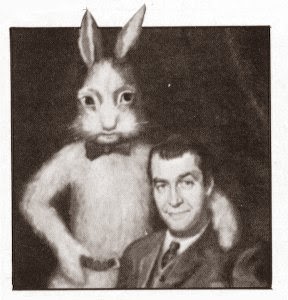
Meet Elwood P. Dowd; a softly spoken, gently mannered, entirely likeable man who had – he said – an invisible six-foot, three-and-one-half-inch tall rabbit friend named, Harvey. Granted, it’s an odd admission for a grown man but in forty-seven year old Elwood’s defence Harvey was in fact a Púca, the Gaelic word for Goblin, who just so happened to resemble a very tall rabbit.
In Mary Chase’s 1944 play, Harvey, the goodhearted bachelor Elwood is regarded as a harmless eccentric in the small town in which he lives. He buys tickets in two’s, always carry’s a spare hat and coat for Harvey, and is forever seen chatting away with nothing at all as if it were the most natural thing to do. When his sister and niece arrive to live with him things inevitably change. Fearing for his mental health his sister, Veta, attempts to have Elwood committed to Chumley’s Rest, a mental hospital whose staff accidently have her committed instead and only after the mistake is recognised does a mad, comedy-prone search ensue for her brother and his invisible companion. As the story unfolds Elwood’s delusion has a peculiarly warming influence on the sanitariums employees including the strict Dr. Chumley, and only just before Elwood is to be given an injection of the ominously named Formula 977 that will make him into a “perfectly normal human being” does Veta realise she’d rather have Elwood the same as he’s always been – carefree and kind – even if it meant living with Harvey.
“One of the delights of the season,” wrote New York Times critic, Louis Nichols, at the time. An interesting choice of words and clearly so ‘delightful’ that the play won the 1944 Pulitzer for Drama. It was awarded this accolade not because Chase bravely tore open the fabric of our elaborate belief systems and challenged our collective and consecrated delusions but rather because it was a ‘delightful’ departure from the harsh realities of a world at war.
Now, regretfully, Mary Chase died in 1981 so I cannot ask her if she was attempting something more detailed or even mischievous with her work, but I think I already know the answer. If she had been she certainly never spoke of it in any public forum that I’m aware of. She was a Catholic, a devout Irish Catholic to be more accurate, with a love of Celtic myth and folklore: one in the same thing to an atheist but to an ardent theist belonging to two completely different desert carts travelling in two completely different directions at entirely different speeds. Still, accidents do occur, be they genetic or of the mind, and Mary Chases Harvey appears to be just that: a magnificent, truthful accident.
Is Elwood delusional? Of course he is. Should we challenge him? Not on your fucking life! That would mean challenging ourselves, and that’s a bridge few people are willing to cross. It’s easier not to. The perception is that Elwood’s delusion is harmless, and just as long as it is we can ignore it because it offends no one. It’s a paper tiger, non-toxic, and the message presented is that the world is just better with the delusion running. Formula 977 – rationalism, logic, and common sense – has no place in this world. Guiltless things are, after all, perfectly innocent.
That, quite obviously, is an outrageous falsehood.
There was nothing at all harmless or innocent about Dena Schlosser who while listening to church hymns in 2004 cut off the arms of her 11 month year old baby girl because she claimed God had wanted her to do it as “an offering” before the apocalypse. There was nothing guiltless about Deanna Lajune LeNay who in 2003 bludgeoned her two boys to death because “God was testing her faith.” There was nothing inoffensive about Andrea Yates who in 2001 drowned her five children because “Satan had possessed her” and she wanted to “save them from Hell.” There was nothing savoury, excuse the pun, about Otty Sanchez who in May, 2012, beheaded her three week old son and ate part of his brain because Satan told her to. And there was nothing at all childlike about Julia Lovemore who in June, 2012, killed her 6 week old daughter by shoving pages of the bible down the child’s throat because she wanted her to ‘absorb’ the books message of love.
As repulsive as each of these religiously-inspired behavioural malfunctions are they are not the example which I choose to make my point here. Recent history has been furnished by another even more grotesquely malformed Elwood P. Dowd incident, and that story is told by this man:
Meet Thomas Römer; professor at the University of Lausanne who in the winter of 2003found himself on the end of what was conceivably one of the most bizarre series of calls ever made in the history of telephony.
The inbound caller identified herself as the head of Biblical Services for the Protestant Federation of France and had what seemed at first to be a mildly odd but otherwise perfectly innocuous question: who the hell are Gog and Magog?
Unfortunately for Römer, an authority on the Old Testament, there was no straightforward answer. He explained that depending on different translations of the Bible one can read, “Gog and Magog,” “Gog from Magog,” “Gog, in the land of Magog,” or even “Gog, prince of Magog.” The short answer was however that Gog and Magog were two creatures, Römer said, that appear in the Old Testament’s Book of Genesis and in two ferociously obscure chapters in the Book of Ezekiel where the author saw in a vision these embodiments of evil – perhaps lands, perhaps kings, perhaps demons – bringing total war to Israel. Complicating matters even more, in the New Testaments’ Book of Revelations Gog and Magog resurface and are seen as being rallied by Satan to battle in the prophesized ‘end times.’
Baffled, the caller pressed Römer asking more specifically, how would Gog and Magog apply to an American evangelical Christian? This was a question more easily answered. Evangelicals, he outlined, believe Gog and Magog to be powerful demons who are harbingers of God’s Final Battle prophesized in apocalyptic Judaic texts.
The story of this call might have ended here had it not been that the enquiry had originated from the highest office of French politics. Then President, Jacques Chirac, had reached out to the Protestant Federation of France (who in turn had reached out to Römer who confirmed the story in a 2007 article in the University of Lausanne’s magazine, Allez savoir) so as to get some urgent clarification following one of the most bewildering calls in its own right ever placed to the Elysée Palace. That particular call had been dialled-in from 1600 Pennsylvania Avenue, Washington D.C. by U.S. President George W. Bush in a failed attempt to broaden his “Coalition of the Willing” in the build up to the invasion of Iraq; the greatest strategic blunder since Lord Cardigan arrived at a less-than brilliant idea on the morning of the 25th of October, 1854, and decided to take his Light Horse Brigade out for a ride at the Battle of Balaclava.
In an interview with French journalist, Jean-Claude Maurice for his book, Si Vous le Répétez, Je Démentirai (If You Repeat it, I Will Deny it), Chirac spoke of being “boggled” at the words he was hearing, and for very good reason. “Gog and Magog are loose in the Middle East, and the biblical prophecies are being fulfilled,” Bush informed his French counterpart recounting the conversation. “This confrontation is willed by God who wants to use this conflict to erase his people’s enemies before a New Age begins.”
This little publicized event – a story Andrew Brown of The Guardian rightly observed “we should all be ashamed of missing” – is a disturbing insight into the workings of a religiously deluded mind; a mind which belonged to a man who claimed God spoke to him on a daily basis (Sharm el-Sheikh, August, 2003) and whose decisions led to the deaths of some 5,300 American and coalition soldiers, the irreversible maiming of some 50,000 others, the killing and maiming of perhaps as many as 500,000 perfectly innocent Iraqi civilians, and the displacement of 4 million refugees. A decade of wanton carnage and destruction made possible in-part or in-whole because in the early stages of this century the President of the United States believed two wildly ambiguous demons had leapt from the pages of an Iron Age fairytale.
Such wild and frankly bizarre imaginings were however far from Bush’s alone. Influential American evangelical preachers such as John C. Hagee, Benny Hinn, George Morrison, Pat Robertson, Billy Graham and Jerry Falwell were all equally obsessed with the hobgoblins contained in the Book of Revelations and had been whipping audiences up with fiery dispensationalist sermons for years before Iraq; speeches often littered with prophetic fatalism and calls for all-out war in the Middle East so as to bring forth the apocalypse and hasten the 2nd coming of Jesus. In 2001 such talk among evangelicals had become the rule, not the exception, and after the events of the 11th of September the conditions were in place for a Christian Fundamentalist’s hoedown from hell.
Now precisely how much of this fatalistic religious longing for the destruction of the world affected George W. Bush’s thinking only he can say. What we do know with a great deal of certainty via Chirac and Römer is that such biblical end time prophecies were without doubt on his mind in the lead up to the invasion. Yes, the original justification – the public face – for the unprovoked, pre-emptive war was the ‘certain’ presence of Weapons of Mass Destruction and the imminent threat of “mushroom clouds over U.S cities;” fantastically erroneous claims which have since been blamed on a series of colossal miscalculations in Intelligence and interpretation. Unquestionably, there was a series of monumental miscalculations in Intelligence and interpretation but it wasn’t just Bush Administration officials in the centre of the delusional clusterfuck. Gog and Magog were in there too, and in this version of Mary Chase’s Harvey, Elwood P. Dowd had command of the world’s largest army.
Volumes have of course already been written on the more pragmatic geopolitical, oil-centric motivations that shaped this shameful and bloody event, but entire libraries could and should be written on what has amounted to be one of the greatest misadventures outside the bounds of rational human thought and action. I’m loath to say it but such libraries will however probably fail to materialize. It’s not in our nature at this time to challenge ourselves that way. Not at least in popular culture. It’s uncomfortable, desperately awkward, fabulously embarrassing, and in the end it’s just easier for most of our neighbours to play Veta.
Not playing Veta is however what best describes this thing called, New Atheism. It’s a noise that has grown in volume since 2001 and is at its very core a reaction to the outward manifestation of dangerous religious hogwash exerting unjustified influence on society. It’s a noise that says, “No, not anymore. We’ve had enough of this adult fantasy absurdity.” It’s a noise that says, “Evidence for your god now, or shut up.” To our neighbours it’s a noise that says, “This is Formula 977… I’m going to hurt you with the truth, not comfort you with a lie.” It’s a noise that says, “Keep your 6ft tall invisible rabbits out of our schools, our politics, our science, our military, and off our streets… and don’t try to convince me that that rabbit ordered you to kill.”
Don’t let the seemingly harmless grandfatherly appearance of this man fool you. Gary North is not someone you want anywhere near your enemies, let alone your family. North publishes Christian Reconstructionist and homeschooling books, is the founder of the Institute for Christian Economics, is an adjunct scholar with the Ludwig von Mises Institute, is presently writing an education curriculum for Congressman Ron Paul, owns Dominion Educational Ministries Inc. (which operates day care centers), and believes children should be put to death by stoning in public squares for cursing their parents.
“When people [children] curse their parents, it unquestionably is a capital crime. The son or daughter is under the lawful jurisdiction of the family. The integrity of the family must be maintained by the threat of death.”
Gary North is a face of the American Taliban; a leading member of the Christian Reconstructionists; a Dominionism (or Dominion Theology) movement which advocates nothing short of supplanting secular western governments with “Biblical theocratic republics in which every area of life is redeemed and placed under the Lordship of Jesus Christ and the rule of God’s law” (David Barton, Reconstructionist theologian). Or as Gary North put it:
“The long-term goal of Christians in politics should be to gain exclusive control over the franchise. Those who refuse to submit publicly to the eternal sanctions of God by submitting to His Church’s public marks of the covenant–baptism and Holy Communion–must be denied citizenship.”
In North’s mind pluralism is heresy and zero tolerance should be afforded to gays, blasphemers, atheists, agnostics, secularists, apostates, adulterers, unchaste women, and just about everyone else who isn’t a homeschooled Reconstructionist; all of whom North believes should be put to death, and always, he insists, by way of public stoning, as detailed in chapter 6 of his book, The Sinai Strategy: Economics and the Ten Commandments
Why stoning? There are many reasons. First, the implements of execution are available to everyone at virtually no cost. Second, no one blow can be traced to any person. In other words, no one citizen can regard himself as “the executioner,” the sole cause of another man’s death. Psychologically, this is important; it relieves potential guilt problems in the mind of a sensitive person. Those who abstain from the “dirty business” of enforcing God’s law have a tendency to elevate their behavior as being more moral than the executioner’s, where in point of fact such abstention is itself immoral. Executions are community projects–not with spectators who watch a professional executioner do `his’ duty, but rather with actual participants.
According to Gary North western civilization’s rejection of public stoning is the product of “God-hating humanistic concepts of justice” which have replaced “the infallible Old Testament;” progressive ideas, he says, that have redefined religiously inspired mob violence as somehow “sinister.”
That modern Christians never consider the possibility of the re-introduction of stoning for capital crimes indicates how thoroughly humanistic concepts of punishment have influenced the thinking of Christians. If humanistic concepts of punishment have persuaded Christians that there was something sinister about the Old Testament’s specified mode of execution, then we should not be surprised to discover that humanistic concepts of justice, including economic justice, have also become influential in the thinking of Christians. Christians have voluntarily transferred their allegiance from the infallible Old Testament to contemporary God-hating and God-denying criminologists and economists.
I could go on and fill the next ten pages with psychotic, unbalanced quotes from this man and his deranged Dominionism brethren, but I won’t. Gary North is a mentally sick, emotionally diseased human being and simply isn’t worth the time of day. I will, however, say this: if there is to be any public stoning it should probably start with the hypocrite Gary North himself as the computer into which he writes his demented thoughts was invented by a atheist (Alan Turing), runs software inspired by either Bill Gates (atheist) or Steve Jobs (atheist), and is powered by electrical generation and transmission technologies set forth by Nikola Tesla (atheist) and Thomas Edison (apostate/deist)… all soiled men deserving of public execution in the eyes of this Christian lunatic.
A close friend of mine happens to be an Atheist and happens to be politically conservative in general; probably fits into a libertarian category best (he’s fine with gay marriage, legalized drugs, things like that). He’s intelligent and very well read on history, politics and religion. I tend to be center-left, very liberal on social issues, more centrist economically, but I hate to generalize and I have no allegiance to either wing. Present your argument and I will consider it.
My friend recently made a comment during a conversation questioning why so many Atheists, like me, appear to be liberal, or at least lean that way. I think the answer is clear; conservative politics, worldwide, is joined at the hip with religion. And the more fundamental one’s religious practices are, the further out on the right one tends to be.
The problem is worsening, too. The trend now, in the Tea Party generation, is forcing conservatives to out-RIGHT each other in order to win their nominations, but going so far right seems to be hurting them in general elections—at least it appears that way in the last two presidential elections and it very easily could have worked out that way in Bush v. Gore, too. I suspect that Hillary (or whatever Democrat ends up running) has to be considered the front runner for 2016, unless the Republicans figure out a way to stop alienating Blacks, Hispanics, women and the secular community. And, important to note, the secular community is far bigger than most people realize; by most counts, a far bigger, though much less powerful, minority than Blacks, Gays, or Hispanics. Also important to note, there are many, many people that have some level of god belief and still understand the need for separation of church and state. In the late 18th century we called these people, the Founding Fathers.
It’s especially ironic that Blacks and Hispanics tend to be among the most religious in the U.S. and the Republican party seems to be making it a priority to alienate them. I think it’s also ironic that it might be the religiosity of the Republican party that is their own worst enemy right now. In fact, if they follow the following suggestions, I would almost guarantee a Republican would win the next Presidential election.
ABORTION. Stop trying to make abortion illegal and focus your efforts on “positively” preventing unwanted pregnancies. Yes, that means you will have to grow up and realize that people like to have sex, and that birth control is absolutely necessary in a modern culture. But you will gain so many moderate, one-issue voters that vote against you, it’s not even funny.
SCHOOL PRAYER, ET AL. I can drive a mile without seeing a McDonald’s or a Starbucks, but I can not drive a mile without seeing a church or a cross. We know you are there, you don’t need to be at town hall. Shun all the “War On Christmas” nonsense, all the Ten Commandments in the courthouse nonsense, stop worrying about god on money, god in the pledge, and all the “Christian nation” bullshit that you think you love so much. Broken record: you will pick up moderate voters that get turned off by all that crap.
NON-WHITE PEOPLE: Try to get just a few of them. You can keep trickling down on them, just stop being so overtly antagonistic toward them; you don’t need that many of them to win, but your conventions are way too pasty (despite your desperate efforts to display as much color as you can manage).
The most important point. Some people might argue that adopting these suggestions would enrage the conservative base and they would be correct. But ask yourself this question… What are those people going to do in the election booth, vote for a Democrat? I don’t think so. If you could stop being so religious, you would only gain market share. You literally would not lose a single vote, and you would probably kick the liberals asses in every election.
But my point here is not to be a republican strategist, it’s to try to explain why so many Atheists seems to lean left.
Lastly, here’s some strong anecdotal evidence on why religion and politics are a bad mix, and why Atheists often dislike conservative politics. These are just a few examples I’ve bumped into in just the last 2 days.
Michele Bachmann blathering on about end times and Jesus during a Syria rant. Some people, I think, are overtly religious for show, like President Obama (and he seems to be getting worse each year). But Michelle is the real deal. This is 3 minutes of audio that will send shivers down your spine regardless of your politics (unless of course you read Revelation and think, yep, that’s sounds about right).
The Andrea Tantaros Show. I don’t listen to much radio, but I just happened to catch the of end this show the last two days picking my kids up from school. I had the local “news station” on which, from what little experience I have with it, usually reports the news and occasionally has some mild right wing commentary. That’s why the last two days stood out to me. The woman on the radio was just wildly over the top right wing, which is fine, I don’t care, it was just unexpected. What made me laugh was her shameless promotion, at sign-off, promoting her book that PROVES god. Again, boisterously right wing politically and all up in god’s business, too. Here’s a link to the show archives. I only heard the last 5 minutes of the show on 10/7 and 10/8. On 10/8 Sam Sorbo (the fill in host) ended the show by playing a clip of Jon Stewart grilling Kathleen Sebelius on Obamacare. She made some criticism, as one would expect, and went on with some pretty standard right wing rhetoric. Again, whatever, I don’t care. Have at it. But here comes the money shot as she begins to pimp her book, starting at 2:38:00 if you want to listen to it. “You know we have freedom because of Christianity. The Christians were the first to believe that we’re all created equal under god. It all goes back to god, which is why I wrote this book on god and heaven. This book proves it! It’s proof of god and heaven!” Then some idiocy about gravity, I guess to sound scientific. On the 10/7 show, she’s riffing on healthcare not being a right and then adds this: “and it’s (healthcare) not a right, god did not give us that right. God gave us OTHER rights.” See, here’s the problem, she mixes in with reasoned arguments, some pretty wacky stuff, which if fine, but it always seems to wind up at God’s feet and thus, for me and many other Atheists, she comes across as delusional regardless of the strengths or weaknesses of her arguments.
Antonin Scalia is not friends with the devil. In this New Yorker interview, Scalia waxed poetic about the devil and heaven and hell. I do not have a problem with Scalia being a believer. I do have a problem with the fact that it appears to me that he is the kind of person that might let his religious beliefs, his Catholicism, supersede all else. In contrast, Sonia Sotomayor is a Catholic but her Catholicism doesn’t rule her decision making, obviously. So I think I have a pretty good feel for Sotomayor’s brand of Catholicism …just in case you may be wondering if Sotomayor is really a believer. She probably is.) Here is a screen shot of the religious back and forth in the piece. Interviewer in bold. Scalia in regular type.
I believe, contrary to what seems to be the customary liberal consensus, that such things as the veiling of women should be forbidden, not only because it expunges women from public space, but because it is inevitably coercive for some (if not most) women – and it is, I think, meant to be coercive. Even those women who don the burqa as an expression of religious piety, I suspect, mean it to be coercive to other women in the same community.
In this post I want to use as an example something that happened recently at the University of Leicester. A sold-out talk by Hamza Tzortzis* on the existence of god was strictly segregated: brothers (male) and sisters (female) directed to one side or the other:
According to an article in the Guardian:
A message on the group’s [the university's Islamic Society] website says: “In all our events, [the society] operate a strict policy of segregated seating between males and females.”
Nothing could be clearer than that.
What, you might ask, has this to do with banning the burqa? Simple, really. For a few paragraphs down from this notice are these words:
Rupert Sutton, from the campus watchdog Student Rights, has claimed there is “consistent use of segregation by student Islamic societies across the country”.
He wrote: “While this may be portrayed as voluntary by those who enforce it, the pressure put on female students to conform and obey these rules that encourage subjugation should not be underestimated.” [my emphasis]
My point is simply this. If, as Sutton says, “the pressure put on female students to conform and obey these rules that encourage subjugation should not be underestimated,” that is, if this is so on a university campus – and that is not hard to believe – try to imagine the weight of “the pressure … to conform”, viz., coercion, involved in the very close-knit ethnic communities that are growing up in some Western cities. In the discussion on the last post, Rahman, a Muslim who has expressed very forcefully his commendably liberal ideal of Islam, continues to say – and he has support from non-Muslims in the discussion – that it is contrary to liberal principles to impose restrictions on the dress people choose to wear. In other words, I acknowledge, that I am the odd man out in this discussion, but I still think, and so I will say, that banning the erasure of women from public space is necessary in societies that would be free, and that, in contexts where the full body covering is customarily used, the question of genuine choice no longer arises.
I emphasise the word ‘choose’ and ‘choice’, because I think it is undoubtedly true that many women in the communities concerned would and do not choose to be restricted by “Islamic” dress, which Maryam Namazie calls “mobile prisons” or “body bags,” and they would not so choose if they were free from religious and social compulsion. At the same time, as I have said before, the existence of this kind of erasure of women is not only threatening to those women, it is threatening to the women in the liberal cultures of France or Britain, Canada or the United States, who live in close proximity to communities in which this erasure is customary. It is threatening because, with the erasure of women by concealing forms of dress, the resulting social context is almost stultifyingly masculine, as a woman who has lived in close proximity to such a community has told me. In such a context, women are effectively being forced to wear dress that obliterates their social existence, or they are being forced to exclude themselves from public space, because they find it overtly masculine and threatening.
In a Telegraph article from 2009, the Muslim Council of Britain is reported to have condemned President Sarkozy of France for his remarks about the burqa:
The Muslim Council of Britain (MCB) said Mr Sarkozy’s claim that the head-to-toe garments worn by Islamic women signify subservience were “patronising and offensive”.
Its criticism comes after Mr Sarkozy used a policy speech on Monday to declare the burqa was “not welcome” in France.
In a move which threatens to reignite the debate over religious clothing in the country, Mr Sarkozy said: “The burqa is not a sign of religion, it is a sign of subservience.
“We cannot accept to have in our country women who are prisoners behind netting, cut off from all social life, deprived of identity.”
Place in a liberal democracy. Religion is a private matter, and should be confined to private space. Effectively to erase the public existence of women by religious or cultural forms of public sexual or gender apartheid is not only illiberal, it is arguably an incitement to precisely the kinds of anti-Muslim prejudice that are rightly deprecated by all reasonable people. It must be remembered that Islamic violence is so widespread in the world today, despite some readings of Islam as opposed to violence – as Juan Cole argues in an extremely one-sided interpretation of the role of violence in Islam (“Top Ten Ways Islamic Law forbids Terrorism“) – that it is hard for many people to separate the unassimilated Muslims in Western societies from those who perpetrate such violence, especially when members of those communities are being attracted to such violent forms of Islam. This may seem to be, as Rahman says, blaming the victim; and perhaps in some sense it is, but it is also to doubly victimise those women who are the object of such acts. They are victimised by being obliterated by their clothing, and then, a second time, by those who find such public declarations of religious affiliation culturally inapposite for free and democratic societies, and who emotionally express their resentment.
Remember that in Nazi Germany, and in much of medieval Europe, Jews (and sometimes Muslims, particularly in Spain) were distinguished by being compelled to wear distinctive forms of dress, and by being confined to certain quarters of cities and towns (areas subsequently known as ghettoes). (The word ‘ghetto’ comes originally from an Italian or Venetian term used for slag or waste, thus expressing the value placed on those confined to the Jewish quarter.) In general, distinctive dress was introduced to make distinctions that would not otherwise have been obvious, so that social divisions would not only be clearly marked, but also so that prejudices could be rightly aimed. Anti-Semitism is harder to express and maintain if the line dividing Christians from Jews is not clear. Thus the distinctive hats compulsorily worn by Jews in the Middle Ages, or the yellow Star of David required by decree in Nazi Germany, Poland, and elsewhere. The same was true in Muslim societies, where Christians and Jews were distinguishable from Muslims, and were prohibited from bearing arms, riding horses, or overtaking Muslims in the street. Distinctions were deliberately illiberal and forced, to make distinctions between true believers and infidels plain. We may deprecate it as much as we like, but those who choose to distinguish themselves in this way, in a world in which women who are so attired elsewhere in the world are held in subjection, have acid thrown in their faces if they dare to go to school or speak to men who are not family members, effectively identify themselves with cultural values which are justly seen as incompatible with liberal democratic ideals of equality and freedom. And would we be entirely wrong is suggesting that that is what they are doing (or being made to do)?
As Maryam Namazie says:
Oh and before the post-modernist left and defenders of multi-culturalism and religion over women’s lives and rights start crying outrage and totalitarianism and the right to choose or what have you let me just say this: far from being liberating, the burqa is a strait-jacket for women; a mobile prison. And no more a real choice than the chastity belt or foot-binding (where women’s feet broken to keep them from wandering away from their male ‘guardians’) …
I don’t know why others do not see the sense of this, and while I know I will win no prizes for saying so, I think we should ban the burqa. To listen to Maryam Namazie on the burqa and other Islamist customs, watch this:
Because he debates well-known people like Lawrence Kraus, Simon Blackburn, and so on. Maryam Namazie calls him an Islamist, and so, it seems, he is, given some of the things written on his blog, where he touts the “miracle” of the Qur’an, and other myths of Islam. For a taster of this, consider the following:
The inability to produce anything like the Qur’an, due to its unique literary form, is the essence of the Qur’anic miracle. The argument posed by Muslim theologians and philosophers is that if, with the finite set of Arabic linguistic tools at humanity’s disposal, there is no effective challenge, then providing a naturalistic explanation for the Qur’an’s uniqueness is incoherent and doesn’t explain its inimitability. This is because a human author is only able to produce the known literary forms in the Arabic language. The development of an entirely new literary form is beyond the scope of the natural capacity of any human author, hence a Divine entity, Allah, is the only sufficient comprehensive explanation. The evidence for this is that for over a millennia, the speech and writings of the Arabs have always fallen within the known forms and expressions of the Arabic language. However, the Qur’an breaks this natural pattern due to its uniqueness.
This is traditional Islamic apologetics, I know, but it is surprising that anyone should expect nonsense such as this to be taken seriously: “The development of an entirely new literary form is beyond the scope of the natural capacity of any human author.” That is a bit like saying of the first epic, the first tragic drama, or the first comedy, that each is “beyond the scope of the natural capacity of any human author.” This is plainly ridiculous.
A lot of people are simply not paying attention. It is, of course, true that the so-called “new atheists” are opposed to religion, and what makes their opposition in some sense “new” is the frank openness of their opposition. Some opponents call it strident and shrill. Academic criticism of religion is one thing, and the new atheism is something completely different, even though, to a large extent, it is anchored in proponents who are either academics or are at least not strangers to academic discussion and the intellectual rigours of academic debate. Yet lately they are accused of leaving that rigour behind, and, in the words of one of the latest commentators:
The New Atheists became the new Islamophobes, their invectives against Muslims resembling the rowdy, uneducated ramblings of backwoods racists rather than appraisals based on intellect, rationality and reason.
The words are those of Nathan Lean, one of the latest to join the ranks of those criticising what they perceive as the extremism of the new atheism. I take the words from another new critic of the new atheism, Jerome Taylor, whose article, “Atheists Richard Dawkins, Christopher Hitchens and Sam Harris face Islamophobia backlash.” And Taylor seems to be fully in accord with other critics, ending his article with another quote from Lean, who claims that the new atheism “sprinkles intellectual atheism on top of the standard neocon, right-wing worldview of Muslims.”
One of the problems with the “new criticism” is that their criticism seems to be as incendiary and ill-founded as, according to them, the new atheist critique of Islam. Indeed, none of them seem to be above misrepresenting the objects of their criticism. For instance, in this latest sally forth from their fastnesses in Britain’s premier newspapers and magazines, Jerome Taylor says, without any qualification, that Sam Harris,
Wearing a palpable disdain for Islam on his sleeve he has also written in favour of torture, pre-emptive nuclear strikes and the profiling not just of Muslims but “anyone who looks like he or she could conceivably be a Muslim.”
While I think that Harris would have been better off had he left his remarks on torture or pre-emptive nuclear strikes unsaid, it is only fair to point out that those who make this kind of blanket statement are seriously misrepresenting what he does say under these headings. Indeed, while the criticism of Islam in fairly general terms seems to me to be justified, given the written evidence of the Qur’an and the Sunnah, there is no excuse for someone like Jerome Taylor to ignore the contexts and the qualifications in terms of which Harris has spoken of torture or pre-emptive nuclear attack. Nor is it obvious that Harris is “using [his] particularly anti-Islamic brand of rational non-belief to justify American foreign policies over the last decade,” as Nathan Lean suggests in his Salon article, “Dawkins, Harris, Hitchens: New Atheists flirt with Islamophobia,” which Taylor quotes with approbation.
One of the problems here, I believe, is that the new atheists have devoted themselves largely to the criticism of Christianity, and their remarks on Islam have tended to be prompted mainly by events, rather than by systematic study and critique of Islam itself. They have done so, for the most part, because they do not feel qualified to criticise Islam in depth. Indeed, as Richard Dawkins recently revealed, some of them have not even read the Qur’an. Of course, that would not settle matters, for the Qur’an itself is not given an historical context. As an apparently timeless revelation, understanding of the Qur’an is impossible without the interpretive gloss provided by extra-Qur’anic sources, such as the Sira (or biography of Muhammad) and the Sunnah, which comprises the whole complex of Qur’an, Sira and Hadith (the remembered sayings of the prophet of Islam). And even then, the Islamic doctrine of abrogation, in which earlier revelations are suppressed in favour of new revelations, is nowhere clearly explained. So, reading the Qur’an is not, in itself, sufficient to ground a comprehensive criticism of Islam. Yet Islam itself, since it makes such large and implacable claims, is in serious need of criticism. Indeed, since its eruption onto the Western stage and into the Western consciousness, on 11 September 2001, and the continued threat of violence from Muslims in response to any perceived insult to its prophet, or criticism of the finality of the revelation supposedly vouchsafed to him, such criticism is an immediate and urgent necessity.
However, there are some things that we can know about Islam simply from the way that Muslims have behaved and are behaving. Of course, when I say this, it may seem as though I am secretly including, within that general statement, all Muslims, and if that is what I am doing, then it may seem as though I am, within the meaning that the word has now attracted, an Islamophobe. (I am pleased to say that, as I write the word, Microsoft Windows 8 does not recognise ’Islamophobe’ as a word in English, and it recognises the word ‘Islamophobia’ only because I added it to the dictionary.) But what is an “Islamophobe”? Is it someone who criticises Islam, or to be an Islamophobe must I harangue or make offensive remarks to known (or supposed) Muslims in the street? A homophobe, for example, is known by his views of homosexuality, views which he cannot keep under wraps upon meeting someone who is (or appears to be) homosexual. He is likely to oppose changing laws that restrict or forbid homosexual activity, or to regret that they have been changed, and he will undoubtedly strenuously oppose giving public legal recognition to the relationships of homosexuals, whether by registering civil unions, or providing laws which allow homosexual persons to “marry” (a word which, in this context, a homophobe would claim to be not only misused, but to be, in the words of the Vatican document, “Considerations Regarding Proposals to give Legal Recognition to Unions between Homosexual Persons, such as ”would obscure certain basic moral values and cause a devaluation of the institution of marriage”). But how is an Islamophobe to be recognised? Is it enough that one supposes that, given the actions and words of many Muslims, Islam poses an immediate danger to Western societies, and constitutes a threat to democratic polities wherever found?
If that is all that is required, then I am an Islamophobe – a term which would then include many other moderate and reasonable people – and the reasons for being so are simple. For at the heart of Islam lies the life and words (or at least the life and words as Islam has received them) of the apostle of Islam, Muhammad. He is, for Muslims, as Jesus is for Christians, someone who led an ideal life, and thus is a model for what constitutes the good life for Muslims. However, that supposedly good life is characterised by an endorsement of violence which is unique amongst the known founders of world religions. It is of course true that there is ample evidence in the Jewish Tanach for horrendous religious violence, amounting, in some cases, to genocide. Interestingly, though, there is scant historical evidence for the events described – in what Christians have self-intrestedly call the Old Testament – in terms of the consecration to destruction of whole peoples, nor do either Christians or Jews, for the most part, at least, think that such actions are justified by their religious beliefs. However, some of the key elements of Muhammad’s life are acts of horrendous violence, and war itself, according to the Qur’an, is central to the proof of religious fidelity. As David Nirenberg points out in his book Anti-Judaism,
Battle comes “in order that God might test what is in your breasts and prove what is in your hearts” (Q[ur'an] 3:154). By revealing the different behavior of those who strive in the way of God, and those who, like the Jews, fear to fight because they are “greediest of mankind for life” (Q 2: 96), war makes visible the hidden inner doubt harbored by the hypocrite. [148]
Muhammad himself was a warlord, and engaged in the most brutal acts, such as, according to one tradition, personally beheading all the men of one Jewish tribe, who were brought to him in batches, and then dividing their possessions, including women and children, amongst the faithful, as booty, taking a fifth of the booty for himself, of which portion one was, variously, either wife or daughter of one of the men he beheaded, whom he took to wife, consummating his “marriage” to her on the very day that her menfolk were slaughtered.
This ideal of the zealous warrior is deeply embedded in the piety of Islam, and the number of those prepared to risk their lives in defence of the honour of their prophet and in furtherance of the supremacy of Islam, is not insignificant. Those who point this out are now being called Islamophobic. But Harris’s point that right-wing nut cases and fascists seem to be the only voices of moral clarity about the threat that Islam poses to democracy and freedom is taken as an expression of the very things that he deplores. His whole purpose in saying that right-wing fanatics and fascists are the only ones who perceive the threat that political Islam poses to Western institutions and freedoms, as he says in his “Response to Controversy,”
was to express my concern that the political correctness of the Left has made it taboo to even notice the menace of political Islam, leaving only right-wing fanatics to do the job. Such fanatics are, as I thought I made clear, the wrong people to do this, being nearly as bad as jihadists themselves. I was not praising fascists: I was arguing that liberal confusion and cowardice was empowering them.
But jihadists do not, Harris believes (and I agree), express views inconsistent with the fundamentals of Islam. Indeed, jihadists and other radical Islamists, always justify their crimes against humanity, as Harris says, ”by reference to their most sacred concern: Islam.” And there is no obvious inconsistency involved in their doing so, for Islam has, from the very beginning, sanctified religious violence. If pointing this out is Islamophobic, then I am Islamophobic, and so are Harris and many others, including Dawkins; and Hitchens, were he still alive, would have to be counted amongst us.
If the claim that jihadists and radical Islamists are not acting contrary to the fundamental principles of Islam is false, then some explanation is required of the widespread violence that characterises the Muslim world. Most radical Islamists kill other Muslims, though, from the claims of security services in Britain, the United States, Canada, and other democratic nations, many plans of jihadist violence in the West have been foiled. This does not mean that Muslims are never a persecuted minority, as the oppression of Burma’s Muslim population testifies, but the widespread violence of Muslims, and the continued threats of violence by Muslims against any who dare to insult their prophet, is often supported by Muslim scholars, whose fatwas (learned opinions of Muslim scholars), beginning with the fatwa against Salman Rushdie, often license the killing of those who insult the prophet or criticise Islam. That does not mean that all Muslims scholars support such declarations, for Islam is not an institution with a centralised authority, like the Roman Catholic Church. In Islam authority is dispersed, but there seems to be no reason to hold that fatwas endorsing the murder of individuals – a practice whose origin can be found in Muhammad’s own practice – can be held to be inconsistent with Islam’s founding principles.
Such beliefs matter, and the criticism of such beliefs is an imperative. It has to be made clear that some things taken for granted in liberal democracies are not negotiable; but it also has to be made clear that the evidence that Islam is compatible with these non-negotiable things is by no means evident, even if we grant that the majority of Muslims resident in those democracies are peace-loving people who simply want to get on with their lives. Glenn Greenwald (another new critic of the new atheism), in a Guardian op-ed, asks “whether rational atheism is being used as a cover for Islamophobia and US militarism.”
Yet it is hard to argue Harris’s point that the beliefs of Islam are unique in demanding many forms of religious violence and oppression. Sometimes, as Harris himself acknowledges, he has “made the job of distorting [his] views easier than it needed to be,” and even that “a careful reader was kind enough to take the author’s feet out of [his] mouth” on a number of issues. But at the heart of Harris’s critique of Islam is his belief that it is not an accident that so many Muslims believe that jihad and martyrdom are the highest callings in human life, while many Tibetans believe that compassion and self-transcendence are.
In other words, as Harris says, “beliefs matter,” and the beliefs of Islam are not only compatible with violence, but may rightly be seen as encouraging violence on behalf of religion. Harris may be wrong, as Hitchens apparently believed, about the moral clarity of right-wing fanatics and fascists, but his central point, bluntly stated, is that the beliefs of Islam directly warrant violent acts of murder and oppression, and that this fact is an impediment to the emergence of a global civil society.
He also points out that his criticism of Islam includes the fact that Muslims do far more harm to Muslims than to others. I quote Harris on this subject in detail:
Finally, as I regularly emphasize when discussing Islam, no one is suffering under its doctrine more than Muslims themselves: Muslim jihadists primarily kill other Muslims. And the laws against apostasy, blasphemy, idolatry, and other forms of peaceful expression diminish the freedoms of Muslims far more than those of non-Muslims living in the West. Liberals like Greenwald, who are so eager to swing the flail of Islamophobia, display a sickening insensitivity to the plight of women, homosexuals, and freethinkers throughout the Muslim world. At this moment, millions of women and girls have been abandoned to illiteracy, compulsory marriage, and lives of slavery and abuse under the guise of “multiculturalism” and “religious sensitivity.” And the most liberal Muslim minds are forced into hiding. The best way to address this problem is by no means obvious. But lying about its cause, and defaming those who speak honestly in defense of a global civil society, seems a very unlikely path to a solution.
The problem is, of course, that the criticism of religion, and especially, today, the criticism of Islam, is likely to appear uncharitable and sometimes even xenophobic. But that criticism is what the new atheism is committed to. Not only Islam, but all religions, fall under its censure. That Islam attracts particularly emphatic dismissal is scarcely surprising, considering the role that Muslim violence plays in the world today. It is not simply, as Greenwald asserts, that “some Muslims commit atrocities in the name of their religion (like some people of every religion do),” for (1) terrorist acts perpetrated by Muslims are not uncommon today, and (2) the sacred texts and traditions of Islam apparently sanction such acts.
This is not to deny what Greenwald calls the Western “splurge of violence” in parts of the Muslim world, though it is hard to justify Greenwald’s claim that
… the western world has been engaged in a decade-long splurge of violence, aggression and human rights abuses against Muslims, justified by a sustained demonization campaign.
Indeed, most of those who have prosecuted the so-called “war on terror” have been very careful to make it clear that the war is not a war on Islam. In his speech immediately following the 9/11 terror attacks, President Bush did not mention Islam once. In his speech to Congress declaring war on terror, he speaks of Al Qaeda as ”a fringe form of Muslim extremism that has been rejected by Muslim scholars and the vast majority of Muslim clerics everywhere.” Sam Harris was, however, as Greenwald is happy to point out, not so careful, and, in the immediate aftermath of 9/11, which sparked Harris’s book The End of Faith, did consider Islam to be the enemy. But for Harris, as his Letter to a Christian Nation makes patently clear, Christianity too is an enemy and in need of severe censure. The only religion for which Harris evinces any sympathy is Vajrayana Buddhism.
In view of Osama bin Laden’s justification for Al Qaeda’s actions on 9/11, and Islam’s stated beliefs, it is hard to fault this logic, but the official American response has been quite different. As Daniel Pipes has pointed out, American officials are reluctant to identify Islamist violence, committed by Islamist Americans in the United States, as Islamist. As he says in the linked article:
Politicians and others avoid mention of Islam, Islamism, Muslims, Islamists, mujahideen, or jihadists. Instead, they blame evildoers, militants, radical extremists, terrorists, and al-Qaeda.
This does not look like “sustained demonization.” This is not to say that other Americans, and others in the West, have not responding by vilifying Muslims. Nor is it to say that the war in Iraq was justified, nor that the human rights of many Muslims have not been violated. Greenwald himself at one point gave the President “the benefit of the doubt” over the war with Iraq, changing his mind, and concluding
… reluctantly, that the administration had veered far off course from defending the country against the threats of Muslim extremism.
In his criticism of Harris, Greenwald appears to have concluded that Muslim extremism is not a threat, and that Muslims, like the votaries of other religions, sometimes commit atrocities. This is surely a misrepresentation of the facts, and Greenwald must know it.
Islam is peculiar in being founded, at least in terms of its own self-understanding, in warfare, just as it was spread by means of imperial conquest. The expression of Islam’s imperialist ideology is a familiar feature of contemporary Islam. According to one writer on the website Islam Watch (which claims to be run “a group of Muslim apostates, who have left Islam out of our own conviction when we discovered that Islam is not a religion at all”):
Islam’s ultimate goal is to conquer the whole world for its God – Allah, by destroy [sic] all other religions and murder all non-Muslims who refuse to convert to Islam.
It seems hard to deny that this is the stated aim of Islam, though its effective power to bring this conquest about may reasonably be held to be in considerable doubt. However, we should not fool ourselves. There are clear signs in Muslim doctrine and history to support the claim that world domination is “Islam’s ultimate goal.” Islam made two major incursions into continental Europe, occupying Spain and the Balkans in the process, but getting no farther, so Islam’s clear intent to subordinate the peoples of the earth to the rule of its god should not be in question; and such ideologies, whatever their power, are dangerous, and should be recognised as such. Sustained criticism is absolutely necessary. However, since the destruction of Islam itself may be as quixotic as Islam’s ultimate goal, in addition to the criticism of Islam, critical understanding of the history of Islam and of the formation of its sacred texts, as well as the development of a more liberal understanding of its beliefs, should be strongly encouraged. Tom Holland’s critical history of Islam’s beginnings is an important place to start. Also necessary is for Muslim scholars and theologians to recognise the importance of a sustained philological and historical critique of the formation of the Qur’an, and other traditions, including the biography of Muhammad (the Sira), for his existence as the sole prophetic voice of early Islam must be severely questioned. These studies will not be easy for the collective of Muslim scholars to undertake, but nothing less is necessary if Islam is not to be a continuing threat to the future of the quickly emerging global civilisation.
.jpg)