Sunday, September 1, 2013

Krystyna Skarbek

Krystyna Skarbek (1 May 1915 – 15 June 1952) was a Polish Special Operations Executive (SOE) agent who became a legend in her own time for her daring exploits in intelligence and sabotage missions to Nazi-occupied Poland and France.

She was a British agent just months before the SOE was founded in July 1940 and had been the longest serving of all British women agents during World War II.  Skarbek was extremely resourceful and quite persuasive. Because of her influence the SOE began to recruit increasing numbers of women agents into the organization.
In 1941 she chose her began using the nom de guerre Christine Granville, which she ultimately legally adopted after the war. Skarbek was a friend of Ian Fleming, and is said to have been the inspiration for the charachters of Bond girls Tatiana Romanova and Vesper Lynd.

Krystyna Skarbek was born on an estate at Mlodzieszyn, 56 km (35 miles) west of Warsaw, to Count Jerzy Skarbek, a Roman Catholic and Stefania née Goldfeder, the daughter of a wealthy assimilated Jewish banker. It was a marriage of convenience which allowed Jerzy Skarbek the benefit of using Stefania`s dowry to pay his debts and continue his lavish life-style. 

The Skarbeks were well connected with notable relations such as the composer Fryderyk Chopin, Chopin's godfather and prison reformer Fryderyk Skarbek, and American Union General Włodzimierz Krzyżanowski.

The couple's first child, Andrzej took after the mother's side of the family while, Krystyna, second born, took after her father. She shared his love for riding horses, which she sat astride, rather than side-saddle. During family visits to Zakopane in the mountains of southern Poland, she developed into an expert skier. From the very beginning, there was a complete rapport between father and daughter and her penchant for being a tomboy developed quite naturally.

Krystyna first met Andrzej Kowerski her childhood playmate, a her family stables, when his father met with her father the Count to discuss agricultural business.  The 1920s financial crisis had left the family in dire financial straits in which they had to give up their country estate and move to Warsaw.  In 1930, when Krystyna was just 22, her father died. The financial empire of the Goldfeder family had almost all but collapsed leaving barely sufficient money to support the widowed Countess Stefania.

Krystyna found work at a Fiat dealership but soon had to quit due to illness incurred as a result of the auto fumes. Initially, a doctor's diagnosis concluded that the shadows on her chest e-rays were that of tuberculosis, since her father had died of the disease.  She received compensation from her employer's insurance company and followed the advice of her physician to spend as much time in the outdoors as possible.  She spent a great deal of time hiking and skiing the Tatra Mountains in southern Poland.

During this time, Krystyna married a young businessman, Karol Getlich but the marriage ended amicably. They were incompatible.  Subsequently, she was involved in a love affair, but it was nipped in the bud, as Karol's mother refused to allow him to marry a penniless divorcee.

One day while skiing at Zakopane, Krystyna lost control on the slopes and was saved in the nick of time  by a giant of a man who stepped into her path and saved her. His name was Jerzy Giżycki - a brilliant, moody, irascible eccentric young man, who came from a wealthy family in Ukraine. At the age of fourteen, he had quarreled with his father, run away from home, and worked in the United States as a cowboy and gold prospector. Eventually he became an author and traveled the world in search of material for his books and articles. He had visited Africa and knew it well. It was his hope to one day return.

On 2 November 1938, Krystyna and Jerzy Giżycki married at the Evangelical Reformed Church in Warsaw. Shortly thereafter Jerzy accepted a diplomatic posting to Ethiopia, where he served as Poland’s consul general until September 1939, when Germany invaded Poland. Skarbek would later refer to Giżycki as having been "my Svengali for so many years that he would never believe that I could ever leave him for good."

LONDON

Frederick Voigt

With the outbreak of World War II, the couple sailed for London, England, where Skarbek offered her services to the British Empire. At first the British authorities had little interest in considering her, but were eventually convinced by Skarbek's acquaintances, including that of journalist Frederick Augustus Voigt, who had previously introduced her to the Secret Intelligence Service (SIS).  In 1940 Voigt was working as advsor for the British in the Department of Propaganda in Enemy Countries.  After World War II, George Orwell described Voigt as a "neo-tory" who expounded on the need to maintain British imperial power as a necessary bulwark against communism and for the maintenance of international peace and political stability.


Skarbek travelled to Hungary and in December 1939 persuaded Polish Olympic skier Jan Marusarz, brother of Stanislaw Marusarz, to escort her across the snow-covered Tatra Mountains into Poland. Having arrived in Warsaw, she pleaded with her mother to leave Nazi-occupied Poland. Tragically, Stefania Skarbek refused to comply and died at the hands of the occupying Germans. In what was a cruel twist of fate, she perished in Warsaw's infamous Pawiak prison The prison had been designed in the mid-19th century by Krystyna Skarbek's great-great-uncle Fryderyk Florian Skarbek, a prison reformer and Frédéric Chopin's godfather, who had been tutored in French language by Chopin's father.
Pawiak Prison
An incident in February 1940, illustrates the danger she faced while working as an undercover spy on home turf. At a Warsaw café, she was greeted by a female acquaintance who exclaimed: "Krystyna! Krystyna Skarbek! What are you doing here? We heard that you'd gone abroad!" Skarbek, with cool composure, denied that her name was Krystyna Skarbek, though the woman persisted that the resemblance was such that she could have sworn it was Krystyna Skarbek! After the woman had left, Skarbek remained some time at the cafe before leaving, so as not to arouse suspicion.

Krystyna Skarbek helped to organize a team of Polish couriers that transported intelligence reports from Warsaw to Budapest. Among them, was her cousin Ludwik Popiel who managed to smuggle out the unique Polish anti-tank rifle, model 35, with the stock and barrel sawed off for easier transport but it never saw wartime service with the Allies. Its designs and specifications had to be destroyed upon the outbreak of war and there was no time for reverse engineering. Captured stocks of the rifle were, however, used by the Germans and the Italians. For a period of time Skarbek, had the weapon concealed in her Budapest apartment.
In Hungary, Skarbek met long-lost childhood friend, Andrzej Kowerski, a Polish Army officer, who would later use the British nom de guerre"Andrew Kennedy". Skarbek met him again briefly before the war at Zakopane. Kowerski had lost part of his leg in a pre-war hunting accident, and was now exfiltrating Polish and other Allied military personnel and gathering intelligence.

Skarbek demonstrated her penchant for quick-thinking strategy. When she and Kowerski were arrested by the Gestapo in January 1941 she feigned symptoms of pulmonary tuberculosis by biting her tongue until it bled. She won their release. Skarbek was related to the Hungarian Regent, Admiral Mikos Horthy, though a distant one at that. A cousin from the Lwów side of the family had married a relative of Horthy. The pair made good their escape from Hungary via the Balkans and Turkey.

Cairo

As soon as they arrived at SOE offices in Cairo, Egypt, they were stunned to discover that they were under suspicion.because of Skarbek's contacts with a Polish intelligence organization called the "Musketeers". The organization was formed in October 1939 by Stefan Witkowski, an engineer-inventor  who would be assassinated in October 1941, whose identities have never been determined.  Another source of suspicion was the ease with which she had obtained transit visas through French-mandated Syria and Lebanon from the pro-Vichy French consul in Istanbul, a concession offered only to German spies.

Suspicions also surrounded Kowerski and were addressed in London by General Colin Gubbins, head of the SOE (from September 1943). In a letter dated 17 June 1941 to Polish Commander-in-Chief and Premier Władysław Sikorski, he wrote the following:

General Gubbins
Last year […] a Polish citizen named Kowerski was working with our officials in Budapest on Polish affairs. He is now in Palestine […]. I understand from Major [Peter] Wilkinson [of SOE] that General [Stanisław] Kopański [Kowerski's former commander in Poland] is doubtful about Kowerski's loyalty to the Polish cause [because] Kowerski has not reported to General Kopański for duty with the [Polish Independent Carpathian] Brigade. Major Wilkinson informs me that Kowerski had had instructions from our officials not to report to General Kopański, as he was engaged […] on work of a secret nature which necessitated his remaining apart. It seems therefore that Kowerski's loyalty has only been called into question because of these instructions.
  
Eventually,Kowerski was able to clarify any misunderstandings with General Kopański following which he resumed intelligence work. Similarly, when Skarbek visited Polish military headquarters in her British Royal Air Force uniform, she was treated by the Polish military chiefs with the highest of respect.

Intelligence obtained by Skarbek through her connections with the Musketeers, had accurately predicted the invasion of the Soviet Union (June 22, 1941). Consequently, when Skarbek and Kowerski's services were dispensed with, Jerzy Gizycki took umbrage and abruptly resigned from his own career as British intelligence agent. (It was discovered only later that a number of Allied sources, including Ultra, also had similar advance information about Operation Barbarossa.)

Skarbek informed Jerzy, her husband that the man she loved was Kowerski.  Giżycki left for London, eventually emigrating to Canada. Their divorce became official at the Polish consulate in Berlin on 1 August 1946.

Krystyna Skarbek was sidelined from mainstream action. The assistant to the head of F section, Vera Atkins, described Skarbek as a very brave woman, though very much a loner and a law unto herself.

France

By 1944 events had occurred that would lead to some of Skarbek's most famous of exploits. Due to her fluency in French, her services her offered to SOE teams in France, where she worked under the nom de guerre, "Madame Pauline". The offer was timely one - the SOE was encountering a shortage of trained operatives to meet the increased demands being placed on it in the run-up to the invasion of France. Though new operatives were already in training, the process took time to complete. The could not be posted throughout occupied Europe until they acquired the necessary physical and intellectual skills, otherwise their fate as well as that of other SOE colleagues and that of the French Resistance would be greatly compromised.

Cecily Lefort
Skarbek's track record in courier work was exceptional during her missions in occupied Europe and required only a little "refresher" work and some guidance about working in France. There was one particular incident which required immediate attention: the replacement of SOE agent Cecily Lefort, a courier who was lost on a busy circuit whose mission it was to be the first to meet the proposed Allied landings. Skarbek was chosen to replace Lefort, who had been captured, tortured, and imprisoned by the Gestapo.

The SOE had set up several branches in France. Though most of the women in France reported to F Section in London, Skarbek's mission was launched from Algiers, the base of the AMF Section. This fact, combined with Skarbek's absence from the usual SOE training program, has been the source of mystery to many historians and researchers. The AMF Section was only set up in the wake of the Allied landings in North Africa, 'Operation Torch', comprising of staff from London's F Section and the MO4 from Cairo.

The functions of the  AMF Section were three-fold: it was simpler and safer to run the resupply operations from Allied North Africa acroos German-occupied France, than from London; since the South of France would be liberated by separate Allied landings there ("Operation Dragoon"), SOE units in the area needed to be transferred to have links with those headquarters, not with forces for Normandy; the AMF Section tapped into the skills of the French in North Africa, who did not generally support Charles de Gaulle and who had been linked with opposition in the former "Unoccupied Zone".

After the two invasions, the distinctions became irrelevant; and almost all the SOE Sections in France would be united with the Maquis into the Forces Francaises de l'Interieur (FFI). (There was one exception: the EU/P Section, which was formed by Poles in France and remained part of the trans-European Polish Resistance movement, under Polish command.)

On July 6, 1944, Skarbek, as "Pauline Armand", parachuted into southeastern France and became part of the "Jockey" network directed by a Belgian-British lapsed pacifist, Francis Cammaerts. She assisted Cammaerts by linking Italian partisans and French Maquis for joint operations against the Germans in the Alps and by inducing non-Germans, in particular Poles who had been conscripted in the German occupation forces to defect to the Allies.

On August 13, 1944, just two days before Operation Dragoon landings, Francis  Cammaerts, another SOE operative,Xan Fielding who had been operating in Crete, as well as a French officer, Christian Sorensen, were arrested at a roadblock by the Gestapo.  When Skarbek learned that they were to be executed, she managed to meet with Capt. Albert Schenck, an Alsatian, who was the liaison officer between the local French prefecture and the Gestapo. She introduced herself as a niece of British General Bernard Montgomery and threatened Schenck should any harm come to the prisoners. She reinforced her threat by offering two million francs for the men's release. Schenck in turn introduced her to a Gestapo officer, a Belgian named Max Waem.

For three hours Christine argued and bargained with him and, having turned the full force of her magnetic personality on him... told him that the Allies would be arriving at any moment and that she, a British parachutist, was in constant wireless contact with the British forces. To make her point, she produced some broken... useless W/T crystals.... 'If I were you,' said Christine, 'I should give careful thought to the proposition I have made you. As I told Capitaine Schenck, if anything should happen to my husband [as she falsely described Cammaerts] or to his friends, the reprisals would be swift and terrible, for I don't have to tell you that both you and the Capitaine have an infamous reputation among the locals.'
Increasingly alarmed by the thought of what might befall him when the Allies and the Resistance decided to avenge the many murders he had committed, Waem struck the butt end of his revolver on the table and said, 'If I do get them out of prison, what will you do to protect me?'
Cammaerts and the other two men were released. Capt. Schenck was advised to leave Digne. He did not and was subsequently murdered by a person or persons unknown. His wife kept the bribe money and, after the war, attempted to exchange it for new francs. She was arrested but released after the authorities investigated her story. She managed to exchange the money but received only a tiny portion of its value.

Skarbek's service in France restored her political reputation and greatly enhanced her military reputation. When the SOE teams returned from France some of the British women sought new missions in the Pacific War, however Skarbek, being Polish, was ideally suited to serve as a courier for missions to her homeland during the final missions of the SOE. As the Red Army advanced across Poland, the British government and Polish government-in-exile worked together to establish a network that would report on events in the People's Republic of Poland. Kowerski and Skarbek, fully reconciled with the Polish forces, were preparing to be dropped into Poland in early 1945. However, the mission, Operation Freston, was canceled because the first party to enter Poland were captured by the Red Army (they were released in February 1945).

All women SOE operatives were assigned military rank, with honorary commissions in either the Women's Transport Service  - which was an autonomous, though elite part of the Auxiliary Territorial Service (ATS) or the Women's Auxiliary Air Force. Skarbek appears to have been a member of both.

In preparation for service in France, Skarbek worked with the Women's Transport Service, but on her return had transferred to the Women's Auxiliary Air Force as an officer, a rank she held until the end of the war.

Skarbek was one of the few SOE female operatives to have been promoted beyond subaltern rank to that of Captain, or the Air Force equivalent, Flight Officer, the counterpart of the Flight Lieutenant rank for male officers. Skarbek, by the end of the war was Honorary Flight Officer, a title that of Pearl Witherington, the courier who had taken command of a group when the designated commander was captured, and Yvonne Cormeau, considered to be the most successful wireless operator.

Decorations

For her remarkable exploits at Digne, Skarbek was decorated with the George Medal. Years after the Digne incident, in London, she spoke about her experiences to another Pole, also a World War II veteran that, during her negotiations with the Gestapo, she was completely unaware of any danger to herself. Only after she and her comrades had escaped did she realize "What have I done! They could have shot me as well!"

In May 1947, she was made an Officer of the Order of the British Empire (O.B.E.) for her work in conjunction with the British authorities. This award is usually presented to officers about the rank of colonel, and a rank above the "standard" award of Member of the Order of the British Empire (MBE) given to other women of SOE. 

In recognition of Skarbek's contribution to the liberation of France, the French government awarded her the Croix de Guerre.

After the war, Skarbek was left without financial reserves or a country to return to. Xan Fielding, whom she had saved at Digne, wrote in his 1954 book, Hide and Seek, and dedicated "To the memory of Christine Granville":

After the physical hardship and mental strain she had suffered for six years in our service, she needed, probably more than any other agent we had employed, security for life. […] Yet a few weeks after the armistice she was dismissed with a month's salary and left in Cairo to fend for herself ... [Alt]hough she was too proud to ask for any other assistance, she did apply for […] a British passport; for ever since the Anglo-American betrayal of her country at Yalta she had been virtually stateless. But the naturalization papers […] were delayed in the normal bureaucratic manner. Meanwhile, abandoning all hope of security, she deliberately embarked on a life of uncertain travel, as though anxious to reproduce in peace time the hazards she had known during the war; until, finally, in June 1952, in the lobby of a cheap London hotel, the menial existence to which she had been reduced by penury was ended by an assassin's knife.
During the latter part of her life, she had met Ian Fleming, with whom she allegedly had a year-long affair,although there is no proof that this affair ever occurred. The man who made the allegation, Donald McCormick, relied on the word of a woman identified only by the name "Olga Bialoguski"; McCormick always refused to confirm her identify and did not include her in his list of acknowledgments.

Death

Christine Granville met an untimely end at a Kensington Hotel on June 15, 1952 where she was stabbed to death by a man by the name of Dennis Muldowney, an obsessed merchant-marine steward and former colleague whose advances she had rejected. After being tried and convicted of her murder, Muldowney was hanged on the gallows at HMP Pentonville on 30 September 1952.

Krystyna Skarbek / Christine Granville was interred in St. Mary's Roman Catholic Cemetery at Kensal Green, in northwest London.

Following his death in 1988, the ashes of Skarbek's comrade-in-arms and partner, Andrzej Kowerski (aka Andrew Kennedy) were interred at the foot of her grave.


A Legend

Skarbek became a legend during her lifetime and after her death, has become forever after immortalized by popular culture.  In Ian Flemings first James Bond novel, Casino Royale, the character Vesper Lynd is said to have been modeled after Skarbeck.  According to William F. Nolan, Fleming also based Tatiana Romanova, in his 1957 novel From Russia, with Love, on Skarbek.

Four decades later, in 1999, Polish writer Maria Nurowska published a novel, Milosnica (The Lover)—a fictional story about a female journalist's attempt to probe Skarbek's story.

A Polish TV series has been announced by Telewizja Polska (Polish Television) about Skarbek.

The Krakow Post report on February 5, 2009 that Agnieszka Holland will direct a big-budget film about Skarbek—Christine: War My Love.

George Medal


Order of the British Empire
Croix de Guerre (France)


Friday, August 30, 2013

The Erdington Murders Coincidences

On 27 May 1817, the body of a murder victim - 20-year-old Mary Ashford was found in a flooded sandpit at Erdington, a village lying five miles outside of Birmingham in England. Exactly 157 years afterwards to the very day and hour of the Ashford murder, history repeated itself in a most brutal and chilling way when 20-year-old Barbara Forrest was strangled and left in the long grass near to the children's home in Erdington where she was employed as a nurse. This may seem nothing more than a coincidence, but more intriguing similarities and parallels between the two murders came to light when the police were investigating the Barbara Forrest murder. As a police archivist officer read through the Ashford murder of 1817 he shook his head in disbelief. Whit Monday had been on 26 May both in 1817 and 1975 - the year of the Barbara Forrest murder. Like Ashford, Barbara Forrest had been raped before being murdered and both victims were found within 300 yards of one another. Ashford and Forrest shared the same birth date, and the coincidences didn't stop there. Both girls had visited their best friend on the evening of the Whit Monday to change into a new dress for a local dance party. After each murder a suspect was arrested whose name was Thornton, and in both instances, this Mr Thornton was charged with murder but subsequently acquitted.

Mary Ashford
Abraham Thornton
Barbara Forest

Let us take a closer look at these uncanny coincidences. At 6.30 a.m. on 27 May, 1817, a labourer on his way to work in Erdington came upon a heap of bloodstained clothes belonging to a woman, near to Penn's Mill. He informed the police and during a search of the area around the suspicious find, they saw two tracks of footprints made by a man and a woman which led towards a flooded sandpit.

The police followed the two sets of footprints and saw that they ended at the edge of the water around the pit. The pit was searched and the corpse of a well-known and well-loved local girl named Mary Ashford was recovered. Her arms were heavily bruised and her clothing was bloodstained. Police made enquiries with the locals and soon established Miss Ashford's last movements on the previous day. On Whit Monday - the 26 May - Mary had travelled from Erdington to Birmingham to sell dairy produce at the local market. She had then made arrangements to visit a friend's house where she would change into a new dress. Then she and her friend - Hannah Cox - would go to the Whitsuntide dance at the Tyburn House Inn in the evening. Mary had arrived at her friend's house at six in the evening. She changed into the new dress and then went to the dance with Hannah, and the two girls seemed to have enjoyed themselves, and they'd had no shortage of male admirers, although for a majority of the evening, Mary had been in the company of a young bricklayer named Abraham Thornton, while her friend had been dancing with a boy named Benjamin Carter. The dance ended around midnight, and the foursome headed towards their respective homes as far as a place known as the Old Cuckoo, which lay just a short distance from Erdington village. Hannah and Benjamin then separated from Mary and Abraham and went off in another direction.

Later on, about 3.30 a.m., Mary Ashford was seen walking towards the home of Hannah Cox's mother. A witness mentioned that the girl was 'walking very slowly and alone'. At the house of Hannah's mother, Mary took of her new dress and changed into her working clothes. She told Hannah she was going home then said goodbye to her friend and left the house at 4 a.m. On two more occasions that morning Mary Ashford was seen. A Joseph Dawson testified that he had set eyes on the girl in Bell Lane around 4.15 a.m., and about ten minutes after that, Mary had been seen again in that same lane by Thomas Broadhurst. Both witnesses noted that Mary had been alone in Bell Lane.

Not long after these inquiries into Mary Ashford's last movements, the police interviewed Abraham Thornton, who seemed in a state of shock after being told that Mary had been murdered, probably by strangulation - after being raped.

Thornton told detectives: 'I cannot believe she is murdered; why, I was with her until four o'clock this morning.'

Thornton seemed sincere enough and apparently didn't understand that he was the chief suspect in the murder investigation. However, he soon understood the situation when he was taken into custody later that day and searched. Detectives grilled him about every detail of events which unfolded after he had left Tyburn House Inn with Mary. Thornton admitted that he'd had sexual intercourse with Mary, but he denied he had raped and murdered the girl. In a deposition the bricklayer stated that when his friend Benjamin Carter and Mary's friend Hannah Cox had left them, he and Mary had strolled hand in hand over a field to a stile. The couple sat talking for about fifteen minutes then went to the Green at Erdington where Mary went into her friend's house to change her dress. Abraham had waited for quite some time but Mary did not come out so he went home alone. Thornton's statement was backed up by three other witnesses who had seen him at that time. One witness, a gamekeeper named John Haydon, had even chatted to the young man for over quarter of an hour. The police continued their investigation into the murder of Mary Ashford, but came up against a brick wall. No one had seen the murder victim and Abraham Thornton together after they had been sighted at the stile at the top of Bell Lane at three in the morning, a fact which provided the police with a real headache.

Thornton was brought to trial in August that year at the Warwick Assize Court before Mr Justice Holroyd. Hundreds of people who believed Thornton had killed Mary Ashford had waited outside the courthouse from six in the morning. All of them hoped they'd be the first to hear that a verdict of guilty had been reached, but they were to be disappointed. After just six minutes of deliberation, the jury returned a verdict of 'not guilty'. In modern English law, that verdict would have been final but in the early 19th century an ancient law existed which enabled Mary Ashford's brother William to appeal against the jury's verdict and thus demand a second trial. This was duly done and upon 17 November 1817, Abraham Thornton once again stood in the dock, this time before Lord Ellenborough at the Court of the King's Bench. By now, interest in the Mary Ashford murder had reached fever pitch in every corner of Britain, and the Fleet Street news hounds were delighted at a dramatic turn in the case. Legal history was made when Lord Ellenborough allowed Thornton to take advantage of an archaic law called 'Trial by Battel'. This ancient right necessitated Thornton renewing his plea of 'not guilty' before throwing down a gauntlet from the dock. This signified a challenge to William Ashford for a fight to the death, unless one of them surrendered or was incapacitated during the fight.

There were objections to the Trial by Battel option, but Lord Ellenborough proudly enunciated to the court: 'It is the law of England!'

If Ashford accepted the challenge and won, Thornton would be executed immediately, but if Thornton won, he would have to be freed and would no longer have to appear in court in connection with the Ashford murder.

Abraham Thornton held what resembled a heavy leather mitten with a trailing feather attached, and invoked the ancient English law. He declared he was innocent and that he was ready to defend his innocence with his body. He then lifted the gauntlet above his head, then hurled it down from the dock as the pressmen scribbled furiously.

William Ashford's counsel disputed Thornton's right to Trail by Battel and criticised Lord Ellenborough for allowing such an alternative to a proper second trial, but the protestations came to nothing. Because William Ashford had not responded to Abraham Thornton's challenge by 21 April in the following year, the latter was thoroughly discharged. He would no longer have to stand trial for Mary Ashford's murder, but because of the adverse publicity, no one would employ the bricklayer, so he later emigrated to the United States.

To this day, criminologists have tried in vain to determine who murdered Mary Ashford. Now for the facts of the eerie case which has strange echoes of the Ashford murder.

On 27 May, 1975, 20-year-old Barbara Forrest was found dead in the long grass of a ditch near Erdington. She had been strangled and raped, and her body, which was partly clothed, had lain undetected for over a week. Barbara had worked at the nearby Pype Hayes Children's Home. Her facial features bore an almost identical similarity to Mary Ashford, and like Mary, Barbara had also been strangled after being raped. The police made inquiries and later arrested Michael Thornton, a Birmingham child care officer who worked at the home where Barbara had also worked. Like the Thornton who stood accused of murdering Mary Ashford in 1817, Michael Thornton was tried for the murder of Barbara Forrest, and he too was later acquitted. Both murders had taken place around the same time of day, and, furthermore, both victims had been to a friend's house to change into a new dress before going out on the evening of Whit Monday to a dance.

Stranger still, days before each victim was murdered, they made prophetic remarks about their impending fate. The week before Mary Ashford was murdered, she told Hannah Cox's mother that she had 'bad feelings about the week to come', but was unable to elaborate on her unfounded sense of dread, and ten days before Barbara Forrest was raped and then strangled to death, she told a colleague at work of a strange premonition. Barbara's words had been: 'This is going to be my unlucky month. I just know it. Don't ask me why.'

Were the 'twin' Erdington murders just a spate of uncanny coincidences, or were more sinister forces at work?

Thursday, August 29, 2013

The Sator square

The Sator square is a square that reads the same forwards, backwards, upwards and downwards:
Sator
Arepo
Tenet
Opera
Rotas

The square has been found at many places around the world: on amulets, carved into walls or stones, written on disks used for extinguishing fire, and so on. Its first known appearance is in the ruins of Pompeii. The square was found in a building that was decorated in a style that became popular since the year 50. Pompeii was covered in ash from the Vesuvius in the year 79, and it follows that this example is almost 2000 years old. This makes the square one of the oldest known palindromes.


What does the Sator square mean? Except for `Arepo', scholars mostly agree on the meaning of the individual words. `Sator' is the seeder, sower, or begetter. It is also used as a metaphor for God, not necessarily Christian, but also Roman. `Tenet' is a verb, and means it, he or she holds. `Opera' is often considered to mean with effort. It is related to opus or opera, which means work. Finally, `Rotas' is generally considered a noun, meaning the wheels. But it might also be a verb meaning turn. Nobody has ever found a word in Roman, Greek, Etruscan, or any Indo-European language that explains `Arepo'. Some people think that it is a name, others that it stands for plough, misspelled to fit the palindrome, and yet others that it is just nonsense. For a long period, people thought the square had a Christian meaning by rearranging the letters into two Pater Nosters in the form of a cross. The Pre-Christian Pompeii find crushed this theory. If Arepo is a name, the Sator square might read: `The sower Arepo holds the wheels with effort', and if it stands for plough, you might get: `God holds the plough, but you turn the furrows'. According to John Cullen, this could have been a motto for farmers in Roman times. Most explanations I have read call the Sator square an ancient meme, with as much meaning as the sentence `all your base are belong to us'. In 1937, the Italian Antonio Ferrua probably gives the best explanation for what the square means: `Esattamente quello che si vuole'(!) E basta di questo argumento (it means exactly what you want it to mean. And so much for that argument!). The Sator square is an example of a meme that went viral long before the internet.

Here is an instance of the square I found in the library in Skara, Sweden, written by an unknown author probably in Stockholm, Sweden, in the year 1722. It starts with Rotas instead of Sator, just as the first appearances of the square. For some reason the version starting with Sator has become more popular.


Because it is a palindrome, the Sator square was thought to have many healing effects, curing snake-bites, headaches, jaundice, and many other illnesses. Medieval books mention the square as a cure for fever and insanity. Interestingly, although we now know that using words to cure an illness is of little help, we humans do use palindromes to repair our body. I will say more about this in a later blog post on palindromes in DNA.

The amount of human effort gone into explaining the meaning of the Sator square is unbelievable. Since 1889, when Francis John Haverfield described a find of the square in a Romano-Bristish building in Cirencester, there has been a steady stream of articles on the Sator square, and the total number of articles easily surpasses a hundred. Rose Mary Sheldon recently published a 54-page annotated biography of the literature on the Sator square: The Sator rebus: An unsolved cryptogram? Charles Douglas Gunn wrote his PhD thesis on the square at Yale in 1969. He suggests that the square was written by a Roman who wanted to take palindromic squares one step further from the misformed four-letter word square Roma tibi subito montibus ibit amor, meaning `For by my efforts you are about to reach Rome, the object of your travel'. He wrote software to generate all possible five-letter Latin word squares. These squares take up more than a hundred pages in his thesis. He concludes that the Sator square is the best.

Cheng I Sao

The most successful pirate of all time controlled a fleet of more than 1,500 ships and upwards of 80,000 sailors — and she did it all without the help of facial hair.
To start with, Ching Shih (1775–1844) was only her stage name; it simply means “Widow of Zheng”.  Her real name and her history prior to 1801 are completely unknown except for the fact that she was a prostitute in one of the famous floating brothels of Canton.  She was captured in a raid by the powerful pirate Zheng Yi, commander of six pirate fleets, who appears to have known her professionally before the raid because his men were specifically instructed to bring the 26-year-old beauty to him.  He had fallen deeply in love with her and proposed marriage, and she agreed on the condition that Zheng Yi grant her 50% of his profits and command of one of his fleets.
Artist’s conception of Ching Shih (origin unknown)
Ching I Sao (“Wife of Zheng”), as she was then known, quickly won the respect of her men and her husband drew upon her shrewd advice to increase his power; his family had been noted pirates since at least the mid-17th century and the cunning former whore advised him to use that reputation in combination with intimidation to build an alliance of pirate fleets which until that time had engaged in self-defeating competition.  By 1804 this alliance, known as the Red Flag Fleet, was the most powerful pirate force in China; it was comprised of over 1500 ships and ranged all the way from Korea to Malaysia.  In 1807 Zheng Yi was killed in a typhoon, and his widow (now called Ching Shih) quickly made a pact with Chang Pao, the late commander’s chief lieutenant, which placed her in absolute command of the fleet with him as her executive officer.  The deal appears to have been leveraged by her sex appeal, because they became lovers and later married (though sources vary as to whether this was before or after her retirement).
Ching Shih realized that in order to maintain control she had to establish strict discipline lest the men believe that a female commander could be defied with impunity.  She therefore imposed a code of behavior far more severe than the pirate “articles” common in the Spanish Main:  disobedience, theft, desertion, dereliction of duty, cowardice and rape of female prisoners were all punishable by beheading.  Her power grew at a frightening pace, and within a year the Red Flag Fleet boasted two hundred oceangoing junks of twenty guns each, eight hundred small ships, dozens of riverboats and over 17,000 men; it was one of the largest navies in the world and nothing could stand against it.  She extorted tribute from merchants all over the China Seas and from coastal towns from Macau to Canton, and became a de facto government in her own right; soon she began to impose taxes and levies and enforced her own laws.
This sketch from 1836 imagines what Ching Shih might have looked like in battle.
Clearly, the Chinese government could not ignore this, so in 1808 it sent a fleet against Ching Shih; she easily defeated it, capturing 63 ships and impressing hundreds of sailors into her navy (those who remained loyal to the Emperor were beaten to death with clubs).  Further attacks were equally unsuccessful, as were the attempts at rebellion by subject villages (which were burned to the ground and saw all their men slaughtered).  In desperation, the Chinese government asked for help from the British and Portuguese; their forces, too, were defeated by the harlot admiral.  By 1810 the government was forced to admit defeat and offered a general amnesty to all pirates who would give up their ships and arms.  Ching Shih was no fool, and saw her opportunity to quit while she was ahead; accordingly, she appeared unannounced at the official home of the Governor-general of Canton and negotiated an incredible deal:  she and all her men were given full amnesty and allowed to keep all of their loot, any of her men who wished to join the Imperial Navy would be allowed to do so, and Chang Pao received a lieutenant’s commission.  Ching Shih thus retired from piracy at 35 and opened a combination casino and brothel which she operated until her death at the age of 69, survived by at least one son.
Ching Shih was quite probably the most successful pirate who ever lived; not only did she defeat all attempts to stop her and make staggering sums of money, but she also managed to keep all her profits and transition into a respectable business when she was still quite young.  And considering that the half-share in the pirate fleet which set the stage for her eventual control of the whole was essentially a price for her favors, I think it’s fair to say she was among the most successful prostitutes of all time as well.  She didn’t become an empress as Theodora did, but she essentially made herself a queen, foiled the efforts of the three greatest navies in the world and died a peaceful death as a wealthy, successful, respected businesswoman at a ripe old age.

Wednesday, August 28, 2013

The Executioner: His Pride and His Shame

In 1553, a wood-cutter named Heinrich Schmidt was standing amongst a crowd in the Bavarian town of Hof, listening to the Margrave detail a plot to assassinate him. The Margrave had arrested three men and accused them of the crime. Now it was time to execute them. There was no official executioner handy, so the Margrave invoked a local custom: he pointed at Heinrich and ordered him to do the deed. The wood-cutter was reluctant but was told that if he refused to carry out the order, then he would be executed instead as well as the men standing on either side of him. So Heinrich Schmidt picked up a sword and cut the heads off the three men.

Having killed these men, Schmidt became a social outcast, like a gravedigger or a slaughterhouse worker, the kind of workers that are called burakumin in Japan and shunned to this day. So Schmidt turned to the only job opening available for a man like himself — he became an official executioner. Two years later, his son, Frantz, was born and, when he was old enough, became his father’s apprentice.

“Leonardt Russ of Ceyern, a thief. Executed with the rope at the city of Steinach. Was my first execution.” So begins the diary of Frantz Schmidt which details his life’s work as an executioner and torturer, first under his father, then in Nuremburg. Over the course of forty-five years, Frantz Schmidt executed 361 people and tortured hundreds more. These acts were all noted in his diary. He was proficient in using the noose, the wheel, fire, and drowning besides the sword, which was considered the most merciful of execution methods.

The only known picture of Schmidt. "Execution of Hans Fröschel, 1591". This drawing was made in the marguns of a court record book. Note Schmidt's collar and curved moustache. [WikiMedia Commons]
The only known picture of Schmidt. “Execution of Hans Fröschel, 1591″. This drawing was made in the margins of a court record book. Note Schmidt’s collar and curved moustache. [WikiMedia Commons]
Each of the methods required a certain knowledge of the human body and its capacity for injury. Executioners had to know how to break a prisoner’s limbs on the wheel in such a way that he would survive for a time. They had to know how to torture without killing. They had to be able to cut out a tongue or perform other judicial maimings without having the prisoner bleed to death. They had to know the proper angle for a waterboard (yes, they had them then.) Sometimes executioners had to heal their prisoner’s broken limbs or other wounds before they could participate in the ritual of public execution. So Schmidt operated as a healer on the side, a trade he found much more congenial and one that he studied. In order to learn more about the human body, he dissected quite a few. Schmidt later estimated that he had treated over 35,000 patients and he was proud of the fact.


Five years after hanging his first man, Schmidt took up work in Nuremburg. He first served as assistant to Nuremburg’s chief executioner, then succeeded him. He also married his master’s daughter — both husband and wife being tainted by association with one of the nastier trades, they would have had difficulty finding a spouse elsewhere. But the post of chief executioner was well-paid and the Schmidt family lived in an upscale part of the city.

A public execution was staged as a morality play. In the first act, the prisoner — whose guilt had already been determined — was allowed a last meal, including alcohol, then was dressed in a white blouse. The executioner then entered and asked the prisoner’s forgiveness before sharing a traditional drink with him. During this time the executioner would be assessing the prisoner’s state of mind and health, judging when he was ready to proceed.

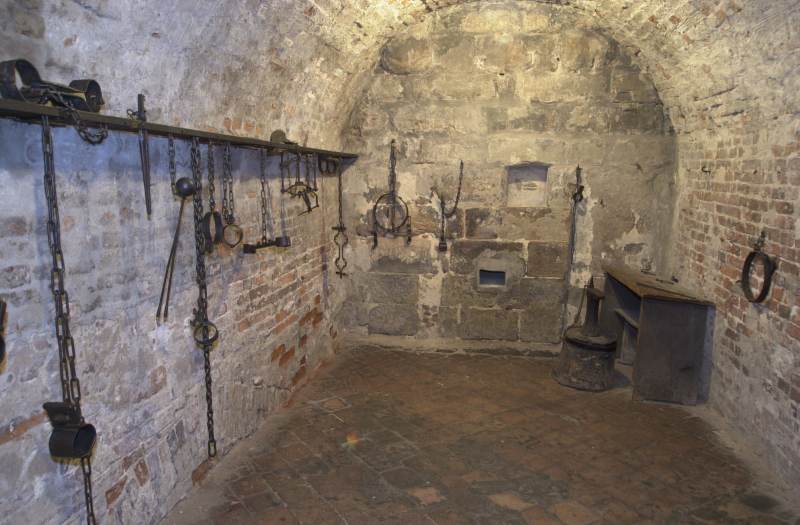
Dungeon under Nuremburg's Old City Hall. Here is where prisoners were held before their execution. Now it's a tourist destination.
Dungeon under Nuremburg’s Old City Hall. Here is where prisoners were held before their execution. Now it’s a tourist destination.
Now the prisoner was brought before a “blood court” consisting of a robed judge holding a rod and a sword, and twelve jurors. The judge would read out the death sentence, including the method of execution, then poll the jurors for their assent. “What is legal and just pleases me,” each would reply. Next the judge asked if the prisoner wished to speak. This was an opportunity for the prisoner to forgive those who had condemned him to death and possibly express his thanks, especially if the sentence was for a merciful beheading. Some prisoners might curse the court, others were too dumb with fear or stupefied by drink to make a coherent speech. When the prisoner was finished speaking, the judge would order the executioner to carry out the sentence and snap in two the white rod he was holding.

The second act of this drama was a procession to the place of execution, which might be a mile or two away. The judge led the way, followed by the prisoner, a couple of soldiers, a chaplain or two, and the executioner and his assistants. Sometimes, if the prisoner was violent or was sentenced to be tortured on the way, he would be carried in a cart. Tortures might include having pieces of flesh torn out with red-hot tongs. The number of these “nips” were spelled out in the sentence. Sometimes the prisoner would have a few more drinks along the way.

The procession route would be lined by crowds of people, who might themselves be drunk and unruly and sometimes threw things at the prisoner. If he could, Schmidt would hurry the prisoner along to avoid problems. The prisoner might pray along with the chaplains and bless the crowd or he might curse his audience or break down in tears.

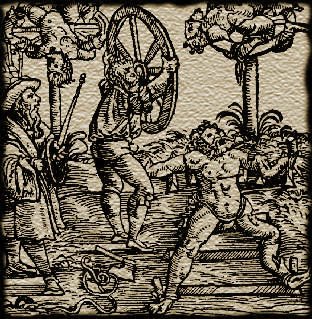
Execution by wheel. The man's limbs are being broken with heavy wheels. This is opposed to execution on a wheel, where the limbs were broken by a rod or weight after the victim was strapped to a wheel.
Execution by wheel. The man’s limbs are being broken with heavy wheels. This is opposed to execution on a wheel, where the limbs were broken by a rod or weight after the victim was strapped to a wheel.
The final act was the execution itself. The condemned prisoner would mount a scaffold or a platform. There, it was expected that a final prayer would issue from his lips as the noose was placed around his neck or as he sunk to his knees and awaited the executioner’s sword. The executioner would perform the deed then turn to the judge:

“Lord Judge, have I executed well?”

“You have executed as judgment and law have required.”

“For that I thank God and my master who has taught me such art.”

Then the executioner and his assistants would clean up and dispose of the remains.


No executioner wanted to make a mistake that would sully the grand pageant of death. Though messy executions were frequent at this time, Frantz Schmidt seldom took more than one stroke of the sword to remove a head. Out of 187 decapitations, only four needed more than a single blow. Schmidt was unforgiving to himself for these four, writing in his diary that he had botched the job and did not try to excuse himself. He was proud to practice his trade well. His headsman skill was at least partly due to the fact that he did not drink — at this time executioners were often as drunk as their prisoners when they wielded their sword.

German executioner's sword. The inscription: “I have to punish crime as the law and judge tell me”. [Weapons Universe]
German executioner’s sword. The inscription: “I have to punish crime as the law and judge tell me”. [Weapons Universe]
Traditionally, the executioner was allowed three sword blows to remove a head. If he needed more, the audience might turn into a mob that attacked him. Only once did Schmidt require three strokes with his sword. This was the execution of a woman who was calm before the blood court and said she was happy to leave this world of woe, but on the way to the place of execution her happiness turned to fear and she had to be restrained. Prisoners who were unable to stand were strapped into chairs before being hanged or beheaded, now this prisoner was carried in the procession strapped to a chair. Instead of holding her head steady, so that her death might be quick, she wobbled it around on her neck making it difficult for Schmidt to properly behead her.


Women were not executed as often as men but repeated offenses might well wind up with a capital sentence. So, Marie Kurschnerin, a prostitute, was pilloried in the stocks and driven out of town. Further offenses brought the punishment of having her ears cropped. Finally, in 1584, Schmidt’s wrote in his diary:

the thief and whore Marie Kurschnerin, together with thievish youths and fellows, had climbed and broken into citizens’ houses and stole a mighty quantity of things. It was an unheard of thing for a woman to be hanged in this city and it had never happened before. Such a dreadful crowd ran out to see this, that several people were crushed to death.

An entry from Schmidt’s diary for 1617:

November 13th. Burnt alive here a miller of Manberna, who however was lately engaged as a carrier of wine. Because he and his brother, with the help of others, practiced coining and counterfeiting money and clipping coins fraudulently. He also had a working knowledge of magic… This miller, who worked in the town mills here three years ago, fell into the town moat on Whitsunday. It would have been better for him if he had been drowned, but it turned out according to the proverb that “What belongs to the gallows cannot drown in water.” This was the last person whom I, Master Frantz, executed.

Frantz Schmidt served the city of Nuremburg for forty years. He successfully petitioned the emperor to allow his children to have the executioner stigma removed from their names so that they could pursue other trades. After his retirement in 1617, Schmidt served as a healer for the last seventeen years of his life. Ironically, during that period most of his children and grand-children, that he had saved from practicing his deadly craft, died. When Frantz Schmidt himself followed them in 1634, Nuremburg honored him with a grand funeral. Social outcast though he was, Schmidt was also well-respected.

Notes:

The main source for all the above is Joel Harrington’s The Faithful Executioner: Life and Death, Honor and Shame in the Turbulent Sixteenth Century, a really interesting book.
Some odd points were picked up from an interview with Harrington and a few items from this article on medieval executions of women which includes an interesting account of the execution by Schmidt of Elizabeth Aurhaltin, aka Scabby Beth.

Schmidt’s original diary long ago disappeared but at least four copies of it were made. Harrington used the earliest copy known as the basis for his book. A 1928 English translation from another copy is a prime candidate for the Internet Archive or Gutenberg.org. Somebody out there hear me.

Also, in this context, I can’t help recommending Gene Wolfe’s The Book of the New Sun tetralogy featuring Severian, apprentice to the Seekers for Truth and Penitence, which is to say, the Torturers’ Guild.